Internal communication in 2026 sits at the center of how organizations build culture, maintain trust, and make sure what leadership says actually reaches employees in a way that lands. The people responsible for it are doing more than sending newsletters. They are managing how employees experience uncertainty, how aligned teams feel during periods of change, and whether the organization’s values show up in day-to-day work. The internal email software behind that function matters more than most organizations stop to think about. That’s why choosing the right one makes a genuine difference to what a communication team can actually accomplish.
The problem is that the market has grown fast enough that knowing where to even start can feel overwhelming. Most platforms make similar promises, and evaluating them takes time that most communication teams, many of whom are running lean with just two or three people, simply do not have. This guide exists to make that decision easier. It covers what internal email software actually is, what distinguishes a strong one, and which five internal email tools are worth your attention in 2026, including honest takes on where each one performs and where each one falls short.
What Is Internal Email Software and How Does It Work?
Internal email software is a purpose-built communication platform that enables organizations to design, send, track, and measure employee emails at scale. If your organization is still sending company-wide updates, newsletters, and leadership messages directly from Outlook or Gmail with no visibility into who opened them, who clicked, or whether any of it landed, you are not alone. Most organizations start there.
Internal email software is what comes next. It sits on top of or integrates directly with the email infrastructure your organization already uses, designed specifically for the demands of one-to-many employee communication at scale. Unlike standard email clients, it is built specifically for the demands of one-to-many internal communication, giving comms teams the infrastructure to manage everything from employee newsletters to leadership updates in one place.

How is internal email software different from standard email?
For most organizations, internal communication started the same way: someone in HR or leadership drafted an update, sent it from their personal Outlook or Gmail account, and hoped it reached the right people. That approach worked well enough when organizations were small and communication was infrequent. As workforces grew, became distributed, and as internal communication took on greater responsibility for culture, change management, and employee experience, the limitations of standard email became harder to ignore.
Standard email clients were built for one way messaging sending, not communication strategy. They handle one-to-one and small group messaging well, but they were never designed to help a communication team send a branded newsletter to 3,000 employees, measure how many people read it, or collect feedback from the people who did not respond. The differences between the two become most visible when communication teams start asking questions that standard email simply cannot answer. Did employees actually read this? Which department has the lowest employee engagement? Did the message land differently across remote and in-office populations? Internal email software exists precisely to answer those questions.
| Capability | Standard Email (Outlook / Gmail) | Internal Email Software |
| Email design | Basic text formatting | Drag-and-drop builders, branded templates |
| Audience management | Manual distribution lists | Segmented employee lists, HRIS integration |
| Analytics | Read receipts only | Open rates, click rates, read time, device breakdown |
| Employee feedback | Reply-based only | Embedded surveys, emoji reactions, eNPS |
| Personalization | Manual | Dynamic content by role, location, or department |
| Scheduling | Basic scheduling | Automated sends, optimal timing recommendations |
| Compliance and security | Standard | Enterprise-grade permissions, audit trails |
What is the difference between an internal email tool and an external email tool?
It’s also worth drawing a clear line between internal email software and external email marketing tools like Mailchimp or HubSpot, because on the surface, they can look similar. While both have design builders, audience management, and analytics, they are built for completely different jobs. External tools are designed to reach customers and prospects, optimizing for things like conversions and unsubscribes. Internal email software is designed to reach employees, tracking signals like read time, department-level open rates, and feedback responses that tell you how informed and connected your workforce actually is. Using a marketing tool for internal communication is a common workaround, and it works until it doesn’t. Without employee-specific data, HRIS integrations, and the security controls that come with a purpose-built platform, you are essentially flying blind on some of the most important communications your organization sends.
What should internal email software actually do?
Internal email software is used across a range of roles and team structures. In some organizations, a dedicated internal communications team owns it entirely. In others, responsibility sits with HR, People and Culture, or Marketing, sometimes all three at once. Regardless of who owns it, the underlying need is consistent: a reliable, measurable way to reach employees with the right message at the right time, without rebuilding the wheel every time a send goes out.
The baseline expectation for what internal email tools should deliver has risen considerably in 2026. Communication teams are being asked to drive culture alignment, support leadership visibility, and demonstrate measurable impact, often simultaneously, and often with very limited resources. According to ContactMonkey’s 2026 Global State of Internal Communications (GSIC) Report, 67% of internal communication teams operate with five or fewer people. The software they use has to close the gap between responsibility and capacity, not add to it.
Here is what that looks like across the six areas that matter most:
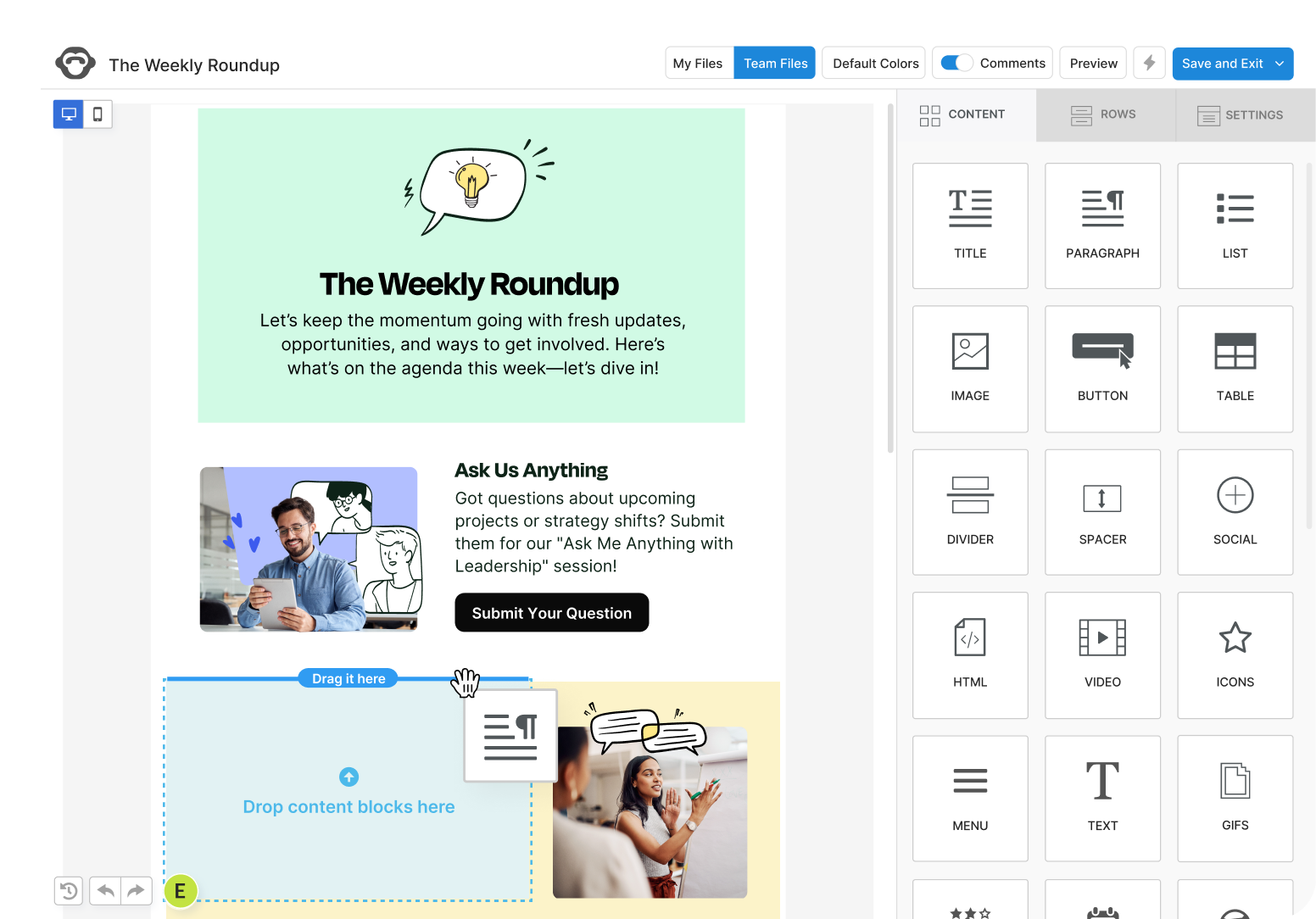
- Design and content creation is where most teams feel the friction first. A drag-and-drop internal email builder with pre-built, brandable templates means a communicator can produce a polished, on-brand newsletter without design expertise or a request to the marketing team. The builder should also support multimedia content, including images, videos, and interactive elements, because a wall of text is one of the fastest ways to lose an employee’s attention before they reach the message that matters.

- Audience segmentation and personalization determine whether your emails feel relevant or like generic, untargeted sends that employees learn to ignore. Segmented employee lists based on department, location, role, or employment status are the foundation. Dynamic content takes it further, allowing a single email to display different sections to different employee groups without creating multiple versions of the same send. HRIS integration keeps those lists accurate automatically, so communicators are not manually updating spreadsheets every time someone changes roles or joins the organization.
- Analytics and measurement is where most standard email clients fall completely flat. A credible internal email platform should surface real-time open rates, click rates, read time, device breakdown, and click maps at both the individual and aggregate level. More importantly, it should make it easy to compare performance across campaigns, departments, and time periods, and produce reports that can be shared directly with leadership without hours of manual compilation. According to GSIC 2026 data, 67% of communicators agree it is difficult to demonstrate the ROI of internal communications to leadership. The right analytics infrastructure is what changes that conversation.
- Employee feedback and two-way communication closes the loop that most one-way email sends leave open. Embedded pulse surveys, eNPS tools, emoji reactions, and comment features built directly into the email mean employees can respond in seconds without being redirected to a separate platform. That low-friction feedback loop is the difference between knowing your message was opened and knowing whether it actually landed.
- AI capabilities in 2026 go well beyond subject line suggestions. Communication teams that are actively leveraging AI are moving faster, catching errors before they reach employees, and spending less time on the mechanics of production so they can focus on strategy and impact. If you want to go deeper on where AI is actually moving the needle in internal communication, AI and the Future of Communication: What’s Actually Changing and What Isn’t is worth a read.

- Workflow and operations covers the features that protect communication quality at scale. This includes approval workflows for teams that require sign-off before sending, safeguards that give communicators a window to catch and correct mistakes before or after a send goes out, and integrations with Outlook, Gmail, Microsoft Teams, and SharePoint so the platform fits into existing workflows rather than creating new ones.
The 5 Best Internal Email Platforms for Employee Communications in 2026
Not every platform on this list does the same thing, which is the point. The best internal email software for a 500-person healthcare organization looks different from what a 5,000-person financial services company needs. The tools below were selected based on four criteria: depth of email-specific functionality, quality of analytics and measurement, ease of implementation for lean teams, and how well each platform holds up when internal communication is expected to do more than just deliver messages.
1. ContactMonkey
Best for: Internal communication teams that want to design, send, measure, and act on employee email campaigns without leaving Outlook or Gmail, and without involving IT.
Overview
ContactMonkey is a purpose-built internal email platform that integrates directly into Outlook and Gmail, which matters more than it might initially sound. Most communication teams already live inside those tools. ContactMonkey extends what those environments can do rather than asking teams to adopt an entirely new system, which is one of the clearest reasons its implementation timelines are faster than most comparable platforms.
The platform is built around a core belief that internal email should be measurable down to the individual and aggregate level, and that the feedback loop between what gets sent and how employees respond should be as short as possible. In practice, that means communication teams can see not just who opened an email but how long they spent reading it, which sections they clicked, how engagement differs across departments or locations, and what employees thought via embedded surveys and reactions, all without leaving their inbox workflow.
Key Features
- Drag-and-drop internal email builder with branded, customizable templates
- Audience segmentation by role, department, location, and employment status
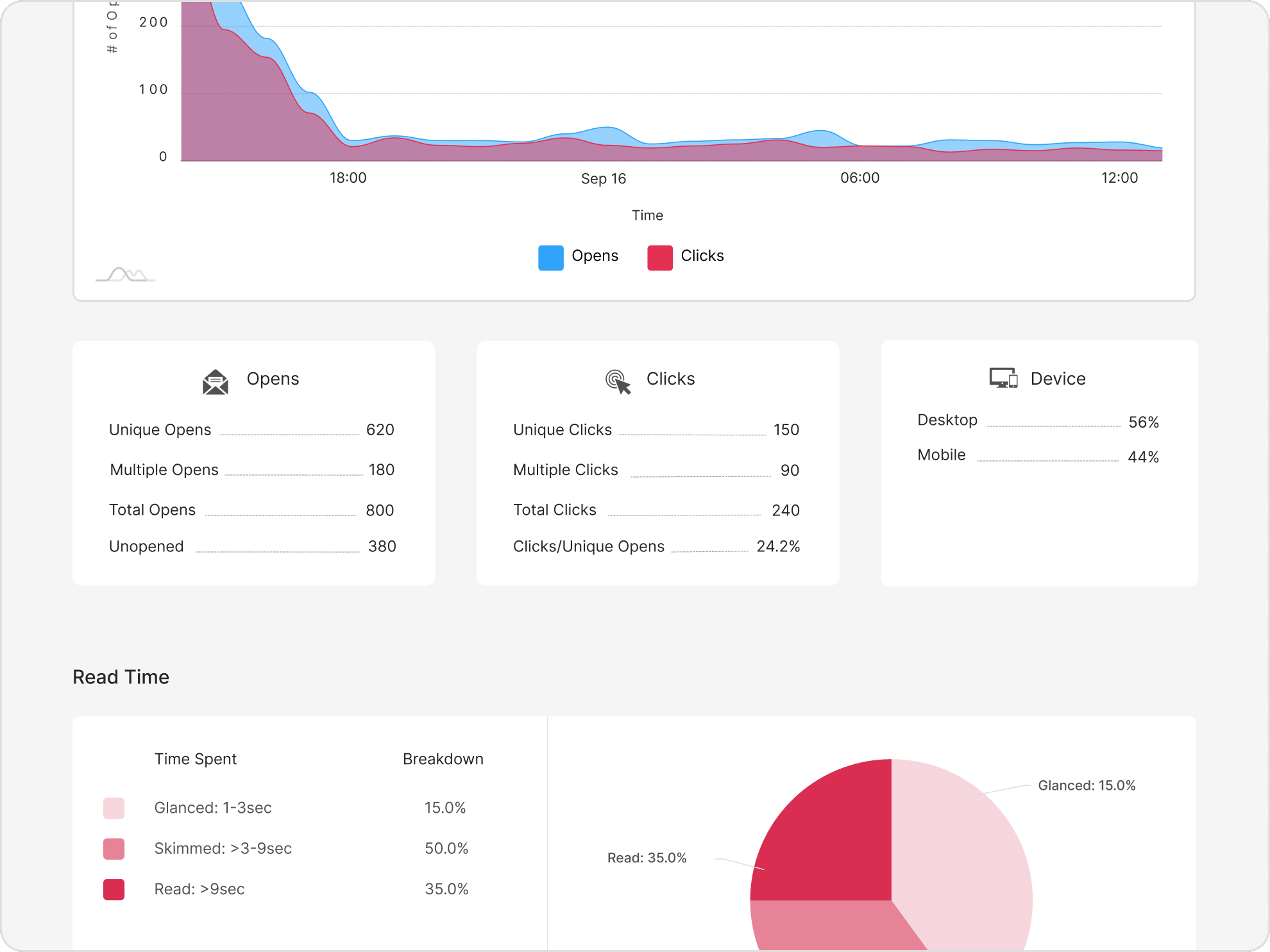
- Real-time analytics, including open rates, click rates, read time, and device breakdown
- Embedded pulse surveys, eNPS tools, emoji reactions, and comment features for two-way communication
- AI Email Builder for drafting and designing on-brand emails from a prompt
- ConfidenceCheck, an AI-powered pre-send review that flags errors, inconsistencies, and accessibility issues before an email reaches employees
- Distribution beyond email, including Microsoft Teams, SharePoint, SMS for frontline employees, and Appspace for digital signage and workplace content
- HRIS integrations and approval workflows for governance at scale
- Timezone sending that automatically delivers emails to each employee at their local time, in a single campaign send
- Deferred sending with a configurable cancellation window of up to five minutes after hitting send, giving teams a built-in undo button before a campaign reaches the entire organization
- Analytics API for enterprise customers to programmatically sync campaign data into Power BI, Tableau, or custom internal dashboards
Pros
The analytics depth is genuinely differentiated and worth understanding specifically. Most internal email tools stop at open rates and click rates. ContactMonkey tracks read time so you know whether employees are actually consuming a message or just opening and moving on, click maps that show exactly which parts of an email are getting attention, device and location breakdowns, audience-level performance filtered by department, role, or geography, and engagement trends across campaigns over time.
Reports are exportable and presentation-ready, which matters for communication teams that regularly need to demonstrate impact to leadership without spending hours reformatting data. For teams under real pressure to prove the value of their work, that combination of depth and usability is a meaningful distinction. According to ContactMonkey’s 2026 Internal Email Benchmark Report, drawn from more than 100,000 internal email campaigns sent through the platform, users see an average open rate of 81% across industries. That is a number most marketing email platforms would consider exceptional, and it reflects what happens when internal emails are relevant, well-timed, and built for the people receiving them.
The Outlook integration is also worth calling out directly because it changes the adoption equation. ContactMonkey lives inside Outlook as a native add-in, meaning communicators design, send, and review analytics without ever leaving the tool their organization already runs on. Dynamic content also lets communicators build targeted distribution lists and send emails to specific employee groups without creating multiple versions of the same message. Conditional content blocks within a single email automatically display different sections to different audiences based on attributes like department, location, role, or language.
When it comes to AI capabilities for internal email, ContactMonkey is leading the way. GSIC 2026 found that 44% of IC teams had to resend an internal email at 1-2 times in the past year, and 27% did so 3-5 times. That kind of rework quietly drains capacity that should be going toward strategy. The AI Email Builder functions as a design agent: drop in a prompt, and it instantly generates a fully designed, on-brand email ready to review and send. ConfidenceCheck gives teams a final quality review before anything goes out, catching errors, broken links, and accessibility issues that are easy to miss when you are working quickly. For mistakes caught right after hitting send, deferred sending gives you a cancellation window of up to five minutes before the campaign reaches your entire organization. And for errors discovered after a send is already out, ContactMonkey allows communicators to edit a live email in place, so a wrong link or outdated detail doesn’t require a full resend and a follow-up apology.
Cons
ContactMonkey delivers the most value to teams that are actively using its analytics to inform their communication strategy. Organizations at an early maturity stage, primarily focused on getting newsletters out the door, may not immediately take advantage of the platform’s measurement depth. The value scales with how intentionally the team uses it. ContactMonkey is also purpose-built for internal email and multichannel distribution. It is not an intranet platform and works best alongside tools like SharePoint or Appspace that provide the broader employee experience infrastructure.
Pricing
Pricing is quote-based and tiered depending on the number of users, recipients, and features required. ContactMonkey does not publish flat pricing publicly, which reflects how meaningfully costs can vary by organization size and use case. The clearest way to get an accurate picture is to request a demo.
Bottom Line
ContactMonkey is the strongest option on this list for internal communication teams whose primary channel is email and who need to move from sending to measuring without a long implementation runway or a technical team standing behind them. The combination of Outlook and Gmail integration, analytics depth, AI-powered quality control, and multichannel distribution makes it the most complete internal email solution for lean teams doing serious communication work. Additionally, the pace of product development is worth noting directly. ContactMonkey ships new updates on at least a weekly cadence. The full product changelog is public, so communication teams evaluating the platform can see exactly what has shipped recently and what is actively being built, rather than relying on a sales roadmap conversation.
Modern internal comms and measurement tools
No design or technical expertise needed. Save time, increase engagement, and dazzle your employees with fun and interactive communications.
Explore all features

2. Staffbase
Best for: Large enterprises already committed to an intranet and employee app investment, where email is one component of a broader omnichannel platform rather than the primary communication need.
Overview
Staffbase is an employee experience platform built around intranet and mobile app capabilities. Email entered the picture through the acquisition of Bananatag, and that acquisition history defines where the product stands today. Email is not what Staffbase was designed to do, and the development roadmap reflects that. Organizations evaluating Staffbase for internal email are evaluating a secondary output of a platform whose core attention is pointed elsewhere.
Key Features
- Employee app and intranet platform
- Email campaign builder via Staffbase Studio
- Audience segmentation and targeting
- Analytics and reporting dashboard
- Integrations with Microsoft 365 and SharePoint
- Multi-language content support
Pros
Staffbase consolidates intranet, employee app, email, digital signage, and SMS under one vendor for organizations that need all of those channels managed from a single platform. It has a strong footprint in industries with large frontline and deskless workforces including manufacturing, healthcare, retail, and transportation, where the branded employee app reaches employees who lack regular desktop or inbox access. The integration ecosystem is broad, covering Microsoft 365, Google Workspace, SAP, Workday, and Salesforce.
Cons
Email is a secondary product built through acquisition, not Staffbase’s core focus or development priority, and the product reflects that. The Outlook add-in is being sunset, adding friction for teams working primarily inside Outlook. Dynamic content, live link editing, AI-powered pre-send validation, and auto-translate with manual editing are not available. Suite pricing applies regardless of which channels a team actually uses, making it a costly path for organizations whose primary need is email. The platform’s complexity, built for large enterprise IT requirements, creates unnecessary overhead for teams with more straightforward needs.
Pricing
Quote-based. Typically $20,000 to $60,000 or more annually depending on features, channels, recipients, and organizational size.
Bottom Line
Staffbase fits a specific buyer: large enterprises actively using the intranet, app, and digital signage features alongside email, where consolidation under one vendor is the goal. For communication teams whose primary need is internal email with deep analytics, a committed Outlook integration, and purpose-built email capabilities, Staffbase asks them to pay suite pricing for a product that sits outside the platform’s core development focus. ContactMonkey delivers more where email performance actually matters, without the overhead or cost of infrastructure teams will not use.
For a closer look at how that plays out in practice, see why Chamberlain Group switched from Staffbase.
3. Poppulo
Best for: Organizations managing legacy multi-channel infrastructure that need a single vendor to cover digital signage, email, and Microsoft 365 surfaces, and where IT consolidation is the primary driver rather than communication effectiveness.
Overview
Poppulo is a platform built through acquisition, and it shows. What started as an email tool has expanded to cover digital signage, mobile, and Microsoft 365 surfaces, but breadth acquired through M&A rarely produces a cohesive experience. Customers consistently flag ease of use as a friction point, and the operational overhead required to manage the platform tends to pull communicators away from their actual job. For organizations where IT consolidation and governance checkboxes drive platform decisions, Poppulo can satisfy those requirements. For communication teams that need to move fast, measure what matters, and build credibility with leadership, the platform creates more work than it removes.
Key Features
- Multi-channel delivery across email, digital signage, Microsoft 365, and mobile
- Audience targeting and segmentation
- Analytics and engagement reporting dashboard
- Content creation with drag-and-drop email builder and branded templates
- Enterprise governance, SSO, and compliance controls
- Integrations with HRIS and enterprise systems
Pros
For large organizations that need structured oversight of who can send what to which audiences, the platform’s targeting and permission architecture is built for that level of complexity. The analytics and reporting capabilities are frequently cited as a genuine strength in reviews, and the multi-channel reach across signage and Microsoft 365 surfaces makes it a reasonable fit for organizations that need to go beyond email to reach dispersed or frontline workforces. A 21-day free trial is available for the email product, which is useful for teams that want to validate fit before committing.
Cons
Usability is the most consistent friction point Poppulo customers report. The email builder has a steeper learning curve than most comparable platforms, with recurring feedback around formatting issues that require ongoing workarounds. Template changes often require contacting support rather than being handled self-service, and additional charges for template modifications, advanced analytics, and new AI features have been a source of frustration for customers who expected those to be included. Customer support responsiveness has been flagged regularly, with slow response times and limited timezone coverage cited across multiple customer accounts.
From an email-specific standpoint, Poppulo sends from external servers rather than through an organization’s Outlook tenant, which means employees sometimes encounter image rendering issues and IT teams face additional security configuration overhead.
Pricing
Quote-based. Typically $90,000 to $150,000 or more annually depending on organization size, channels, and modules required. Additional charges apply for advanced analytics, AI features, and template customization.
Bottom Line
Poppulo is built for organizations where IT governance and multi-channel consolidation are the primary evaluation criteria. For communication teams where ease of use, implementation speed, and predictable pricing carry more weight, the platform’s complexity and cost structure are worth evaluating carefully against what a more focused internal email platform can deliver.
4. Workshop
Best for: Internal communication teams that want a clean, fast, web-based email builder with AI assistance and do not require Outlook-native sending or advanced analytics depth.
Overview
Workshop is one of the newer entrants in the internal email software market, founded in 2020, and has built a following among small to mid-sized communication teams drawn to its straightforward interface and speed-to-send workflow. The platform positions itself as email-first with AI and automation at the center of the product experience, including an AI assistant called Cici that helps plan, draft, and refine internal communications. Workshop also supports cross-posting to Microsoft Teams, SharePoint, and Slack, with an SMS add-on for teams that need to reach employees beyond email. The limitations become more apparent as organizational complexity grows.
Key Features
- Drag-and-drop email builder with branded templates
- Cici, an AI assistant for planning, writing, subject line suggestions, and content rewrites
- Cross-posting to Microsoft Teams, SharePoint, and Slack
- SMS add-on for two-way employee texting
- Analytics and engagement tracking
- Native Canva integration within the builder
- Integrations library including HRIS connections
Pros
Workshop’s interface is designed to be intuitive and fast to learn, which works for lean communication teams that cannot afford a long onboarding runway. The Canva integration directly within the builder removes the need to switch between tools when creating visual content, and Cici, the AI assistant, is useful for drafting and refining content, helping communicators move from brief to send-ready faster. For organizations with straightforward communication needs and smaller, less segmented audiences, Workshop is easy to get started with.
Cons
Workshop is web-based only with no Outlook add-in, which is a meaningful limitation for organizations where communication teams and executive assistants work primarily inside Outlook. Sending from external infrastructure rather than through an organization’s own environment raises security considerations that IT teams in regulated industries flag consistently. Analytics capabilities are less robust than more established platforms, with limited segmentation depth and reporting flexibility for teams that need to break performance down by department, location, or role. As a platform founded in 2020 with a limited enterprise reference base, long-term scalability is a variable worth validating, and renewal pricing is worth clarifying upfront, as customers have reported meaningful cost increases after the first year.
Pricing
Not publicly listed. Quote-based depending on organization size and features required. Renewal price increases beyond year one have been reported by customers, so it is worth clarifying renewal terms during the sales process.
Bottom Line
Workshop suits smaller communication teams that prioritize ease of use and fast email production over analytics depth, Outlook integration, or enterprise security controls. Organizations with more complex segmentation needs, larger distributed workforces, or stricter IT requirements will likely find the platform’s capabilities constraining as their programs mature.
5. Cerkl Broadcast
Best for: Large organizations whose primary challenge is content relevance across a highly diverse, distributed workforce, and where automated personalization at the individual employee level is worth the trade-off in usability and analytics flexibility.
Overview
Cerkl Broadcast is an enterprise-focused employee communications suite built around AI-powered content personalization. Rather than sending the same email to every employee, Cerkl’s MyNews Engine curates and delivers personalized content digests based on each employee’s interests, engagement behavior, preferred language, and delivery timing. The platform covers email, Microsoft Teams, Slack, SharePoint, intranets, microsites, and an optional mobile app. The question is whether automated content curation at the individual level is the primary problem a communication team needs to solve, because the rest of the platform asks teams to accept real trade-offs to access that one capability.
Key Features
- Internal email builder with drag-and-drop functionality
- MyNews Engine, AI personalization that curates content for each employee based on interests and engagement behaviour
- MyNews Digest, automated personalized news digests employees can configure for preferred topics, language, and timing
- Multi-channel distribution across Teams, Slack, SharePoint, intranets, and microsites
- Optional mobile app for frontline and deskless employees
- Cross-channel analytics dashboard
- HRIS sync and enterprise security with SOC 2 Type II compliance
Pros
Cerkl’s personalization engine goes beyond static segmentation by learning from individual employee behavior over time. For large organizations where a single all-staff newsletter struggles to feel relevant across hundreds of different roles and locations, that is a specific answer to a specific problem. The channel footprint is also broad, combining email, Teams, Slack, SharePoint, and an optional mobile app in a single content hub.
Cons
Several usability gaps have been reported consistently. The absence of an auto-save feature is a meaningful workflow risk, and formatting flexibility is limited compared to more mature builders. The analytics dashboard requires external processing to surface the insights most teams need for leadership reporting, adding friction to what should be a straightforward workflow. Cerkl also has lower market visibility than the larger platforms on this list, with fewer widely recognized enterprise references, which is worth factoring in for teams evaluating long-term platform stability.
Pricing
Starts at $799 per month. No free tier available. The mobile app is an add-on at approximately 20% above the base plan. Custom plans available for larger organizations.
Bottom Line
Cerkl Broadcast serves a narrow use case. For organizations where automated content personalization at the individual level is the top priority, the MyNews Engine is a differentiator. For communication teams that need a reliable builder, analytics that surface impact without manual processing, and a platform with an established enterprise reference base, the usability limitations and lower market visibility introduce risk that is worth weighing carefully before committing.
Quick Review: Comparison Chart of Top Internal Email Platforms
| Feature | ContactMonkey | Staffbase | Poppulo | Workshop | Cerkl Broadcast |
| Primary focus | Email-first | Intranet and employee experience suite | Multi-channel enterprise comms | Email-first | AI personalization and omnichannel |
| Best for | Lean IC teams needing measurable email with Outlook integration | Large enterprises needing full employee experience suite | Large enterprises needing multi-channel governance | SMB and mid-market teams prioritizing speed and simplicity | Organizations with large diverse workforces needing personalized content |
| Outlook integration | Native add-in, committed long-term | Add-in being sunset | External server, no native add-in | Web-based only | Web-based only |
| Email analytics | Deep: open rates, click rates, read time, click maps, device and audience breakdown | Limited, reported accuracy issues | Strong reporting, advanced features cost extra | Basic | Cross-channel dashboard, limited depth |
| AI capabilities | AI Email Builder, ConfidenceCheck, smart send-time optimization | AI content tools | AI content suggestions and insights | Cici AI writing assistant | MyNews Engine, AI-powered personalization |
| Dynamic content | Yes, up to 10 audience conditions | No | No | Limited | Yes |
| Employee feedback tools | Embedded surveys, eNPS, emoji reactions, comments | Basic | Basic | Basic | Pulse surveys |
| Deferred sending | Yes, up to 5 minutes | No | No | No | No |
| Timezone sending | Yes | No | No | No | No |
| Live link editing | Yes | No | No | No | No |
| Multi-language | Yes, with manual editing capability | Yes, no manual editing | Yes | Auto-translate only | Yes, employee-configured |
| Multichannel distribution | Teams, SharePoint, SMS, Appspace | Intranet, app, signage, SMS | Teams, SharePoint, signage | Teams, SharePoint, Slack, SMS add-on | Teams, Slack, SharePoint, microsites, mobile app |
| HRIS integration | API-based, 80+ providers | Yes | Yes | SFTP-based | Yes |
| Pricing model | Quote-based, recipient and license count | $20K to $60K+ annually | $90K to $150K+ annually | Quote-based, renewal increases reported | From $799 per month |
How Do You Choose the Right Internal Email Software for Your Organization in 2026?
With more platforms available than ever and organizational expectations for internal communication continuing to rise, choosing the wrong tool is an expensive mistake. The right evaluation process looks at whether the platform fits how your team actually works, what your organization genuinely needs today, and what you will need as your internal comms program matures.
What does your organization actually need right now?
Before evaluating any internal email platform, the most useful thing you can do is audit where your current setup is breaking down. The answer will tell you more than any feature comparison chart. Start by asking these questions honestly:
- Are you sending internal emails without clear visibility into engagement or impact?
- Does your team spend too much time manually creating, formatting, and correcting emails?
- Are you struggling to reach the right employees with relevant content and prove results to leadership?
Your answers will tell you whether you need a platform that solves a fundamental infrastructure problem first, such as basic analytics and Outlook integration, or whether you are ready to invest in more advanced capabilities like dynamic content, AI-powered personalization, or multi-channel distribution.
Internal email features you should prioritize
Not every feature on a platform’s marketing page will matter to your team. The following are the capabilities that have the most direct impact on day-to-day communication work in 2026, mapped to the outcomes they support.
For design and content efficiency: A drag-and-drop internal email builder with branded templates reduces the time spent on production and ensures consistency across sends without requiring design expertise. If your team is rebuilding the same layouts from scratch every week, that is a solvable problem.
For reaching the right people: Audience segmentation and dynamic content capabilities determine whether you can send one relevant email to multiple employee groups simultaneously, or whether you are stuck managing separate sends for every audience variation. For organizations with distributed, hybrid, or frontline-heavy workforces, this is not optional.
For measurement and leadership reporting: Internal email analytics that go beyond open rates, specifically read time, click maps, device breakdown, and audience-level performance, are what separate platforms that help you optimize from platforms that just help you send. If you are expected to demonstrate communication impact to leadership, the reporting capabilities of your platform will either enable or block that conversation.
For employee feedback: Embedded survey tools, eNPS, and reaction features that collect feedback directly within an email remove the friction that standalone survey platforms create. Employees who can respond in one click are far more likely to respond at all.

For Outlook and Gmail users: Outlook integration is not just a convenience feature. Platforms that send through your organization’s own email infrastructure rather than external servers are more secure, more reliable, and easier for IT teams to approve. If your communication team and your employees live inside Outlook, a native add-in changes the adoption equation entirely.
For global or distributed teams: Timezone sending, multi-language support with manual editing capability, and HRIS integration that keeps audience lists accurate without manual updates are capabilities that matter significantly more as organizational complexity increases.
For quality control and operational efficiency: Pre-send validation tools, deferred sending, and live link editing after send address the operational risks that compound quietly over time. According to ContactMonkey’s 2026 GSIC data, 44% of communication teams had to resend or correct an internal email at least once in the past year. Infrastructure that prevents those errors is worth evaluating explicitly.
10 questions to ask an internal email software vendor before you buy
When evaluating any internal email platform, the goal is to map key features directly to your organization’s communication needs and long-term goals. These questions are designed to help you do exactly that.
- Does the platform offer a drag-and-drop internal email builder with modern, brandable templates that non-designers can use without IT or design support?
- Does the platform integrate natively with Outlook and Gmail, sending through your organization’s own email infrastructure rather than an external server?
- Does the platform offer a centralized internal email analytics dashboard covering open rates, click rates, read time, click maps, and audience-level performance breakdowns?
- Are employee feedback tools built directly into the email experience, including embedded employee surveys, eNPS, pulse surveys, and in-email reactions, or do they require a separate platform?
- What personalization and targeting capabilities does the platform support, including dynamic content, audience segmentation, multi-language emails, and timezone-based delivery?
- What AI capabilities are built in, and do they cover content creation, pre-send quality review, accessibility checking, and send-time optimization?
- Does the platform support advanced sending features like bulk sending, deferred sending, and live link editing after send?
- What integrations does the platform support, including Microsoft Teams, SharePoint, HRIS systems, SMS, and business intelligence tools like Power BI or Tableau?
- What does the onboarding process look like in practice, including implementation timeline, IT involvement, training support, and whether a dedicated customer success manager is included?
- What security certifications does the platform hold, does it provide dedicated IP addresses, how is HRIS data synced, and what does renewal pricing typically look like after year one?
- Has the platform completed its migration from Exchange Web Services to the Microsoft Graph and Exchange Online Admin API, and will your organization experience any disruption before or after Microsoft’s October 2026 EWS retirement deadline? (Why this matters)
Build a Smarter Internal Email Strategy With ContactMonkey
Choosing the right internal email software is one of the most impactful decisions an internal communication team can make, and it is one that often gets made too quickly, based on a demo that looked good rather than a genuine assessment of what the organization actually needs.
What the 2026 data makes clear is that internal communication is no longer a support function. It is a direct driver of culture, employee trust, and organizational alignment. The teams that will have the most impact are the ones with the infrastructure to back up their effort with measurement, act on feedback in real time, and reach every employee with content that actually feels relevant to them.
ContactMonkey is built for exactly that. Whether you are a two-person team trying to move beyond basic Outlook sends or a larger organization looking to replace a platform that has stopped keeping up, the combination of analytics and reporting, Outlook-native sending, and AI capabilities makes it the most complete internal email platform for teams that take internal communication seriously.
Book a demo today to see how ContactMonkey helps internal communication teams send smarter, measure what matters, and make every email count.