57% of internal communicators say artificial intelligence (AI) in the workplace is their top area of focus in 2026, according to ContactMonkey’s Global State of Internal Communications (GSIC) 2026 report. AI has moved to the center of the agenda, and the data shows the question is no longer whether to use it in internal communications. Teams are already adopting it, driven as much by necessity as by curiosity.
What that looks like in practice varies widely. At its core, AI in employee engagement means using technology to personalize communications, automate how you listen to employees, accelerate the analysis of feedback and engagement data, and surface recommendations for what to do next. For IC and HR teams specifically, AI for internal communications means having a faster, more consistent way to produce, distribute, and measure the communications that keep employees informed and connected. Teams are at different points in that journey, with adoption continuing to expand across the workflow.
The question worth asking is where AI is actually moving the needle on engagement, and where teams are leaving the most value on the table. This guide is built for IC and HR teams who want a clearer answer to that question. It covers the use cases that generate real engagement lift, a ready-to-use prompt library for surveys and analysis, the risks you need to get ahead of, and a 30-60-90 day plan for rolling it out without overcomplicating things.
What AI-Powered Employee Engagement Actually Means in 2026
So you might be wondering what the role of AI in employee engagement actually looks like. The honest answer is that it depends on where you are starting from. Some IC teams are using AI-powered tools to run sentiment analysis across thousands of survey responses. Others are using AI to draft a first version of a newsletter before refining it. Both count.
What has changed in 2026 is less about what AI can do and more about how widely it is being used – IC teams are beginning to acknowledge the role of AI, but implementation is stalling. AI is starting to show up across every part of the internal communications workflow, but that does not mean every use case delivers the same value. Internal communications is a specific discipline. Messages often go to the entire organization and shape how employees understand priorities, leadership decisions, and what matters most. That makes how you use AI just as important as whether you use it at all.
Let’s get a little more specific and look at the jobs AI can and cannot do when it comes to employee engagement.
Unlock Internal Comms Superpowers
Discover why 10,000+ rely on us. See the internal email and employee newsletter platform in action.
Book demo

Where does AI genuinely add value in employee engagement?
According to GSIC 2026, 78% of internal communicators say creating content and templates takes up most of their time. That is the clearest signal of where AI earns its place. It takes on the repetitive work that slows teams down and frees up time to focus on messaging, targeting, and what the communication actually needs to do.
There are four jobs AI does reliably well in employee engagement work:
- Drafting: AI is a strong first-draft engine. ContactMonkey’s AI-powered content creation helps IC teams generate structured employee newsletters and internal email campaigns from a prompt, so your time goes into editing and refining rather than starting from a blank page. The output is not always publication-ready, but it gives you a clear starting point.
Example scenario: A leadership update is running over 600 words and getting low read times and minimal clicks. After an AI-assisted edit, it comes down to 200 words with a clear action in the first paragraph. Track read time and click-through rate on the next three sends to see whether the shorter format is actually landing better with your audience.
- Designing: Getting from a draft to a polished, professional email layout has historically been one of the more time-consuming parts of the IC workflow. ContactMonkey’s CoAuthor (AI Email Builder) removes that friction by turning a plain language prompt into a structured, ready-to-edit email with intelligent formatting, visual hierarchy, and context-aware placeholders already in place. An email that is visually clear and easy to scan is more likely to be read than one that is not, which makes design a direct driver of employee engagement.

- Personalizing: AI can tailor communications by role, location, department, or workforce type and adjust tone, length, and content accordingly. This matters in organizations where employees experience work very differently, especially across hybrid and frontline environments.
- Analyzing: AI is most useful when it helps surface patterns that would otherwise take time to uncover. It can process large volumes of engagement data and open-text feedback, identify sentiment trends, and highlight early signals of disengagement across teams or locations. ContactMonkey’s upcoming AI capabilities will expand further into this area, helping IC teams understand what is working and where attention is needed without relying on manual analysis.
- Reducing pre-send anxiety: Even well-written emails go out with errors when teams are working at pace. ContactMonkey’s ConfidenceCheck reviews every internal email before it goes out for broken links, readability issues, accessibility gaps, and content inconsistencies. For IC teams sending at volume, it functions as a built-in editorial safeguard that catches the kinds of errors that manual review tends to miss after hours of working on the same draft.
- Recommending: Beyond analysis, AI can turn those patterns into next steps. That might mean suggesting the best time to send an internal email, flagging content that may not land with a specific audience, or identifying gaps in your communication approach.
Across all of these areas, the value of AI comes from how it supports the work. Deloitte’s research on AI and workplace productivity shows a broader shift, where AI is reducing time spent on repetitive tasks and allowing teams to focus on more meaningful work, including collaboration, planning, and decision-making. Tools like ContactMonkey’s ConfidenceCheck and CoAuthor already sit at the intersection of drafting and recommending, reviewing content before it goes out for broken links, accessibility issues, tone inconsistencies, and errors that are easy to miss after multiple revisions.
If you want a closer look into AI in internal communications, our guide on How Internal Communications Teams Can Use AI in 2026 walks you through the main use cases and where it actually adds value.
What can AI not do for employee engagement?
AI can take a meaningful amount of work off an IC team’s plate, but there are certain things it understandably can’t do well. Remember, employee engagement still depends on context, trust, and accountability, all of which still sit with people.
- Making judgment calls: The part of internal communications that AI cannot replicate is knowing when, how, and whether to say something at all. That means deciding what to communicate during a sensitive restructuring, how to frame a leadership message that employees are already skeptical of, or when to hold a message because the timing is wrong. Those decisions depend on organizational knowledge, professional instinct, and an understanding of how your workforce reads between the lines. That kind of judgment comes from experience working inside an organization, and it remains yours.
- Trust and internal dynamics: Engagement is shaped by how employees feel about leadership, their teams, and the organization as a whole. AI can support how messages are written or analyzed, but it cannot build trust or navigate internal dynamics. That comes from consistent, credible communication over time.
- Accountability: AI can suggest, draft, and analyze, but it does not own the outcome. Internal communications does. Every message that goes out reflects on the organization, which means there needs to be a clear human in the loop reviewing, shaping, and standing behind it.
There is also a practical reality in 2026. Employees are becoming better at recognizing when something feels overly generic or AI-generated. When that happens, the message tends to feel less personal. That does not mean AI should be avoided, but it does mean it needs to be used with intention.
What Are the Real Risks of Using AI for Employee Engagement?
The most important risk of using AI in employee engagement work is trust. When employees find out that their open-text survey responses are being processed by an algorithm, or that their communication behavior is being analyzed, the reaction is often cautious. If you haven’t been transparent about how AI is involved, it can weaken the trust your employee engagement strategy depends on.
The most practical approach is also the simplest. Be transparent with employees about where AI is used in your engagement programs. Employees are generally more comfortable with AI-assisted analysis than you think, as long as they understand what is being done with their input and who is accountable for the decisions that follow.
Beyond transparency, here are five areas to get clear on before rolling out any platform with AI tools built in:
- Bias and fairness: AI models reflect the data they were trained on, and that data is rarely neutral. Treat AI outputs as a starting point, and make sure a human reviews them before it shapes a decision about an individual or a team.
- Accuracy of AI summaries: AI will occasionally summarize feedback in ways that do not reflect what employees actually said. Cross-reference AI summaries against a sample of original responses before presenting findings to leadership.
- Data security: Find out whether your employee data is being used to train the AI models inside the platforms you use. This should be a non-negotiable point of clarification before you sign any contract.
- Surveillance concerns: There is a meaningful difference between analyzing aggregate survey themes and monitoring individual communication behavior. Keep your AI-driven employee engagement analytics at the aggregate level unless you have a clear policy framework in place.
- Accountability: Before any AI-generated output gets shared with leadership or informs a communications decision, someone on your team needs to own the review step.
We recently hosted a webinar on AI in internal communications and received a wide range of questions from the internal comms community. If others are asking these questions, chances are you are thinking about them too. To catch up on the discussion, read Your AI in Internal Comms Questions, Addressed.
How Can AI Be Used to Improve Employee Engagement? (Use Cases and Examples)
AI creates the most value in employee engagement when it is applied to areas that are both time-intensive and measurable. For internal communications teams, that usually means improving how messages are targeted, delivered, and understood across a distributed workforce. The following use cases focus on where AI can drive clear improvements in relevance, efficiency, and engagement outcomes.
1) Personalizing employee communications at scale
For internal communicators, personalization has become a core part of driving any effective employee engagement strategy. As the number of internal messages increases, employees are making faster decisions about what to read and what to ignore, and that’s why relevance is what determines whether a message lands.
AI makes it easier for internal communicators to personalize employee engagement in a practical way. Instead of sending the same message to everyone, IC teams can tailor communications based on how employees actually work and what they need to know. AI supports this in a few key ways:
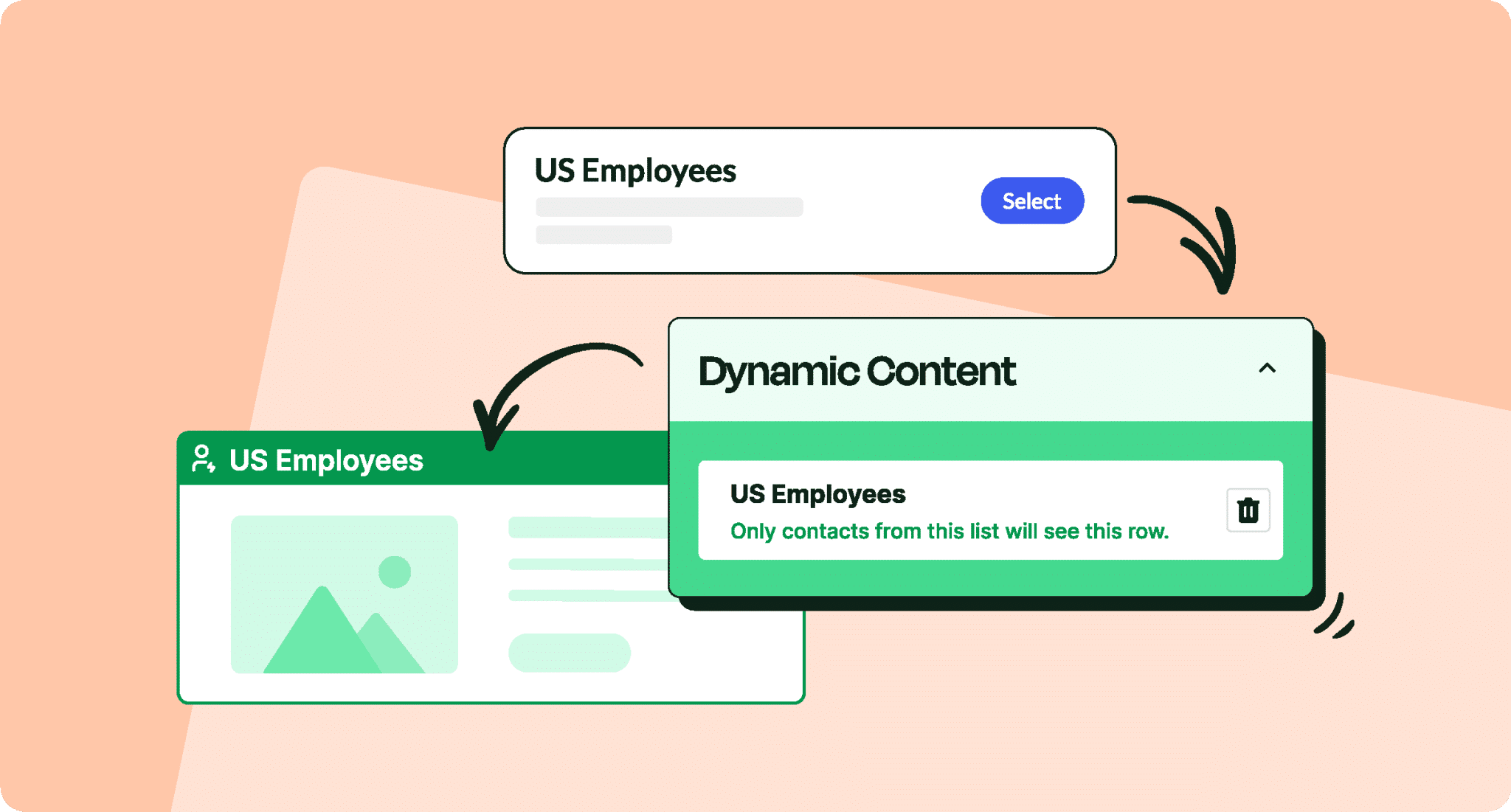
- Audience segmentation based on department, location, role, or workforce type, with audiences that stay up to date automatically
- Creating content copy that adjusts tone, length, and level of detail for different employee groups
- Translation to support multilingual and diverse workforces
This matters for internal communication teams in 2026 because employees are already receiving a steady stream of internal emails, newsletters, and updates. The challenge is making sure those messages are relevant enough to be read and acted on, and personalization improves that directly. It leads to stronger engagement across segments, not just higher averages, and a clearer connection between communication and action.
Example scenario: A change management rollout goes out as one generic all-staff email about a restructuring. After AI-assisted personalization, three audience-specific versions go out for managers, frontline employees, and remote workers, each leading with what the change means for that group specifically. For frontline workers, AI also summarizes long leadership updates into plain-language versions and translates them where needed. What to measure: reduction in follow-up questions to HR and IC, and reach and completion rates across deskless employees.
Coming soon: AI is also starting to support this earlier in the workflow. ContactMonkey’s upcoming Audience Preview feature will act like a virtual focus group, giving communicators persona-specific feedback on clarity, tone, relevance, calls to action, and overall reaction across different employee groups. This will help improve employee engagement by making it easier to tailor messages to how different audiences will actually read, understand, and respond before the message is sent. At ContactMonkey, we release new features almost weekly. If you want to stay up to date, check out our product updates page to see what is new and how it can help you.
2) Building more effective employee engagement surveys faster
Employee surveys are one of the primary ways internal communication teams measure engagement, but the quality of insight depends entirely on the quality of the questions. One of the key themes in the GSIC 2026 report is that many organizations are still operating with basic measurement practices, which means surveys are being run but not always producing clear, actionable insights. AI can naturally become useful here by helping you ask better questions, target the right audience, and gather more useful employee feedback.
Where AI adds value in survey design:
- More targeted question sets: AI can generate role-specific or topic-specific questions so employees are only asked what is relevant to them. This improves response quality and reduces drop-off.
- Shorter, more focused surveys: AI helps remove redundant or low-value questions and prioritize the ones most likely to produce insight. Shorter surveys tend to see higher completion rates and more thoughtful responses.
- Stronger open-text prompts: AI can suggest clearer, more specific prompts that encourage employees to share meaningful feedback instead of one-word answers. This improves the depth of qualitative data.
- Better survey structure: AI can recommend how to sequence questions so the survey flows logically, which makes it easier for employees to complete and reduces fatigue.
- Faster iteration between surveys: Instead of starting from scratch each time, AI can build on previous surveys and feedback, helping you refine questions based on what worked and what did not.
This is where AI tools for employee engagement surveys and AI-driven survey prompts become valuable for IC teams. The goal is not just to run surveys faster, but to collect feedback that is easier to interpret and act on. The impact shows up in three ways:
- Higher completion rates because surveys are shorter and more relevant
- More useful qualitative feedback from better open-text responses
- Clearer signals that help IC teams identify issues and adjust communication strategies
For internal communicators, better survey design leads directly to better decisions. When you can trust the feedback you are collecting, it becomes easier to connect employee sentiment to specific actions, which is what ultimately drives employee engagement.
3) Analyzing sentiment and themes across employee feedback
Most IC teams collect open-text feedback, but the challenge is making sense of it in a consistent and useful way. An employee pulse survey sent to a workforce of a few hundred people can generate thousands of words of unstructured responses. Reading through all of it manually is time-consuming, and summarizing it fairly is harder than it sounds.
This is where AI improves employee engagement analysis in a meaningful way. Rather than spending hours categorizing responses by hand, AI can scan large volumes of open-text feedback and identify the themes showing up most frequently. Specifically, it can help you:
- Identify sentiment trends across departments, roles, or locations to see where engagement is strongest and where it is slipping
- Cluster recurring themes such as recognition, scheduling, workload, or communication clarity, so nothing gets buried in a wall of text
- Compare results against previous survey cycles to answer the question IC teams get asked most often: what changed since last quarter
- Benchmark sentiment against relevant industry data to understand whether what you are seeing is specific to your organization or part of a broader trend
Coming soon: ContactMonkey’s AI Insights Agent will soon bring this capability directly into your communications workflow. Rather than exporting data and running your own analysis, the agent will monitor campaign performance continuously and surface specific recommendations before your next send. If your internal email campaigns are getting opened but no one is acting on them, ContactMonkey AI will show you exactly where attention drops and what to change so the message actually lands.
A Practical AI Prompt Pack for Employee Engagement Work
The prompts below are starting points for IC professionals who want to bring AI into employee engagement in a practical way. Drop them into your AI tool of choice, swap out the placeholders, and edit the output before anything goes out. For email and newsletter drafting, you can run these directly through ContactMonkey’s CoAuthor. For analysis and planning prompts, use an external tool like ChatGPT or Claude.
| Category | When to use it | The prompt |
| Drafting audience-specific internal emails | You need to communicate the same update to different workforce segments without writing each version from scratch | “Write an internal email announcing [topic] for [audience, e.g. frontline manufacturing employees]. The tone should be [warm/direct/reassuring]. Keep it under [word count]. Avoid jargon and lead with what this means for them.” |
| You are sending a follow-up to employees who did not open or act on a previous message | “Rewrite this internal email for employees who missed the first send. Keep the core message, but change the subject line and opening paragraph. Original email: [paste text].” | |
| Writing employee engagement survey questions | You are building a pulse survey and want questions that generate honest, useful responses | “Write five pulse survey questions for [audience, e.g. remote employees] on the topic of [theme, e.g. manager communication]. Questions should be specific, neutral in tone, and include at least one open-text question.” |
| You want to adapt a general survey for a specific workforce type | “Rewrite these survey questions for [frontline/hybrid/remote] employees. Adjust the language so it reflects their day-to-day experience. Original questions: [paste questions].” | |
| Analyzing open-text feedback | You have survey responses and need to identify what employees are actually saying | “Here are open-text responses from our recent employee survey: [paste responses]. Summarize the top five themes, identify the sentiment behind each, and flag any outliers that suggest an urgent concern.” |
| You want to understand what changed between survey cycles | “Compare these two sets of survey responses from [date] and [date]. Identify where sentiment improved, where it declined, and what themes appear in one period but not the other. [Paste both sets of responses].” | |
| Manager follow-up communications | Survey results are in and managers need to communicate findings to their teams | “Write a short email from a people manager to their team sharing the results of our recent [survey name]. Highlight [top theme] as a strength and [top concern] as an area we are actively addressing. Tone should be transparent and action-oriented.” |
| Building an engagement communications plan | You are planning communications around a specific initiative and need a structural starting point | “Create a four-week internal communications plan for [initiative, e.g. benefits enrollment, return to office, culture survey launch]. Include recommended send frequency, suggested audiences, and one key message per week.” |
How to roll out AI for employee engagement in 90 days
Getting AI into your employee engagement workflow does not require a large budget, but it does requires a clear starting point, a willingness to test, and a governance structure that ensures comms are reviewed and owned by you. Here is a realistic plan for doing that in 90 days.
Days 1 to 30: Start with one engagement scenario and set your baselines
Start with one use case. Pick the engagement moment that is currently costing your team the most time or producing the least consistent results. For most IC teams that is either drafting internal emails or analyzing survey responses. Before you change anything, document your current baselines: open rates, survey response rates, time spent on drafting, and number of revision cycles per communication. You cannot prove AI is working without knowing where you started.
- Identify one high-frequency, time-consuming task to test AI on
- Document current performance baselines across key employee engagement metrics
- Choose your AI tools, whether that is ContactMonkey’s CoAuthor for email drafting or an external tool for analysis
- Run your first AI-assisted draft or analysis and compare the output against your manual process


Days 31 to 60: Add personalization, survey prompts, and closed-loop comms
Once you have a working baseline and one proven use case, expand deliberately. This is where you introduce audience segmentation into your internal email workflow, start using the prompt pack from this guide to build better employee engagement surveys, and establish a process for communicating survey results back to employees. That last step is where most organizations fall short. According to GSIC 2026, 47% of organizations say actions from employee feedback are only sometimes communicated back to employees.
- Segment at least one employee newsletter by audience type using AI-assisted personalization
- Use the survey prompt library to build and send a pulse survey to one employee segment
- Draft a follow-up communication sharing what you heard and what you plan to do about it
- Track response rates and sentiment shift against your Day 1 to 30 baseline
Days 61 to 90: Review what is working, set clear processes, and expand to more teams
By Day 61, you should have enough data to start making the case internally for broader adoption. This phase is about turning your early results into a repeatable system and putting the governance structure in place before you scale. Use your employee engagement analytics to build a simple reporting dashboard you can share with leadership monthly, and document the governance decisions your team has made so they do not have to be relitigated every time a new use case comes up.
- Build a simple dashboard tracking communication engagement and survey sentiment over time
- Present early results to leadership using the metrics you established in phase one
- Scale your AI-assisted workflow to three to five audience segments
- Complete your minimum viable governance checklist before expanding further
Where ContactMonkey AI Fits Into Your Employee Engagement Workflow
Most AI employee engagement platforms ask you to change how your team works, but ContactMonkey is one of the few platforms purpose-built for AI for internal communications. ContactMonkey AI features are available on the web app itself, which means IC teams get access to a full suite of AI-assisted communications tools in one place without relying on a plug-in or add-on. Here is what the AI capabilities inside ContactMonkey do today:
- AI-powered content creation helps you draft, edit, refine, and adapt internal email copy faster. Employees engage with communications that are clear and relevant to their situation. When IC teams spend less time on manual drafting and editing cycles, they have more capacity to focus on what actually drives engagement: the right message, for the right audience, at the right time.
- CoAuthor (AI Email Builder) turns a plain language prompt into a structured, professionally designed employee newsletter or internal email inside the ContactMonkey editor in seconds. Rather than manually arranging layouts or starting from scratch, you can describe what they need and get a ready-to-edit email with intelligent formatting, visual hierarchy, and context-aware placeholders already in place. For employee engagement, this matters because design and readability directly affect whether employees read past the first line. An email that is visually clear, mobile-ready, and easy to scan is simply more likely to be read than one that is not.
- ConfidenceCheck reviews every internal email before it goes out for broken links, readability issues, accessibility gaps, and content inconsistencies. Engagement drops when employees lose trust in the quality and reliability of communications. Catching errors before they reach the inbox protects that trust at scale.

- AI-assisted language translation ensures employees across regions and language groups receive the same message with the same clarity. Frontline and globally distributed employees are among the hardest to reach and the most likely to disengage when communications do not account for their context. Translation removes one of the most common barriers to that reach.
- George, ContactMonkey’s AI chat assistant, supports your teams and users throughout the platform, answering questions, surfacing resources, and reducing friction during onboarding and day-to-day use. Faster internal support means fewer delays between planning and execution, which keeps employee engagement strategies moving rather than stalling in a support queue.

Putting It Into Practice
AI has moved to the center of the employee engagement agenda because the workload facing most internal communications teams has outpaced what manual workflows can sustain. The time most communicators spend on drafting, formatting, correcting, and resending is time that could go toward the strategic work that actually moves engagement: understanding your audiences, strengthening leadership communications, and closing the loop on employee feedback.
The teams getting the most out of AI right now are working with it as a partner in their workflow. They identify where their process breaks down most often and using AI intentionally to that specific problem first. Whether that’s a better first draft, a faster survey analysis, or follow-up comms that actually goes out.
AI works best when it matches the pace of your always-on communications workflow, taking on the repetitive production work so you can stay focused on the strategy that shape how communication actually lands. The organizational context and the sensitivity needed in certain moments: those remain yours. What AI changes is how much of your time gets consumed before you get there.
FAQ
What is AI in employee engagement?
AI in employee engagement is the use of artificial intelligence to personalize internal communications, automate employee listening, analyze feedback at scale, and surface recommendations that help IC and HR teams act faster and more effectively. It delivers the most value in high-volume, time-intensive workflows like drafting, survey analysis, and reporting. Where it falls short is in areas that require organizational context, trust-building, and accountability, which remain human responsibilities.
How does AI improve employee engagement?
AI improves employee engagement by helping IC and HR teams communicate more consistently, relevantly, and efficiently across a distributed workforce. It reduces the time spent on manual drafting, formatting, and analysis, freeing up capacity for the strategic work that actually influences whether employees read, trust, and act on internal communications. The clearest improvements show up in open rates, survey response rates, and the speed at which feedback gets acted on and communicated back to employees.
What are the best AI tools for internal communications?
The best AI tools for internal communications are purpose-built platforms that support the full send, listen, and measure workflow without requiring teams to adopt a separate system. ContactMonkey offers a suite of AI features built specifically for IC teams, including AI-powered content creation, CoAuthor for email design, and ConfidenceCheck for pre-send quality reviews. For analyzing open-text survey feedback and building communications plans, general tools like ChatGPT or Claude work well as a complement to a dedicated IC platform.
What are the risks of using AI for employee engagement?
The biggest risk of using AI for employee engagement is losing employee trust by failing to be transparent about how AI is involved in engagement programs. Additional risks include bias in AI-generated analysis, inaccurate summaries of open-text feedback, and unresolved questions around how employee data is stored and used by AI providers. The most effective way to manage these risks is to establish a clear governance framework, inform employees where AI is used, and assign a named human reviewer for all AI-generated outputs before they inform any decisions.
How do you measure the impact of AI on employee engagement?
The most reliable way to measure the impact of AI on employee engagement is to establish clear baselines before introducing any AI tools, including open rates, survey response rates, read time, and revision cycles per communication. From there, track performance on AI-assisted internal email campaigns against those baselines, monitor whether survey response rates improve when AI-assisted prompts are used, and measure whether your team is spending less time on production work over time. The metrics that matter most are the ones tied directly to your engagement goals, not AI adoption as an end in itself.
If you want AI-assisted internal communications that are measurable and easy to adopt in Outlook and Gmail, book a demo with ContactMonkey today.