AI in internal communications has moved past the “should we try this?” stage. According to ContactMonkey’s 2026 Global State of Internal Communications (GSIC) report, 57% of internal communicators say that AI in the workplace is their top area of focus this year, ahead of employee experience, change management, and everything else on the list. The question now is how to use it where it genuinely helps and how to use it well.
Internal communications teams tend to be small, busy, and expected to cover a lot of ground. Nobody in an organization is better positioned to use AI thoughtfully than the people doing this work. You already understand your audiences, you know which messages need careful handling, and you sit at the intersection of leadership and the broader workforce. That context is exactly what AI lacks, and exactly what makes internal communicators the right people to use it well.
This guide covers what AI for internal communications actually does in a real workflow today, where it creates the most meaningful lift, and where human judgment still has to lead. It also includes an AI prompt library you can use across email, change communications, channel adaptation, and frontline audiences. The goal here is to give internal communicators a practical guide for using AI intentionally, with a clear sense of where it helps and where it does not.
What Can AI Really Do for Internal Communications Teams?
In 2026, AI and internal communications are no longer separate conversations. Most teams are using AI in some way or another already, and a recent Gallagher study found that nearly seven in ten internal communications professionals expect it to play a significant role in how they work over the next five years. McKinsey research points in the same direction, with more than nine in ten organizations planning to expand their AI investments over the next three years across every part of the business.
For internal communicators, this kind of momentum is worth paying attention to. As AI becomes a standard part of how organizations operate, the real difference now is between teams that have figured out where AI fits in their existing workflow and teams that are still working that out. Before getting into the how, it helps to be clear on what AI is genuinely good at and where you still need to be in the driver’s seat.
For more context on what this means for internal communicators specifically, read our blog on AI and the Future of Communication: What’s Actually Changing and What Isn’t.
Where AI creates real lift for internal communicators
The AI applications for internal communications that deliver the most consistent value are the ones that remove the repetitive, time-consuming work sitting between your strategy and your send button. Here is where that shows up in practice:
Content creation and clarity
The most common entry point for AI in internal communications is drafting, and for good reason. According to GSIC 2026, 73% of communicators spend between one and six hours every week on designing, formatting, and sending internal emails alone. AI reduces that time significantly by turning a rough brief into a structured first draft in seconds. It’s also useful for rewriting existing content to improve clarity and scannability, things like breaking up dense paragraphs, simplifying language, or tightening a 400-word leadership update into something employees will actually read. If your message is technically correct but not landing, AI can help you find where it’s losing people and suggest a cleaner version.


Personalized employee communications
Audience-specific messaging has always been the right approach, but for most internal communications teams, it has not really been realistic until now. AI lets you take a single source message and adapt the tone and framing for a frontline worker, a people manager, and a senior leader without starting from scratch each time, making it one of the most practical effective employee engagement strategies available to internal communications teams today. GSIC 2026 found that emails sent to smaller, more targeted audiences consistently outperform organization-wide sends, with open rates at organizations under 50 employees averaging 86% compared to 55% at organizations with more than 10,000 employees. Audience segmentation allows IC teams to send personalized emails and newsletters with the right tone and format for each group.
ContactMonkey’s upcoming Audience Preview feature will take this further, letting you validate how a message lands with different employee segments before it goes out. You can test clarity, tone, relevance, and CTA’s against AI personas (such as a frontline worker, a people manager, or a non-native English speaker), so you know how it reads before anyone actually receives it.
Localization for global teams
For organizations communicating across regions and languages, AI removes the need to wait on external translation vendors and significantly reduces the time it takes to localize content across multiple languages. Having a human review the output is still best practice, but AI handles the first pass so that process moves considerably faster. Speed is part of it, but there is a more important reason this matters. When some employees are consistently last to know, particularly during a restructuring or a difficult quarter, it undermines the trust your communications are supposed to be building. If every employee gets the same info at the same time, in the language they understand, it really shows that your organization means what it says about inclusion.
Routine automation and workflow
The content of your internal communications will always require your judgment. The logic behind when it goes out, to whom, and what happens if someone does not engage does not have to be. Onboarding sequences, policy acknowledgment reminders, and follow-ups to employees who missed a critical message can all be triggered automatically based on rules you set once. According to GSIC 2026, internal communicators spend an estimated 240 hours per year on email execution alone. Automating the sending logic is how you protect your time for the work that actually requires you to think.
Employee feedback and survey analysis
Most teams are pretty good at collecting employee feedback, but fewer are good at doing anything with it quickly. AI can process open-ended survey responses, identify recurring themes in employee feedback, and surface the issues employees are raising most often. All of this in a fraction of the time it would take to analyze responses manually. This is particularly useful after major announcements, organizational changes, or culture initiatives where the volume of feedback is high, and the window for a credible response is short.
ContactMonkey’s upcoming Insights Agent is being built to handle exactly this, monitoring employee sentiment continuously and surfacing what employees are raising most often so you are not waiting until the next survey cycle to find out.
Engagement data and reporting
Employee engagement analytics is only useful if someone acts on it. AI can turn a dashboard of open rates and click-through figures into a readable narrative that you can present to leadership in a way that connects internal comms performance to real business outcomes. The workflow is straightforward: pull your analytics, bring the key figures into an AI tool, and prompt it to write a summary for a specific audience against a benchmark. What takes an hour to produce manually takes minutes with AI assistance, and the output is much easier for a non-comms audience to understand.
The next step beyond that is an Insights Agent that does not wait for you to pull the data at all. It monitors your campaigns continuously, shows you exactly where attention dropped, and tells you what to change before the next send, so you’re always informed on what to do differently next time.
Pre-send editorial review
Of all the use cases in this list, this one has the most immediate and measurable impact on quality. Before an email reaches thousands of employees, AI can quickly review the draft for broken links, accessibility gaps, readability issues, and tone inconsistencies that manual review tends to miss. Sending a correction to thousands of employees is never a good look, and it happens more than most teams would like to admit. The GSIC 2026 report found that 44% of internal communications teams had to resend or correct an email at least once in the past year, and 27% had to do so three to five times, reinforcing just how much is at stake when internal email engagement suffers from avoidable errors. A pre-send AI review catches the mistakes that human eyes miss when you’re in a rush or have been staring at the same draft for two hours.

AI chatbots in internal communications
AI chatbots for internal communications are most useful for the questions that come in constantly and have clear, documented answers. Policy lookups, benefits FAQs, onboarding queries, and the kind of ‘where do I find this’ requests that currently eat up ten minutes of someone’s day to answer individually. Where they tend to fall short is anywhere the answer requires nuance, like sensitive HR topics, performance conversations, or anything where an unverified answer creates real risk. The things that matter most when setting one up are making sure employees can easily reach a human when the chatbot cannot help, and keeping the scope narrow enough that it stays useful rather than becoming a source of confusion.
ContactMonkey’s AI assistant, George, is a good example of this done right. Rather than attempting to answer everything, George stays focused on helping users navigate the platform, find the right resources, and get answers to common questions without waiting on a support response. It knows what it is good at, and when a question falls outside that scope, it hands off to a human. For internal communications teams, that kind of well-scoped AI assistance means less time spent on routine questions and more time spent on the work that actually requires your expertise.

What AI still cannot replace
While the capabilities above are real, so are the gaps. Remember, AI has no organizational memory. It doesn’t know that your CEO always wants the headline before the context, that your sales team is three weeks into a reorg and morale is shaky, or that a particular topic needs to be handled carefully. That context lives with you. Here are a few things AI will get wrong if nobody checks the work:
- Tone in sensitive moments: AI can produce a structurally correct change communication that lands completely wrong because it has no read on how employees are actually feeling right now.
- Accuracy on specifics: Dates, names, policy details, and organizational references need to be verified every time. AI generates plausible content, not necessarily correct content.
- Accountability: When a message goes out to 10,000 employees, a human made that call. AI can support the process, but it cannot own the outcome.
- Trust: Today, employees can tell when communication feels generic. The organizational context, the human voice, and the editorial judgment that makes a message actually land, those still come from you.
Recently, ContactMonkey hosted a webinar on AI in internal communications and collected questions from communicators just like you. The most common ones are answered in full here: Your AI in Internal Comms Questions, Addressed. Chances are, if you have a question, someone else in the room did too.
Where AI in internal communications is headed
The use cases covered above reflect where most teams are today, but they represent only a fraction of what AI will do for internal communications. The trajectory points toward AI that fits naturally into your workflow and works alongside you as a genuine partner, one that knows your calendar, your audiences, and what needs to happen next. The next generation of AI agents for internal communications will move beyond assisting with individual tasks and start handling more of the end-to-end workflow.
That means an agent that pulls content from internal systems and stops you chasing contributors for updates. An agent that routes the same message to the right channel at the right time for each employee, so Dan gets the email at 9 am, Ryan gets an SMS mid-afternoon, and Sarah gets it on Teams. An agent that monitors your campaigns continuously, shows you exactly where attention dropped on your last leadership update, and tells you what to change before the next send. And at the center of all of it, an intelligent assistant that pre-loads your communications calendar with recommended sends, audiences, and timing, so execution starts before the planning work does.
The internal communicator does not disappear in this model. The strategic thinking, the organizational context, the relationships with leadership and employees, those stay with you.
A Practical AI Prompt Library for Internal Communications Teams
The prompts below are organized by use case and built to be copied, adapted, and used directly in your workflow. They work in any AI tool your organization has approved, including Microsoft Copilot, ChatGPT, Google Gemini, or Claude. If you are using ContactMonkey, you can paste these prompts directly into CoAuthor inside the email editor to generate a structured first draft in seconds. For brand consistency, tone, and editorial standards, the Custom Check section of ConfidenceCheck lets you turn your own prompts into automated rules that run on every send, so your organization’s specific requirements are checked every time.
But before getting into them, it is worth spending a moment on what makes a prompt actually work, because the quality of what comes back from AI depends almost entirely on what you put in.
Why do most AI prompts produce mediocre drafts, and how do you fix that?
The most common prompting mistake internal communicators make is treating AI like a search engine. You type in a topic, expect a usable draft, and get something that is technically correct but completely generic. A useful prompt gives AI enough context to produce something worth editing. Before writing any prompt, run through these five elements:
- Context. What is happening, why the decision was made, and any organizational background that shapes how the message should land. If this announcement follows a difficult quarter, that context changes the tone entirely.
- Audience. Who is receiving this, what they already know, and how they are likely to feel about it. A message going to a team that has been vocal about flexibility needs different handling than one going to a team that has been asking for more structure.
- Channel. Where this will be read. An email read on a desktop has more room than a message read on a phone between shifts. Frontline employees reading on mobile need shorter paragraphs and a visible call to action above the fold.
- Goal. What you need employees to understand, feel, or do as a result. Be specific. “Inform employees about the policy” is not a goal. “Get employees to confirm their schedule with their manager by August 15” is.
- Constraints. Word count, reading level, tone, things to avoid, and any language your organization does not use. If your CEO never uses the word “journey,” your prompt should say that.
Remember, AI does not know your organization; you do. Here is what that looks like in practice:
| Vague prompt | Specific prompt | |
| The prompt | “Write an email about our return to office policy.” | “Write an internal email announcing a change to our return to office policy for our Toronto-based marketing team. Starting September 1, employees are expected in the office three days a week, Tuesday through Thursday. The tone should be direct and supportive. Acknowledge that this is a change from our current flexible arrangement and explain that the decision was made to strengthen team collaboration. Include one clear call to action asking employees to confirm their schedule with their manager by August 15. Keep it under 200 words.” |
| What you get | A generic, corporate-sounding email that could have been written for any company in any industry. Vague tone, no specifics, and a call to action that says something like “please reach out with any questions.” | A draft that is specific to your audience, reflects the actual decision that was made, and requires editing rather than rewriting. |
| How to use it in ContactMonkey | Not recommended for CoAuthor. A prompt this vague will produce output that requires more rewriting than starting from scratch. | Open a new email in ContactMonkey, click the CoAuthor icon in the email editor, and paste this prompt. CoAuthor will generate a structured draft with subject line, body copy, and layout ready to edit. Run ConfidenceCheck before sending. |
AI Prompts for internal emails: announcements, updates, and policy changes
| Scenario | AI Prompt | What to watch for in the output |
| All-hands announcement | “Write an internal email announcing [topic] to all employees. Lead with the key message in the first two sentences. Include what is changing, when it takes effect, and what employees need to do. Keep it under 250 words. Use a clear, direct tone and avoid jargon.” | Check that the call to action is specific. AI often ends with something vague like “please reach out with any questions” rather than a concrete next step. |
| Executive leadership update | “Draft an internal email from [executive name and title] updating all employees on [topic]. The tone should be confident and transparent. Acknowledge any uncertainty honestly. End with a clear statement of what employees can expect to hear next and when. Keep it under 300 words.” | Read it back as an employee. If it sounds like a press release rather than a message from a person, it needs another editing pass. |
| Policy change notification | “Write an internal email informing [audience] of a change to [policy name]. Explain what is changing and why in plain language. Summarize the key points employees need to know in three bullet points. Include a clear call to action. Keep it under 200 words.” | Verify every policy detail manually. AI will produce plausible specifics that may not match your actual policy. |
| Benefits enrollment reminder | “Write a reminder email for [benefits enrollment period]. The audience is full-time employees who may not have completed enrollment yet. Lead with the deadline. Include the two or three most important actions employees need to take. Keep it under 150 words and avoid HR jargon.” | Check that the deadline is prominent. AI has a tendency to bury the most urgent information mid-paragraph. |
| Subject line options | “Generate five subject line options for an internal email about [topic]. The audience is [describe employees]. Each subject line should be under 50 characters and make the purpose of the email immediately clear.” | Read each option aloud. If it sounds like a marketing email rather than an internal update, it will not land the way you want it to. |
Use these prompts in CoAuthor by opening a new email in ContactMonkey, clicking the CoAuthor icon, and pasting the prompt directly. For recurring sends like enrollment reminders or policy updates, you can also set up Custom Check rules in ConfidenceCheck to automatically flag issues specific to that communication type on every send.
AI Prompts for employee feedback, surveys, and recognition
Following through on the listening side of internal communications, running pulse surveys, closing the employee feedback loop, and recognizing people in a way that actually feels personal, is the part that tends to get pushed when teams are busy. The prompts below help you produce these communications faster so the follow-through actually happens. They also work well as dedicated sections inside your employee newsletter, where employee recognition and survey content tend to drive strong engagement.
| Scenario | AI Prompt | What to watch for in the output |
| Pulse survey invitation | “Write an internal email inviting [audience] to complete a pulse survey about [topic]. Explain why their feedback matters and how it will be used. Include how long the survey takes and the deadline to respond. Keep it under 150 words. The tone should be warm and genuine, not corporate.” | Check that the “why it matters” section sounds specific to your organization. Generic statements about valuing employee feedback tend to reduce response rates rather than increase them. |
| Engagement survey launch | “Write an internal email announcing the launch of our annual employee engagement survey to all employees. Explain the purpose of the survey, how responses will be kept confidential, and what we plan to do with the results. Include the open and close dates and a clear call to action. Keep it under 250 words.” | Confidentiality language needs to be verified against your actual survey setup before this goes out. Do not let AI make promises your process cannot keep. |
| Feedback loop closure | “Write an internal email updating employees on what we heard in the recent [survey name] and what actions we are taking as a result. Acknowledge the key themes that came up. Be specific about what is changing and what is not, and explain why. Keep it under 300 words.” | This is the communication most teams delay, and the one employees notice most. Make sure the actions listed are real and confirmed before sending. |
| Employee recognition announcement | “Write an internal email recognizing [employee name or team] for [achievement or contribution]. Explain what they did and why it matters to the organization. The tone should feel genuine and specific, not like a generic award announcement. Keep it under 150 words.” | Read it back and check whether it could apply to any employee at any company. If it could, it needs more specificity. Recognition lands when it is personal. |
Use these prompts in CoAuthor to generate a first draft, then embed your survey or feedback block directly in the ContactMonkey email editor before sending. For recognition announcements that go out regularly, a Custom Check rule can ensure every send meets your tone and format standards without manual review each time.
AI Prompts for change management communications
Change management communications are where AI earns its place in the workflow. Use it to build the foundational documents quickly, then apply your organizational context in the editing pass. This is the category where the human review step matters most.
| Scenario | AI Prompt | What to watch for in the output |
| Employee-facing FAQ | “Generate a FAQ document for employees about [change]. Write eight to ten questions employees are likely to ask, including how this affects their day-to-day work, timeline, and who to contact with concerns. Answer each question in two to three sentences using plain, honest language. Acknowledge what is still unknown where relevant.” | Add the questions employees will actually ask, not just the ones that are easy to answer. AI tends to avoid the hard questions. |
| Manager cascade kit | “Create a manager communication kit for [change]. Include a one-paragraph summary managers can use to brief their teams, three to five talking points covering the key messages leadership wants reinforced, answers to the three questions employees are most likely to ask, and a suggested timeline for when managers should communicate. Write in plain language managers can use directly.” | Check the talking points against what leadership has actually agreed to say. AI will generate plausible messaging that may not reflect your organization’s official position. |
| Rumor control statement | “Draft a brief internal communication addressing misinformation circulating about [topic]. Acknowledge that employees may have heard different things. State the facts clearly and directly. Avoid being defensive. End with a commitment to share more information by [date or milestone] and a contact for questions. Keep it under 150 words.” | Tone is everything here. If the output sounds dismissive or corporate, it will make things worse. Read it as a skeptical employee before it goes anywhere. |
| Change announcement email | “Write an internal email announcing [change] to [audience]. Lead with what is changing and why the decision was made. Be honest about the impact on employees. Include what happens next and by when. Acknowledge the emotional response employees may have without being dismissive. Keep it under 300 words.” | This is the prompt where AI is most likely to produce something that reads as tone-deaf. The emotional acknowledgment in particular, needs a human edit every time. |
Use these prompts in CoAuthor to build your foundational change communications quickly. Because this is the category where accuracy and tone matter most, always run ConfidenceCheck before sending. If your organization has specific language requirements for change communications, for example required disclaimers or restricted terminology, set those up as Custom Check rules so they run automatically on every send
AI Prompts for frontline and deskless employee communications
Frontline employees are often the hardest audience to reach and the most underserved by standard internal communications templates. These prompts are built for communications that need to work on a mobile screen, in a noisy environment, and for readers who have very little time.
| Scenario | AI Prompt | What to watch for in the output |
| Plain language rewrite | “Rewrite the following internal communication for a frontline audience. Use short sentences and simple words. Aim for a Grade 6 reading level. Remove any corporate language or acronyms. If there is an action required, make it the first sentence. Keep it under 150 words.” | Check that the action is genuinely the first thing a reader sees. AI often adds context before the instruction, even when you ask it not to. |
| Mobile-first email | “Write a short internal email for [frontline role] about [topic]. The email will be read on a mobile device. Use short paragraphs of no more than two sentences. Lead with the most important information. Include one clear call to action. Keep it under 100 words.” | Check paragraph length on a phone screen before sending. What looks fine in a desktop editor can still feel dense on mobile. |
| Translation-ready message | “Write an internal message about [topic] for employees whose first language may not be English. Use simple sentence structures. Avoid idioms, slang, and culturally specific references. Write in a way that translates accurately and clearly into other languages. Keep it under 150 words.” | Read it back and flag any phrase that only makes sense in English. These are the phrases that tend to break in translation. |
| Shift briefing summary | “Summarize the following information into a shift briefing for [frontline role]. Write it as five bullet points that a team lead can read aloud in under two minutes. Each bullet should be one sentence. Focus only on what employees need to know to do their jobs today.” | If any bullet requires background knowledge to understand, it needs to be rewritten. Assume the reader has thirty seconds and no context. |
Use these prompts in CoAuthor and pay particular attention to the output on mobile before sending. ContactMonkey’s email editor lets you preview how your email renders on a mobile screen, which is worth checking for every frontline send. If plain language or reading level is a standing requirement for your frontline communications, add it as a Custom Check rule so it is enforced on every draft.
A Simple Operating Model for AI in Internal Communications
Most guidance on AI in internal communications stops at the use case level. Here is what to do next. The workflow below is designed to be repeatable across every type of communication your IC team produces, whether it’s a monthly newsletter or a company-wide change announcement. While it’s not complicated by design, the goal of this model is a process your team can follow consistently.
The eight-step workflow for every AI-assisted communication
The table below breaks each step into what you do and where AI fits in, so there is no ambiguity about who owns what. Think of it as a standing brief for every communication your team produces.
| Step | What you do | What AI helps with in ContactMonkey |
| 1. Plan | Define your audience, goal, and channel before anything else | Use ContactMonkey’s audience segmentation to identify the right employee groups and review past campaign performance to inform timing |
| 2. Draft | Open a new email in ContactMonkey, click the CoAuthor icon, and type your prompt | CoAuthor turns your prompt into a structured, formatted email with subject line, body copy, and layout ready to edit in seconds |
| 3. Human edit | Read the draft as an employee would. Add organizational context, adjust tone, and make it sound like it came from your organization | Nothing. This step belongs entirely to you |
| 4. QA | Run ConfidenceCheck before anything goes out. Review flagged items and decide what to act on | ConfidenceCheck flags broken links, placeholder text, accessibility issues, readability concerns, and content inconsistencies. Custom Check rules flag issues specific to your organization’s standards |
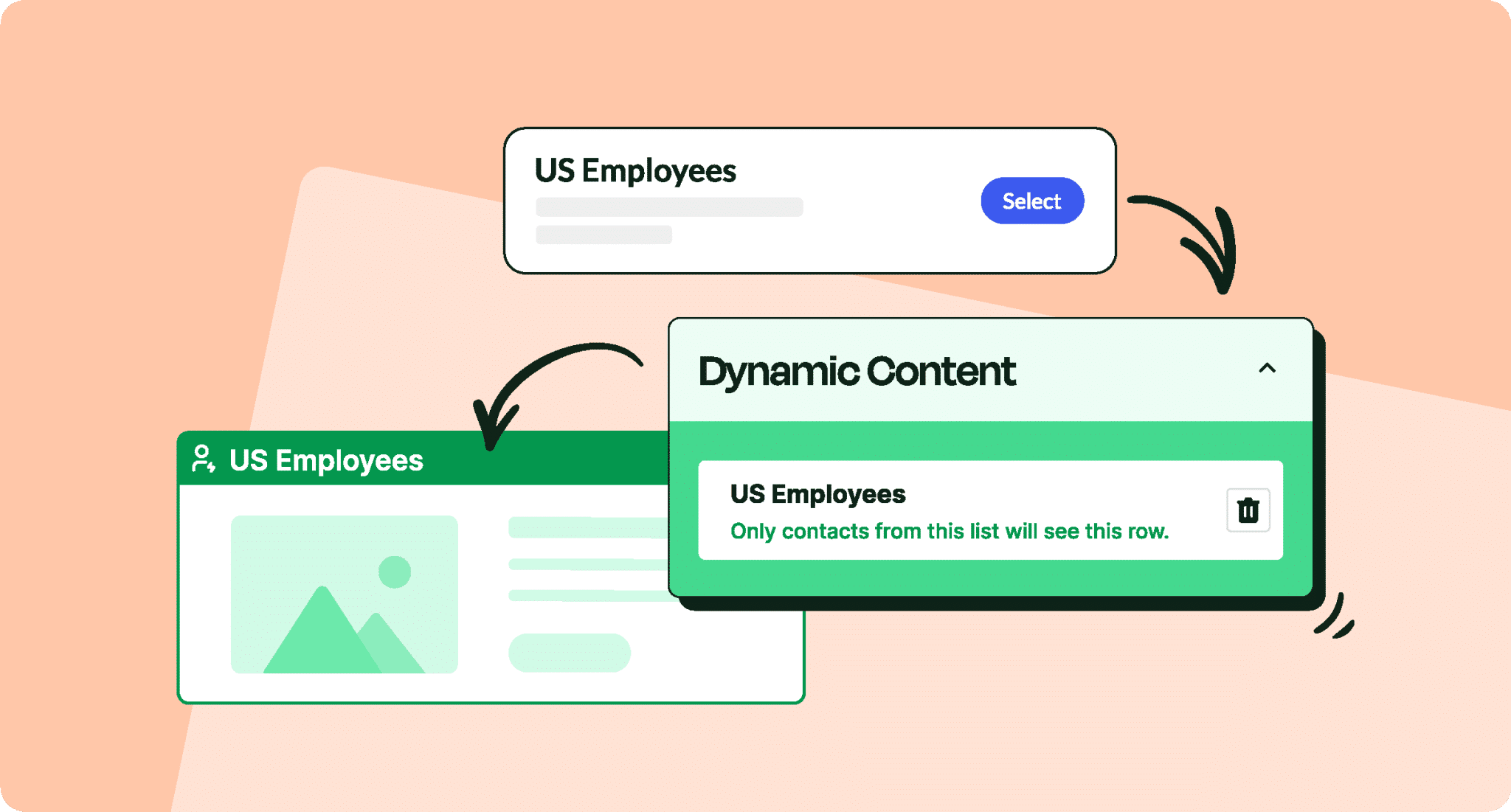
| 5. Personalize | Use ContactMonkey’s dynamic content and segmentation features to adjust tone, format, and framing for each audience segment | CoAuthor can adapt the same core message for different employee groups with a follow-up prompt |
| 6. Publish | Schedule your send at the right time for your specific audience and region using ContactMonkey’s scheduling features | Send time data shows when your employees are actually opening emails so your timing is based on real behavior |
| 7. Measure | Review open rates, read time, click rates, and department-level engagement in ContactMonkey’s analytics dashboard | Export your analytics and use AI to turn the data into a readable narrative for leadership |
| 8. Improve | Use what you learned to make the next communication better. Adjust subject lines, send times, content length, and audience segments based on what the data shows | ContactMonkey’s campaign analytics surface patterns across sends so you can see what is working and apply it to the next one |
What should a human review before anything goes out?
AI makes the production side of internal communications significantly faster, but that speed creates a new risk. When a draft looks finished, it feels finished, but more often than not, it is not. Before anything is sent, a human should check:
- Accuracy: AI generates plausible content, not necessarily correct content. Verify every fact, date, name, and policy detail against a source you trust.
- Tone and context: Does this sound like your organization? Is the emotional register right for the moment? A message sent during a difficult period needs different handling than a routine update.
- Approvals: Does this communication require sign-off from legal, HR, or a senior leader? For policy changes, compliance-related content, or sensitive announcements, documented approval is not optional.
- Data and privacy: Do not enter personally identifiable information, confidential business data, or sensitive employee details into a consumer AI tool. If you are using ContactMonkey’s AI features, your data is processed in real time and not retained for model training.
- Governance: If your organization has a formal AI governance process, get your internal communications use cases registered within it. The NIST AI Risk Management Framework identifies transparency, accountability, and human oversight as the foundations of trustworthy AI use.
How ContactMonkey Puts AI to Work in Internal Communications
Email is still the most reliable channel for reaching employees. ContactMonkey’s 2026 Internal Email Benchmark Report found an average open rate of 81% across more than 100,000 internal email campaigns, a figure that no other channel consistently matches. ContactMonkey AI is built specifically for internal email, designed to make every email faster to create, safer to send, and more consistent in quality.
Here is how ContactMonkey is leveraging AI to make internal comms easier for you:
ConfidenceCheck: a pre-send review that runs before every send
ConfidenceCheck is ContactMonkey’s built-in AI editorial assistant. Before you hit send on any email, it reviews your draft and flags the issues that manual review tends to miss. It checks for things like:
- Broken links so employees do not hit dead ends
- Content inconsistencies including mismatched copy, off-context links, and placeholder text left in by mistake
- Readability signals including estimated read time and clarity issues that could affect comprehension
- Spelling and editorial errors as part of a quality review that goes beyond spellcheck
- Accessibility gaps aligned with WCAG 2.1 Level AA standards, including color contrast, alt text, heading structure, descriptive links, and font size
You can also set up Custom Checks with ConfidenceCheck to enforce your organization’s own editorial standards on top of the baseline review. Custom Check lets you define your own rules, things like flagging banned terms, enforcing date formats, catching generic CTA labels, or ensuring every message clearly states who it applies to, so your specific requirements run automatically every time you send.

CoAuthor: build better emails faster with AI Email Builder
CoAuthor is ContactMonkey’s AI Email Builder, built directly into the drag-and-drop email editor. In your prompt, just describe your message in plain language, including the topic, the audience, and the tone, and CoAuthor will automatically design a structured email with a subject line, body copy, and logical layout, ready for you to review and refine before sending.
Here is what CoAuthor helps with:
- Automated email creation turns your prompt into a structured, ready-to-edit internal message
- Conversational editing lets you refine content using natural language instead of manually adjusting layouts
- Intelligent layout structuring organizes sections, formatting, and visual hierarchy for clarity and scannability
- Context-aware placeholders instantly add relevant images, buttons, and draft copy
There are no external tools, no copy-pasting between platforms, and no reformatting a plain text draft into a designed template. The draft is built inside ContactMonkey from the moment it is generated, which means you stay in the same workflow from prompt to send. CoAuthor handles the first draft, and you apply the organizational context, adjust the tone where needed, and run ConfidenceCheck before it goes out.

To read more about CoAuthor, read our blog post here: From Prompt to Draft: Introducing CoAuthor (BETA).
Write, refine, and adapt comms with AI-powered content creation
Beyond CoAuthor, ContactMonkey’s AI-powered content creation tools help internal communications teams write, refine, and adapt messages at every stage of the process. Whether you are improving the tone of an existing draft, rewriting a message for a different audience, or optimizing a communication for clarity and readability, the tools are built into the platform so you are not switching between applications to get the work done. The drafting and refining work that eats up most of a communicator’s day moves significantly faster when AI is handling the first pass.

Reach every employee in their language with AI-assisted translation
ContactMonkey’s AI-assisted translation lets internal communications teams localize messages into multiple languages directly from a single source draft. For organizations communicating across regions, this removes the bottleneck of waiting on external translation workflows and ensures every employee receives the same information at the same time, in a language they can actually work with.
Meet George: ContactMonkey’s AI chat-based assistant
George is ContactMonkey’s AI chat-based assistant, built into the platform to answer questions, surface relevant resources, and keep your workflow moving without interruption. For internal communications teams who are learning new features, troubleshooting a send, or trying to get the most out of CoAuthor and ConfidenceCheck, George provides immediate, contextual guidance without needing to pause work and wait for a support response. For lean teams with no dedicated IT support, that kind of on-demand help makes a real difference in how quickly you can get up and running and stay that way.
Putting It All Together: Building a Company Newsletter With ContactMonkey AI
The best way to understand how ContactMonkey’s AI features work together is to see them applied to a real example. Below is a step-by-step walkthrough of how an internal communications team can use CoAuthor, AI-powered content creation, and ConfidenceCheck to build and send their monthly employee newsletter, from the first prompt to the final pre-send review.

Step 1: Generate your first draft and design with CoAuthor
First, open CoAuthor inside the ContactMonkey email editor and type in a single prompt:
“Create a monthly company newsletter for all Acme employees. Include the following sections: a brief intro from the communications team, an upcoming events table with three placeholder events, a featured stories section highlighting a recent client success, a company update about a recent product initiative and its impact, and an employee feedback block with a single question about professional growth opportunities. The tone should be warm, clear, and professional. Avoid jargon. Keep it under 500 words.”
CoAuthor generates a complete, structured newsletter with all the sections, a logical layout, and placeholder copy ready to edit, in seconds. Instead of starting from a blank page, your team starts from something that’s already 70% of the way there.
Step 2: Refine specific sections with AI-powered content creation
The first draft is solid but needs adjusting in places. The company update section reads well for a desk-based audience but needs to be simpler and more direct for the frontline employees who will also receive this newsletter. You can type a follow-up prompt directly in the editor:
“Rewrite the Mission in Action section for frontline employees who were not directly involved in the Community Access program launch. Use plain language, short sentences, and explain why this matters to them specifically. Keep it under 100 words.”
The section is updated immediately without leaving the platform or rebuilding any part of the layout.
Step 3: Run ConfidenceCheck to check your newsletter for any errors
Before the newsletter goes out to the full employee list, you run ConfidenceCheck. As an example, it flags three issues:
- Two event dates in the upcoming events table are still showing as “MM dd, yyyy” placeholders
- The “View Full Event Calendar” button link is broken
- One image in the featured stories section is missing alt text, flagged as an accessibility issue
All three are fixed in under five minutes. Without ConfidenceCheck, at least one of these would have made it into employee inboxes, and you would have had to resend the newsletter.
You also have Custom Check rules configured for your newsletter that run automatically alongside the standard review, catching issues that standard ConfidenceCheck would not flag on its own. Some examples of rules you can set up for your organization:
- Tone and voice: Flag any content that sounds overly formal or legalistic for internal communication
- Brand design: Flag any use of green that is not exactly #0fba69
- Links and CTAs: Flag any button text that uses generic labels like “Click here” or “Learn more”
- Formatting and style: Flag any date not written in the format “Month DD, YYYY”
Step 4: Send your email with confidence
You can re-run ConfidenceCheck one last time to confirm everything is resolved before the newsletter goes out. Once there are no remaining flags, it goes out on schedule. The whole process, from opening CoAuthor to hitting send, took significantly less time than building the same newsletter manually would have. More importantly, it went out without errors, without placeholder text, and without accessibility issues that could have excluded part of the audience it was meant to reach.
Turn AI Into a Real Part of How Your Team Works
A prompt library and an operating model are only useful if your team actually follows them. The internal communications teams getting the most out of AI in 2026 are the ones who have built it into how they actually work, both consistently and deliberately. IC teams that do find that their internal communications improve over time, and that they have more capacity for the strategic work that actually moves the needle for their organization.
ContactMonkey brings that system together inside the channel internal communications teams already rely on most: email. From CoAuthor generating your first draft to ConfidenceCheck reviewing it before it goes out, the AI features are built into the same workflow you are already using, which means there is no new tool to learn and no process to rebuild from scratch.
See how it works for yourself. Book a demo, and we will walk you through ContactMonkey’s AI features in action.