Something has quietly happened to the internal communicator’s job description over the last few years, and nobody updated the title to reflect it.
The role used to be about crafting messages, keeping the newsletter on schedule, and making sure the all-hands had a deck.
Today, it has absorbed everything from culture integration during acquisitions, return-to-office resistance, comms for frontline workers who cannot attend town halls, cross-functional alignment between HR and IT and People teams who have completely different ideas about what good communication looks like. Plus, there’s the ongoing effort to prove to a leadership team that cares almost exclusively about revenue that internal communications is connected to that revenue.
To manage all of it, you need a system that handles the full email lifecycle (drafting, validating, reviewing, sending, and analyzing) without demanding heroic effort at every step. When that system works, you finally have the capacity to absorb everything else the job keeps throwing at you.
We think about this constantly, because it is the context in which everything we build either helps or does not. When Ryan Duguid, ContactMonkey’s Chief Product and Technology Officer, opened our most recent roadmap session with communicators joining from across North America and beyond, he didn’t start with a product announcement, but instead – a question:
“How do we build things at ContactMonkey? What shapes our product, our vision, our strategy, and how do internal communicators form a core part of that each and every day?”


The Pressures Shaping Internal Communications Right Now
Internal communicators are being asked to be data-driven at exactly the moment when many of them find data genuinely intimidating.
Organizations have declared themselves data-forward, leadership expects metrics in every debrief, and IC teams are under growing scrutiny to justify their existence in terms that resonate with executives who think in revenue and retention numbers.
Dashboards sit underused, not because people do not care about what they show, but because the experience of looking at a wall of numbers can feel like being asked to speak a language you’ve never studied. What communicators actually want is the ability to ask a question and get a real answer in plain language: tell me which of these campaigns actually worked, and why.
Meanwhile, change management has effectively collapsed into internal communications. There is no settling phase anymore. Restructures layer on top of technology rollouts layer on top of acquisition integrations, sometimes several in a short period, and IC teams are absorbing a workload that used to belong to a separate function, often without the budget or authority to match the expectation.
How We Decide What to Build at ContactMonkey
Every decision Ryan’s team makes traces back to one question: What can we do to make internal communicators’ lives easier each and every day?
In practice, that means listening across multiple channels simultaneously: customer success conversations, support tickets, and Canny, the feedback tool inside the product where communicators submit and upvote requests and where the product team spends time every week.
But listening only takes you so far. When communicators asked for spell check and broken link detection, Ryan’s team heard a different underlying problem around pre-send anxiety and asked whether they could do something more innovative about it. The result, as Ryan described it:
“Think of it [ConfidenceCheck] as an editor in your pocket that can check all the things you’re doing each and every day. Not just dictionary lookups, but wrong dates, mismatched names and titles, links that resolve but point to the wrong page, accessibility failures, and custom organizational rules you define yourself.”
The organizing principle behind the roadmap is what Ryan calls “the right message, to the right audience, at the right time, and through the right channel,” mapped against the full workflow of an internal communicator: sourcing content, collaborating across teams, getting approval, validating before send, targeting the right audiences, and finally understanding what happened.
Every step in the workflow is a place where something can slow down or demand more of ICs than it should.
What We Have Shipped and What Is Coming
Ryan directly shared: “Instead of waiting for six months and then saying, ta-da, here’s this capability and hoping that we’ve hit the mark – we’ve got the vision of what we want it to be, influenced by all of you, and then we step back and we say, what are chunks of value we can deliver along that journey?”
We release product updates twice a week. Here are a few releases that have landed in 2026:
1. ConfidenceCheck: Your pre-send editor
ConfidenceCheck runs a full editorial review before you send: accessibility issues, links that point to the wrong destination, dates that have already passed, and custom rules your organization defines, including approved terminology, brand voice standards, and restricted language.
As our Hypermail sending engine now delivers up to 100,000 messages per minute, Ryan put the stakes plainly: “What’s really important when you’re sending to thousands is that we get the message right up front, rather than helping you fix things up after it’s gone out the door.”
2. Audience Preview: A sanity check before you send
Audience Preview runs your draft against research-backed behavioral personas before the email goes out, giving you a read on how different types of employees are likely to engage with it.
When Ryan demoed it live, the feedback on his own draft was unsparing: “This draft lands poorly and is not ready to send. All personas agree that the email is overwhelmingly long, unfocused, causing most readers to abandon it or cherry-pick information while ignoring the rest.” The CEO message, the tool noted, was too generic and full of jargon, and HQ-specific events were missing time zones, alienating remote staff.
3. Insights Assistant: Ask your data a question
Insights Assistant replaces the export-to-Excel chain with a conversational interface that lets you ask plain-language questions of your campaign data and get immediate answers, including visualizations.
During the live demo, Ryan asked the tool to summarize recent engagement performance in an email format suitable for a leadership update, and it returned a formatted email ready to copy into Outlook.
AI for Internal Communications
From first draft to final send, ContactMonkey’s AI for internal communications works alongside you to make every message clearer, faster, and more impactful.
Explore all features
4. Pages: Content beyond the Inbox
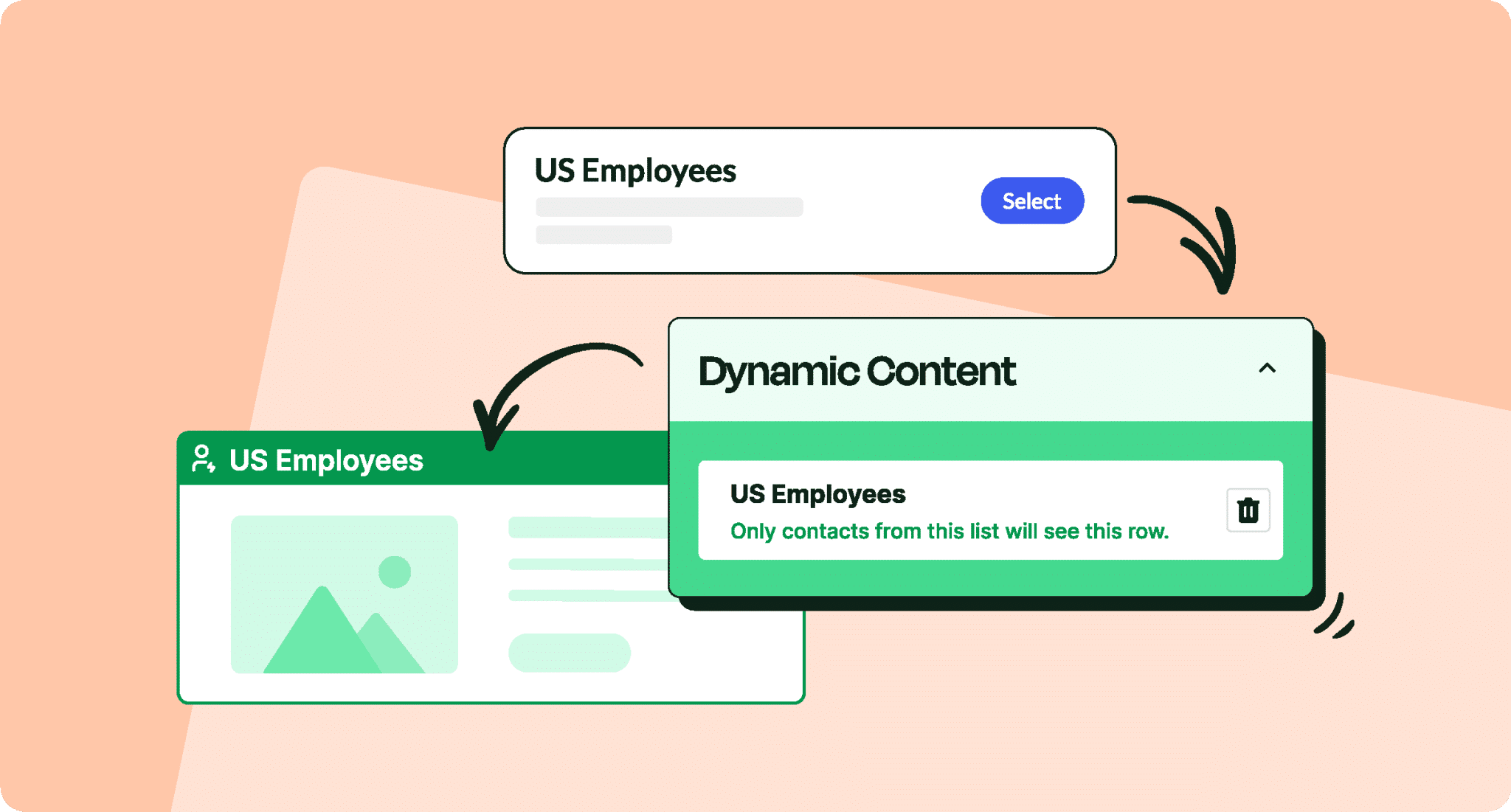
Pages lets you publish trackable web content without an intranet, an IT team, or a SharePoint project. You build the page in the same editor you already use for email, embed a link directly in your send, and get full web analytics connected to your email analytics rather than sitting separately.
When a customer asked how Pages differs from linking to SharePoint, Ryan answered from experience: “I spent eight years working on SharePoint myself at Microsoft. Love the product. But it’s a complex beast, and a lot of customers have said they just want to throw up simple pages that are easily accessible.”
The Roadmap: On the Horizon
During our roadmap session, “Now” and “next” were confirmed as firm commitments on the roadmap. The “later” bucket is directional, subject to change as we learn. That’s not a promise or a commitment, but it gives you a way to look at what we’re thinking about, shape and influence it.
“Next” in the queue is Journeys, a native cadence-based sending capability for communicators who are looking to automate deployment based on events and more.
Further out, is the vision for AI-assisted draft creation that addresses one of the most time-consuming parts of the IC workflow directly:
“You might be in a tool like ChatGPT or Claude, connected to your SharePoint, your Notion, your OneDrive, and you can ask it, hey, I want to create a monthly newsletter. Those tools also know about ContactMonkey’s history. So take all that, assemble an email, push it into your email builder knowing how the templates are laid out, and you get the first draft that you can work with.”
On AI broadly, Ryan’s framing is the one we keep coming back to: “The success for us would be that you don’t even talk about it as AI. Much in the same way as today, if you scan a receipt, you don’t call that AI receipt scanning. You just scan a receipt and you know it’s automatically going into your expense system. AI is the helper here.”
We built the platform for the version of your job that actually exists, and we’re making sure it will serve you well into the future as your role evolves. If something here reflects a problem you are trying to solve, or a direction that does not match what your team needs, talk to your customer success manager. The roadmap is shaped by what you tell us, and that is how we decide what to build next.
If you’re not yet a customer and are interested in shaping the future of an internal communications platform that makes your life easier, book a demo to connect with one of our experts.