What’s the answer to fewer miscommunications, stronger collaboration, and a team that actually stays in the know? A clear, intentional internal communication plan. If you’ve ever had employees miss an important update, misinterpret leadership messages, or feel disconnected from what’s happening, this guide is your starting point to fix that.
Internal communications planning is not the most glamorous part of the job. But for most IC teams, it is the work that determines whether everything else holds together or falls apart. Every internal communicator knows the feeling. You send something important and have no idea whether it actually landed. Did anyone open it? Did the right people see it? Did managers pass it along? The unread message, the send mistake, the “did anyone actually see this?” are the anxieties that come with the job when there is no real plan behind the work.
This is the reality for a lot of internal communications teams. According to ContactMonkey’s 2026 Global State of Internal Communications (GSIC) report, 78% of IC professionals say content creation takes up the majority of their time, compared to just 36% focused on strategy. This comes down to planning rather than resourcing. The answer to all of those anxieties is the same. Getting the right message to the right audience at the right time through the right channel. That is what a strong internal communication plan makes possible. It defines your audiences, your key messages, your channels, your cadence, and how you will measure whether any of it is working. It turns reactive execution into something more deliberate and, frankly, more sustainable.
In this article, we will show you how to build an internal communication plan from the ground up, including a reusable internal communications plan template, a communication matrix, and real examples you might be able to relate to.
What Is An Internal Communications Plan?
An internal communication plan is the operational backbone of how your organization communicates with employees. It is the document that defines who your audiences are, what messages they need to receive, which channels will carry those messages, how often communications go out, and what success looks like. It is the connective tissue between your internal communication strategy and the actual work of reaching employees.
A good internal communication plan is built around your organization’s actual communication reality, the mix of desk-based and frontline employees, the leadership cadence, the compliance requirements, the moments that require organization-wide alignment, and the day-to-day operational updates that still need to reach the right people at the right time.
What is the difference between an internal communication plan, strategy, and campaign?
These three terms get used interchangeably, which creates real confusion about what IC teams are actually responsible for building. The table here breaks them out clearly so you can see the differences at a glance:
| What it is | When it happens | What you get | |
| Internal communication strategy | Sets the direction. Answers why your organization communicates the way it does, what outcomes you are working toward, and how communications connect to business goals | Long term, typically annual or multi-year | Strategic framework, guiding principles, priority outcomes |
| Internal communication plan | Translates the strategy into operational decisions. Defines audiences, messages, channels, cadence, owners, and metrics | Ongoing, typically quarterly or annual with regular updates | The plan document, editorial calendar, channel matrix |
| Campaign plan | Covers a specific initiative with a defined start and end point, open enrollment, a return-to-office rollout, a culture change effort | Short term, initiative-specific | Campaign brief, timeline, content assets, post-campaign measurement |
The practical implication is that a lot of teams try to build a plan when they actually need a strategy first. Others build a strategy and never get to the operational level where communication actually happens. Both leave IC teams stuck. The internal communications plan is where strategy meets execution.
Unlock Internal Comms Superpowers
Discover why 10,000+ rely on us. See the internal email and employee newsletter platform in action.
Book demo

What are the benefits of having an internal communication plan?
The benefits of an internal communication plan show up in ways you can measure and in how things feel day to day for your team.
- Alignment across stakeholders. When IC, HR, leadership, and department heads are all working from the same plan, the debates about channel selection, message ownership, and send timing happen once at the planning stage rather than every time a new request lands in your queue. This is especially important in organizations where internal communications responsibility is distributed across multiple teams, which, according to GSIC 2026, describes the majority of organizations surveyed.
- Faster execution with less rework. The decisions that slow most IC teams down are not about writing quality. They are about who owns what, which channel is appropriate, and whether leadership has signed off. A plan makes those decisions in advance. GSIC 2026 found that 44% of IC teams had to resend or correct an internal email one to two times in the past year, and 27% did so three to five times. Most of that rework is preventable with clearer planning and approval workflows built in from the start.
- Stronger message reach and relevance. A plan forces audience segmentation decisions that most teams skip when they are in reactive mode. That segmentation matters more than most communicators realize. ContactMonkey’s 2026 Internal Email Benchmark Report found that organizations sending to 50 or fewer employees achieve an average open rate of 89%, compared to 73% for organizations with more than 10,000 employees. The difference is not list size alone. It is targeting, and targeting is a planning decision.
- Consistent employee experience. GSIC 2026 found that 56% of respondents say employees sometimes miss key updates, and 30% say it happens often or very often. Inconsistency is one of the primary causes. When communications go out on an ad hoc basis, important updates compete with noise and get lost. A plan establishes a predictable cadence that employees learn to expect and trust.
- A measurement baseline you can actually use. Without a plan, there is nothing consistent to measure against. A plan creates the conditions for real performance tracking because you know what went out, to whom, through which channel, and when. That data is what allows you to demonstrate the impact of internal communications to leadership, which according to GSIC 2026, nearly 50% of IC professionals say is difficult to do.
How To Create an Internal Communication Plan in 7 Steps
Most IC teams know what they need to communicate. What is harder to pin down is the operational layer underneath it. Things like who owns which messages? Which channels are doing real work versus just adding noise? How often do different audiences actually need to hear from you? How will you know any of it is landing?
Those questions do not have to be answered from scratch every quarter. A good internal communication plan answers these questions upfront, so your team can focus on delivering messages that are relevant, timely, and tailored to each audience.
Each step below produces a tangible component of your finished plan, from an audience map and channel matrix to an approval workflow and measurement system. By the time you reach step seven, you will have a complete internal communication planning framework. Work through the steps in order, because the decisions you make early, particularly around audiences and objectives, will shape every channel and cadence decision that follows.
Step 1: Audit your current internal comms before you plan anything new
Before building anything new, you need an honest picture of what is actually happening. Most IC teams are surprised by what a proper audit surfaces. You’ll start to notice things like channels that no one really needs anymore, messages going to the wrong audiences, approval steps that aren’t clearly defined, and groups of employees who aren’t being reached consistently.
The audit is also where you start to answer the channel question honestly. Which channels are actually reaching employees? Which ones leave you questioning, “did anyone see this?” That answer shapes everything that follows.
A good internal communications audit covers four things:
- Map out every active channel your organization is using, internal email, intranet, digital signage, SMS, team meetings, manager cascades, and anything else that carries official communications.
- Look at who owns each channel, how often it is used, and whether it has any performance data attached to it.
- Identify duplication, places where the same message is going out across multiple channels without a clear reason.
- Identify which audiences are undercommunicated to, which topics fall through the cracks, and which moments in the employee lifecycle currently have no communications attached to them.
For frontline and deskless employees especially, this step tends to reveal the most. In most cases, missed updates are a reach and channel problem that only becomes visible when you audit what you actually have. This audit becomes your baseline. It shows you what is working, what is redundant, and where to focus first, and it gives you something concrete to bring into the planning conversations with leadership and stakeholders.
Step 2: Define your objectives and what success actually looks like
This is the step most teams rush, and it’s the one that determines whether your internal communication plan stays connected to the business or just turns into a list of things to send. Start by stepping back from the communications calendar entirely and asking the bigger questions:
- What are the organization’s key business priorities for the year?
- What cultural or behavioral changes are on the horizon?
- Where is leadership alignment weakest?
- What employee experience problems are showing up in survey data or exit interviews?
Your internal communication strategy should be working in service of those priorities. Once you have that context, define your objectives at two levels:
- Strategic objectives cover the outcomes your communications are designed to influence, improving employee engagement, building trust in leadership messaging, or supporting a major change initiative.
- Operational objectives are the measurable targets that tell you whether you are making progress. Open rates, read rates, survey participation, manager cascade completion, or behavior change metrics tied to specific initiatives.
A useful discipline here is to make each objective Specific, Measurable, Achievable, Relevant, and Time-bound, a framework commonly known as SMART objectives. In practice, this means writing objectives that name a concrete outcome, attach a number or threshold to it, and give it a deadline. “Improve employee engagement” is a direction. “Increase internal newsletter open rates to 65% by Q3” is an objective you can actually track and report against.
Step 3: Segment your audiences by role, location, and access
Audience segmentation is where a lot of internal communication plans start to miss the mark. It is easy to default to organization-wide sends because they feel efficient, but a message written for everyone tends to land with no one. As internal communications leader Alyssa Towns noted in ContactMonkey’s top employee engagement trends in the workplace 2026, employee expectations have shifted considerably. People are navigating more information than ever before, both inside and outside of work, and organization-wide communications simply do not cut through the way they once did.
The practical starting point is mapping out your core audience segments before you assign a single message or channel. The most useful ways to think about segmentation are:
- Role and function, because what a frontline worker needs to know about a policy change is fundamentally different from what a people manager needs to communicate to their team about it.
- Location and timezone, particularly relevant for global or distributed organizations where send timing and channel access vary significantly.
- Work environment, desk-based employees, remote employees, and frontline or deskless workers have different levels of access to internal communications platforms and different habits around when and how they consume information.
- Language, in multilingual workforces, segmentation by language is not a nice-to-have. It is a basic condition for whether communications reach people meaningfully.
- Tenure and familiarity, a new hire and a ten-year employee need different context around the same message.
The segmentation work you do here will directly inform your channel decisions in step five and your message framework in step four. A frontline employee who does not have regular access to email needs a different channel than a desk-based employee who lives in Outlook. A regional team navigating a local policy change needs a different context than a global all-staff audience receiving the same core update.
It is also worth thinking about segmentation as a core employee engagement practice in 2026. It shapes whether people pay attention at all. When employees consistently receive communications that don’t feel relevant to their role and situation, they stop paying attention. Once your segments are defined, document them in your plan with enough detail that anyone on the team, or a new hire six months from now, can understand who each segment is, what their communication needs are, and what constraints exist around reaching them.
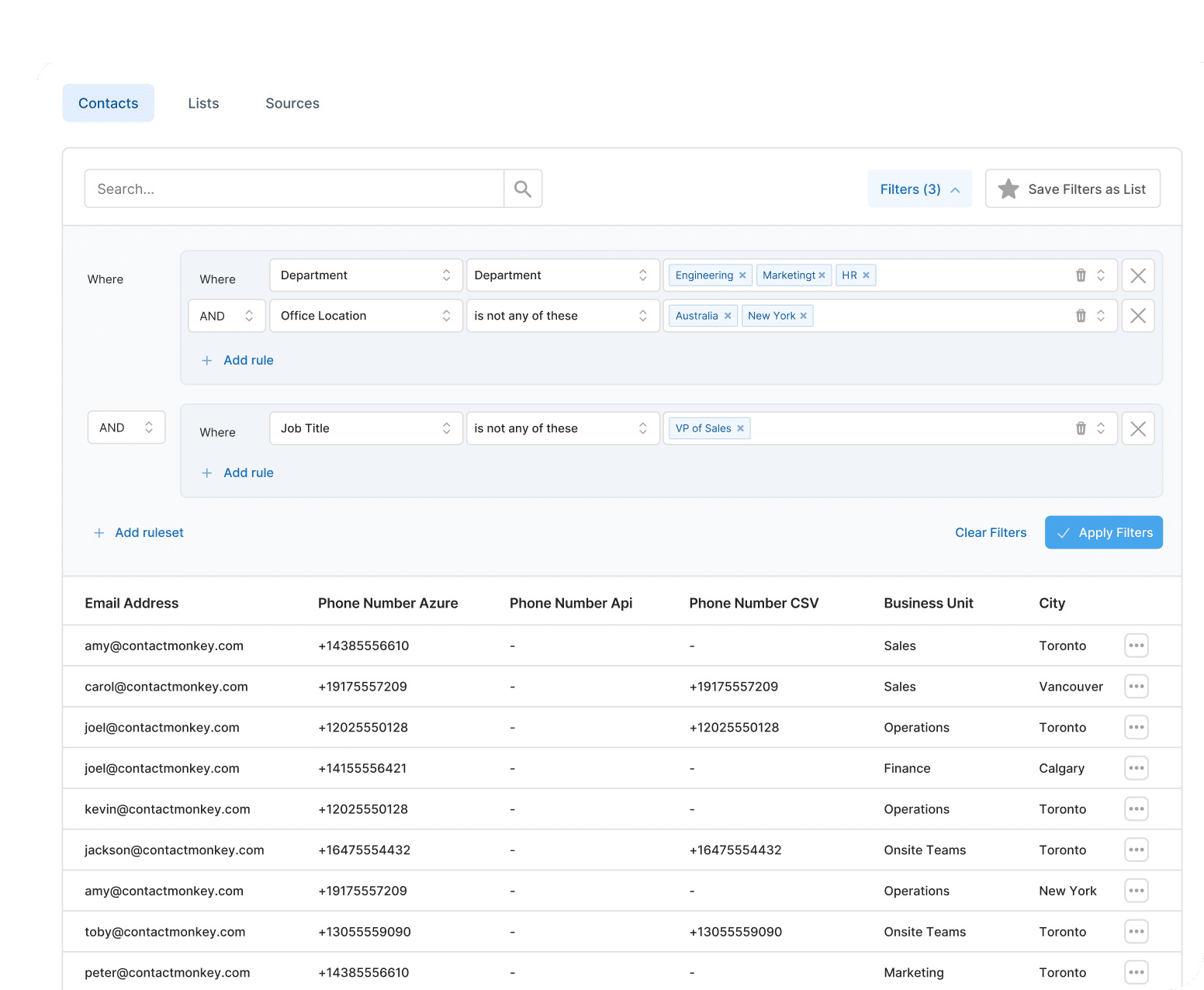
Getting the right message to the right audience starts here. ContactMonkey’s audience segmentation feature helps IC teams target employees based on real organizational data, making it easier to keep communications accurate and relevant as things change. Our upcoming Audience Preview feature will have different AI personas that stimulate how your different audiences would react to an email, so you can validate your tone, relevance and CTAs before sending anything out. For teams managing multiple audience segments across hybrid and frontline workforces, that kind of infrastructure makes the difference between segmentation as a principle and segmentation as a practice.

Step 4: Define your key messages and narrative pillars
Most IC teams think about messages at the campaign level, what needs to go out this week, what leadership needs to announce before Friday. That is necessary work, but it is not a message framework, and without one, internal communication planning stays reactive even when a calendar exists.
Narrative pillars are the 2-4 overarching themes that your communications will consistently reinforce throughout the year. Your pillars should come directly from your strategic objectives. They give individual messages a through-line and keep your communications connected to the business goals you defined in step two. Common examples include themes like:
- Organizational transparency
- Leadership visibility
- Operational clarity
- Employee recognition
Once your pillars are in place, the next layer is mapping your key messages to the moments that matter. Start with what you already know is coming: major business announcements, leadership communications, policy or operational changes, cultural initiatives, and the recurring moments in the employee lifecycle that require consistent messaging year over year. When you map those moments out on a calendar, it becomes pretty obvious where things are piling up, where employees might feel overloaded, and where important moments are missing communication altogether.
For each key message, be deliberate about three things:
- What do employees need to know?
- What do you need them to do as a result?
- And how should they feel after receiving it?
Getting the message right before it goes out is one of the most important things an IC team can do. ContactMonkey’s AI email builder, CoAuthor, helps you generate first drafts from a simple prompt, while ConfidenceCheck is the AI editorial assistant that reviews your email before send, catching broken links, accessibility issues, tone inconsistencies, and errors that manual review tends to miss. When used together, they provide the second pair of eyes you need before any email reaches employees.
Step 5: Choose your channels based on function, not familiarity
If you have been in an IC role for any amount of time, you know how channel decisions usually get made. Someone senior prefers Slack, so Slack becomes official. The intranet gets relaunched with good intentions and quietly abandoned six months later. Email gets used for everything because it is always there. Before long, you have five channels, unclear ownership across all of them, and employees who have no idea which one actually matters.
The better approach is to give each channel a specific job and stick to it. Email is not the same as an intranet post, which is not the same as a manager cascade, which is not the same as a digital signage update. Each one carries a different level of attention and suits a different type of message. When everything goes through every channel, employees stop being able to tell what actually requires their attention.
Internal email remains the most reliable channel for reaching employees at volume. ContactMonkey’s 2026 Internal Email Benchmark Report, drawn from more than 255,000 internal email campaigns across 20 industries, found an average open rate of 76%. No other internal communications channel comes close to that level of consistent reach. That said, email works best for important updates, leadership communications, and anything that requires a record or a specific action. Using it for everything trains people to tune it out, which defeats the purpose entirely.
A practical way to think about your channel plan is to match the message type to the right vehicle:
- Organization-wide updates that need broad reach and a clear record, internal email or all-hands meetings.
- Leadership communications that need to feel direct and personal, a message from leadership followed up through manager conversations.
- Operational updates that require employees to take action, internal email with embedded pulse surveys or acknowledgment tracking built in.
- Culture and engagement content that invites participation, channels that allow two-way interaction like pulse surveys or team discussions.
- Frontline and deskless employees who are rarely at a desk, SMS, digital signage, or mobile-first internal communications platforms.
Every channel in your plan also needs a named owner and a clear send cadence. Without that, channels multiply, nobody knows who is responsible for what, and employees start receiving inconsistent messages with no sense of which one to trust.
Effective internal comms depends on meeting employees where they already are. This means choosing channels that your employees already use instead of the one that is most convenient. ContactMonkey supports this by delivering messages through Outlook, SMS, Teams, and SharePoint, so communications reach people in the channels they use every day. With HRIS integrations across 80+ providers, your comms also stay aligned as your workforce evolves.
Step 6: Build your action plan with owners, workflows, and approvals
A communications plan without an action plan is just a strategy document. This step is where you turn everything you have built in steps one through five into something your team can actually execute against week to week.
The action plan answers 3 questions that most IC teams leave unresolved until something goes wrong:
- Who owns each communication?
- What does the workflow look like from brief to send?
- And who needs to approve what before anything goes out?
Start with ownership. Every communication in your plan should have a named person responsible for it, not a team, not a department, a person. Shared ownership is how deadlines get missed and sends get delayed.
Next, document your workflow. A standard internal communications workflow moves through four stages: intake, drafting, review and approval, and send. Before any piece of content enters that workflow, it helps to start with a brief. Internal communications leader Alyssa Towns, who has worked with IC teams across a range of organizations, makes the case for why in her guide to the internal communications brief. A brief captures the objective, audience, key messages, channel, and deadline for a given communication before anyone starts writing. It is a small step that eliminates a significant amount of back-and-forth later, particularly when multiple stakeholders are involved in the review process.
Approval workflows deserve particular attention. Defining who has final sign-off on different content types, a routine newsletter versus a sensitive leadership announcement, will save your team more time than almost any other planning decision you make. Without that clarity, approvals become the bottleneck that holds up every send.
Step 7: Set your metrics and commit to a reporting cadence
At some point, someone in leadership is going to ask you to prove that your internal communications are working. It is one of the most common pressure points for IC teams, and according to GSIC 2026, nearly 50% of IC professionals say demonstrating the ROI of internal communications in their organization is difficult. It usually comes down to measurement not being built into the plan from the start, which makes the impact much harder to show later on.
Start with the metrics that map directly to the objectives you set in step two. If your goal was to employee engagement strategy with leadership communications, your metrics should include open rates, read times, and click rates on leadership sends. If your goal was to drive action on a specific initiative, track completion rates, survey responses, or policy acknowledgments. Chasing every available metric is a fast way to produce reports that nobody reads. Fewer metrics tied clearly to your objectives will always tell a more useful story.
A practical internal communication plan measurement framework covers four areas:
- Reach, are your communications actually getting to the people they are intended for, across all audience segments including frontline employees.
- Engagement, are employees opening, reading, and clicking through, and how does that vary by segment, channel, and content type.
- Comprehension and action, are employees doing what the communication asked them to do, whether that is completing a form, attending an event, or acknowledging a policy.
- Sentiment, are people responding positively, and are there patterns in employee feedback that point to specific improvements you need to make.
On reporting cadence, a monthly performance review covering channel metrics and a quarterly strategy review that evaluates progress against your objectives is a sustainable rhythm for most IC teams. The monthly review keeps you close to what is working. The quarterly review is where you make decisions about what to change.
If you want a concrete starting point for understanding the business value of your internal communications work, ContactMonkey’s ROI Calculator lets you calculate exactly how much time and money your team could save, and compare your results against ContactMonkey’s own benchmark data. It is a useful tool for grounding leadership conversations in numbers rather than narratives.
How much is low employee engagement costing you?
Tally it up with ContactMonkey’s ROI calculator.
Calculate now

How Do You Write an Internal Communication Plan? Start With This Template
A good internal communication plan template does not need to be complicated. The goal is a working document that your team actually uses day to day. The one-page version below is designed for teams that need something they can pick up and run with quickly, while the expanded version gives you more room to document the details behind each component.
One-page internal communication plan template
| Field | Your Response |
| Organization/Team | |
| Plan period | |
| Plan owner | |
| Situation summary | What is the current state of internal communications in your organization? What is working, what is not, and what has prompted this plan? |
| Goals and objectives | What are you trying to achieve? List two to four strategic objectives tied to business priorities. |
| Audience segments | Who are your key audiences? List each segment and any relevant access or language considerations. |
| Key messages and narrative pillars | What are the two to four themes your communications will consistently reinforce this period? |
| Channels and cadence | Which channels will you use, what is the job of each one, and how often will you communicate through each? |
| Content types and initiatives | What recurring content will you produce, for example newsletters, leadership updates, pulse surveys, town halls, and what campaign activity is planned? |
| Owners and workflow | Who is responsible for each content type? What does the brief to send workflow look like? Who has approval authority? |
| Measurement and reporting | What metrics will you track? What is your reporting cadence? |
Expanded internal communication plan template for enterprise teams
For most IC teams, the one-page template above is enough to get started. Managing internal communications across a large, distributed, or multinational organization adds layers of complexity that a one-page template cannot fully capture. For enterprise internal communications teams managing larger workforces, multiple regions, or complex approval structures will need to go a layer deeper on a few key components.
On top of the core fields, consider documenting the following:
- Audience segment detail, for each segment include work environment, timezone, language considerations, channel access, and any known constraints around reaching them. Document each segment with enough detail that anyone on your team can work from it:
| Segment | Role and function | Work environment | Location and timezone | Language considerations | Primary channel access |
- Channel governance, beyond naming your channels, document the rules around each one. Who can post, what content belongs there, and what happens when something urgent needs to go out outside of the normal cadence.
| Channel | Job | Cadence | Owner | Governance notes |
| Internal email | ||||
| Intranet | ||||
| SMS | ||||
| Digital signage | ||||
| Manager cascade | ||||
| Other |
- Approval authority by content type, a routine newsletter and a sensitive leadership announcement should not go through the same approval process. Document who has final sign-off on each content type so the workflow is clear before a deadline is looming.
- Regional or multilingual considerations, if your workforce spans multiple countries or languages, note how key messages will be adapted, who is responsible for translations, and whether send timing needs to vary by region.
- Reporting recipients and cadence, document not just what you will measure, but who receives performance reports and how often, so measurement becomes a regular organizational habit rather than an ad hoc exercise.
The Internal Communication Plan Matrix (How to Put It Into Practice)
You have your plan. Now you need something your team can realistically work from day to day. That is what the internal communication plan matrix does. It takes everything you’ve mapped out and brings it into one place, so your team can see what’s going out, who it’s for, which channel it’s using, how often it’s happening, and who owns it.
Think of it as the operational layer of your plan. The plan tells you what you are trying to achieve, while the matrix tells you how you are running it week to week. Here is what a working matrix looks like:
| Audience segment | Message type | Channel | Cadence | Owner | KPI |
| All employees | Inform | Internal email | Weekly | IC Manager | Open rate, read time |
| People managers | Align | Manager cascade toolkit | Monthly | HR Business Partner | Cascade completion rate |
| Frontline employees | Action | SMS | As needed | Operations Lead | Acknowledgment rate |
| Leadership team | Change | Direct email from CEO | Quarterly | IC Director | Open rate, sentiment score |
| New hires | Inform | Internal email | Weekly for first 90 days | People team | Open rate, survey feedback |
The message type column is worth spending time on because it forces a decision most teams skip. Every communication falls into one of five categories: informing employees of something they need to know, aligning them around a strategic priority, driving a specific action, managing a crisis, or supporting a change initiative. Each type carries different expectations around tone, channel, urgency, and follow-up. When you name the message type upfront, the channel and cadence decisions almost make themselves.
Here are a few tips for making the matrix work:
- Keep it somewhere everyone can access and edit, because a matrix that lives in one person’s files will not help the rest of the team.
- Review it at the start of each month to confirm ownership, flag upcoming moments that need content, and adjust cadence if anything has changed organizationally.
- Use it when new requests come in. Being able to show a stakeholder where a new communication fits, or does not fit, in the existing matrix is one of the most effective ways to manage incoming requests without derailing everything else.
- Expect it to change. Your first matrix will not be perfect, and that is fine. The value is in having a starting point that your team can refine over time as you learn more about what resonates with each audience segment.
Internal Communication Plan Examples and Use Cases
Example 1: Company Internal Communication Annual Plan
This is the foundational internal communication annual plan that most IC teams need but rarely have documented in one place. It covers the full year across all audience segments, channels, and key moments.
Situation: A mid-sized organization with a mix of desk-based and frontline employees, a small IC team of three, and a history of reactive, ad hoc communications that have led to inconsistent messaging and low employee engagement scores.
Objectives:
- Increase internal email open rates to 70% by Q3
- Improve employee engagement scores by 10% year over year
- Establish a consistent leadership communication cadence by end of Q1
Audience segments: All employees, people managers, frontline workers, new hires
Narrative pillars: Organizational transparency, employee recognition, operational clarity
Key moments mapped across the year:
- Q1: Annual strategy announcement, benefits enrollment, new hire onboarding refresh
- Q2: Mid-year business update, manager enablement campaign, engagement survey launch
- Q3: Survey results communication, culture initiative launch, leadership town hall
- Q4: Year-end review, recognition campaign, planning communications for the year ahead
Channel plan:
- Weekly internal email newsletter to all employees
- Monthly leadership update email from the CEO
- Quarterly all-hands town hall
- Manager cascade toolkit for high-sensitivity topics
- Pulse surveys following major announcements
Measurement: Open rates, read times, survey participation rates, engagement score trends, reported quarterly to leadership
Example 2: CEO Internal Communication Plan
Leadership communication is one of the most requested and least structured areas of internal communications in most organizations. GSIC 2026 found that 40% of IC teams cite leadership communication as a top strategic priority, yet many are managing it reactively, drafting something whenever the CEO has something to say rather than building a consistent cadence employees can rely on. A CEO internal communication plan solves that by establishing a predictable rhythm of leadership visibility that builds trust over time.
Situation: A large organization where employees report low confidence in leadership transparency. The CEO communicates infrequently and only during major announcements, which has created a perception that leadership is out of touch with day-to-day employee experience.
Objectives:
- Establish a consistent and predictable leadership communication cadence within 60 days
- Improve trust in leadership messaging as measured by the next engagement survey
- Increase open rates on leadership communications to above the organizational average
Audience segments: All employees, people managers (who will cascade key messages to their teams)
Key messages: Strategic priorities, organizational values in action, recognition of employee contributions, honest updates during periods of change or uncertainty
Cadence and channel plan:
- Weekly: A short note from the CEO delivered via internal email, focused on one priority, one recognition, and one update. Kept under 300 words.
- Monthly: A longer leadership update covering business performance, people priorities, and what is coming next. Sent via internal email with an embedded pulse survey to collect employee sentiment.
- Quarterly: A town hall with a live Q&A component, followed by a recap email summarizing key themes and questions raised, including ones that could not be answered in the session.
Manager cascade: For sensitive or complex topics, the CEO communication is accompanied by a manager toolkit that includes talking points, anticipated employee questions, and guidance on how to hold team-level conversations.
Measurement: Open and read rates on all CEO communications, pulse survey sentiment scores, town hall attendance and participation rates, manager cascade completion rates
Example 3: Change Management Internal Communication Plan
A change management internal communication plan is one of the most high-stakes communications challenges an IC team will face. Whether the change is a restructuring, a technology rollout, a leadership transition, or a shift in business strategy, how you communicate it will directly shape how employees experience it.
GSIC 2026 found that change management ranks as the third highest strategic priority for IC teams in 2026, with 43% of respondents citing it as a key focus area. The organizations that handle change well are almost always the ones that planned their communications before the announcement went out, not after.
Situation: An organization is rolling out a new HR technology platform that will change how all employees submit time off, access pay information, and complete compliance training. The rollout affects all 4,000 employees across desk-based and frontline populations.
Objectives:
- Ensure 100% of employees are aware of the change and what it means for them before go-live
- Drive platform adoption to 80% within 60 days of launch
- Minimize confusion and support ticket volume by proactively addressing common questions
Audience segments: All employees segmented by role (desk-based vs. frontline), people managers who will support their teams through the transition, and HR and IT teams who need early and detailed information
Communication phases:
| Phase | Timing | Key actions |
| Pre-change | Six to eight weeks before go-live | Announce the change with a clear explanation of why it is happening. Brief managers before the all-employee announcement goes out. Publish and maintain a live FAQ document. Run a pulse survey to capture early concerns. |
| During the change | Go-live through first 30 days | Send role-specific guidance via internal email segmented by audience. Use SMS and digital signage for frontline employees. Hold drop-in Q&A sessions. Send weekly progress updates showing adoption milestones. |
| Post-change | 30 to 60 days after go-live | Share a recap communication acknowledging what went well. Communicate adjustments made as a result of employee feedback. Run a final pulse survey to measure sentiment and capture outstanding issues. |
Measurement: Email open and read rates by segment, platform adoption rates at 30 and 60 days, support ticket volume, pulse survey sentiment scores before and after go-live
Metrics That Prove Your Internal Communication Plan Is Working
Let’s be real. Leadership is not reading your communications calendar, they are looking at results. Whether your internal communication plan is working comes down to whether you can show that employees are informed, aligned, and taking action, and whether you can back that up with numbers. The table below gives you a practical set of internal communication KPI examples by channel to start tracking.
| Channel | KPIs to track |
| Internal email | Open rate, read time, click rate, click-to-open rate, unsubscribe rate |
| Pulse surveys | Response rate, sentiment score, question-level engagement |
| Intranet | Page views, unique visitors, time on page, search terms used |
| Town halls and events | Attendance rate, live question volume, post-event survey score |
| Manager cascade | Cascade completion rate, team-level acknowledgment, manager confidence score |
| SMS and digital signage | Delivery rate, acknowledgment rate for action-required messages |
For measuring internal communication effectiveness over time, benchmark your results against your own historical data first, then against industry averages. ContactMonkey’s 2026 Internal Email Benchmark Report, drawn from more than 255,000 internal email campaigns across 20 industries, gives you a concrete picture of what strong performance looks like across open rates, read times, click rates, and more by industry and company size.
Download the full report to see how your numbers compare.
2025 internal email benchmarks are in!
See where you stand. Download our report to measure your performance.
Get the guide

How To Choose the Right Internal Communications Platform for Your Plan
Building a strong internal communication plan is one thing. Executing it effectively is another. Without a dedicated internal communications platform, everything ends up scattered across tools, spreadsheets, and manual processes, with little visibility into what is actually reaching the right people. Ultimately, the anxiety most IC teams feel, the unread message, the send mistake, the “did anyone actually see this?”, usually comes down to a lack of visibility and control.
The right infrastructure helps bring consistency to your internal comms plan, so emails reach the people they’re meant for, at the right time, through the right channels. That is what ContactMonkey is built to support. When evaluating internal communication tools, here is what actually matters for plan execution:
Right message: Make sure every send is ready before it goes out
The message is where everything starts. A communication that goes out with the wrong tone, a broken link, or content that does not match the audience it is reaching is worse than no communication at all. ContactMonkey’s CoAuthor helps IC teams generate first email drafts from a simple prompt you enter, while ConfidenceCheck reviews content before send, catching broken links, accessibility issues, tone inconsistencies, and any other errors you might miss at first glance. When you use both AI features together, you’re essentially covering the full lifecycle of an internal email. It also brings more consistency to your workflow, helping you move faster and reduce the risk of avoidable mistakes that we’ve all experienced.

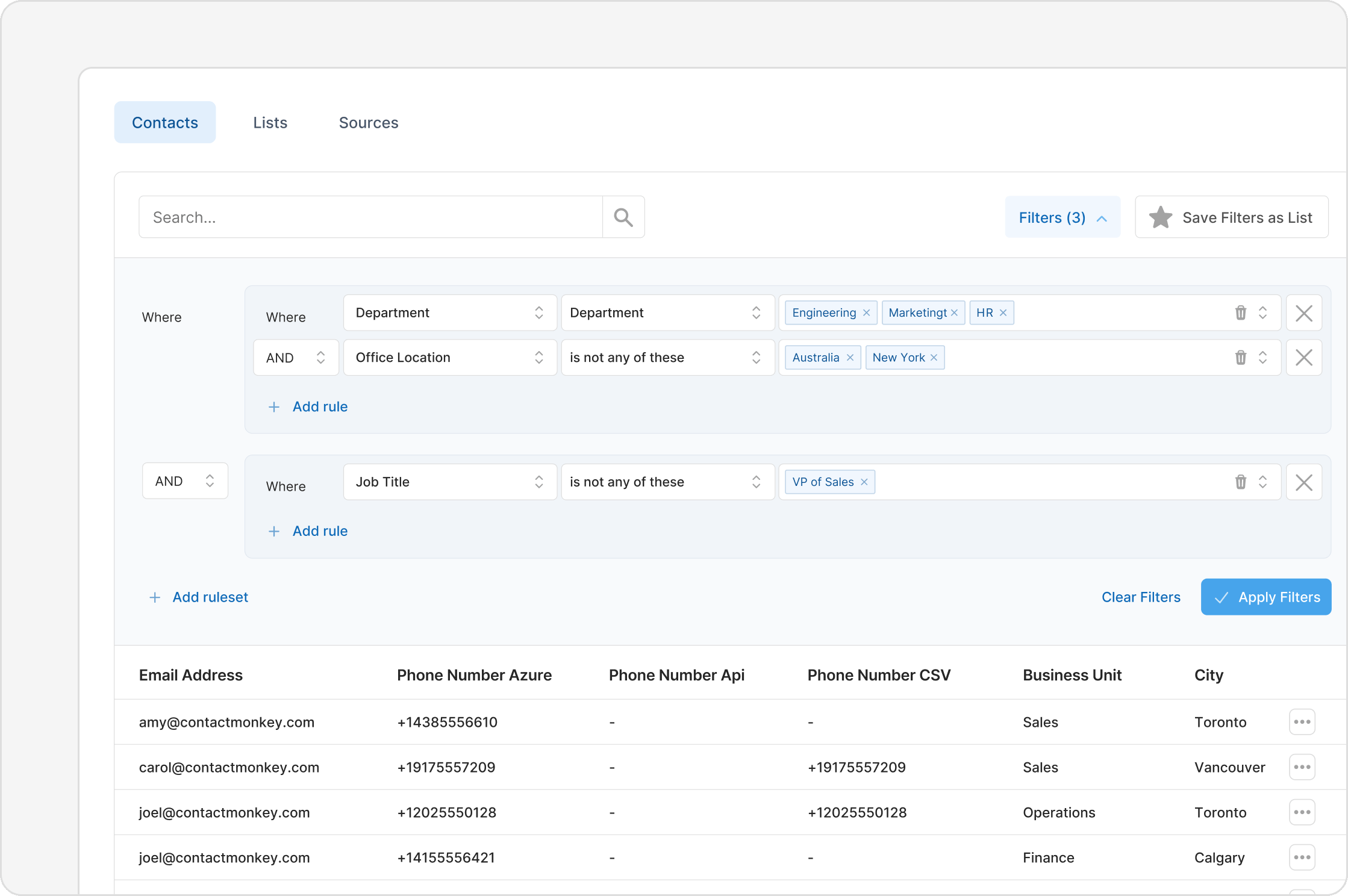
Right audience: Target the people who need to hear it
Your plan is built around specific audience segments. Your platform needs to send to those segments without having to manually rebuild distribution lists anytime something changes. ContactMonkey’s audience segmentation lets you target employees based on real organizational data, by department, location, role, or any combination. Audience Preview goes a step further, letting you pressure-test how a message will land with a specific audience before it goes out, so you can adjust what you need to before sending. Remember, sending the same message to everyone quickly makes people tune out. That’s why you need an internal communications platform that allows you to tailor content based on who it’s actually for.
Right time: Let analytics inform when you send
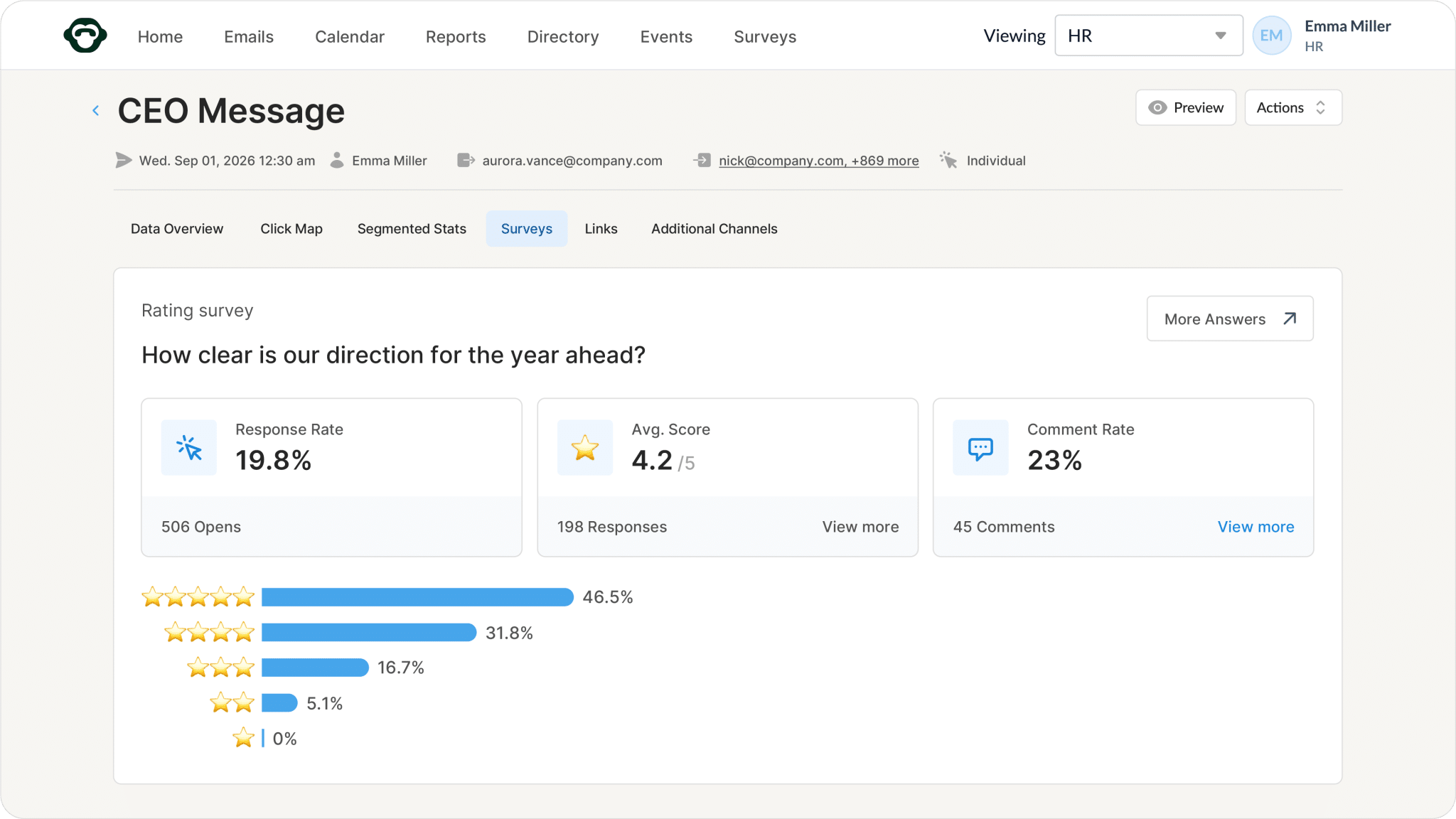
Open rates, read times, click rates, and department-level breakdowns are what allow you to measure your plan against the objectives you set. Without that data, it’s difficult to know when your messages are actually being seen or acted on, which makes decisions like send timing harder to get right. ContactMonkey’s internal communication analytics give you a real-time view of how every send is performing down to the segment level, so you always know what is working and what needs to change.

Right channel: Reach employees where they actually are
Choosing the right channel starts with understanding how your employees already consume information. ContactMonkey supports that by delivering internal email newsletters through Outlook, alongside channels like SMS, Teams, and SharePoint, so messages reach employees in the tools they already use.
Within internal email newsletters, features like embedded pulse surveys, emoji reactions, and eNPS make it easier for employees to respond directly in their inbox, helping you capture sentiment without adding extra steps. For enterprise communications teams managing large, dispersed workforces, SMS adds another layer of reach, helping ensure frontline employees are included alongside your broader newsletter program.
Build Your Internal Communication Plan With ContactMonkey
Building a working internal communication plan is an ongoing process that you continuously build, test, and refine as your organization changes, your audiences grow, and your measurement shows what is and isn’t landing. The IC teams that stay ahead are the ones that treat their plan as a living part of how they work, not a document they revisit once a year when someone asks what the communications strategy is.
That is exactly what ContactMonkey is built to support. From building and sending internal email newsletters to tracking engagement by audience segment, collecting employee feedback in real time, and reporting results to leadership, ContactMonkey gives IC teams the infrastructure to execute their plan without the back-and-forth that comes with managing it across disconnected tools. Whether you are a one-person team building your first internal communication plan or an enterprise communications function managing thousands of employees across multiple regions, ContactMonkey grows with you.
Want help getting started? Book a demo today to see how ContactMonkey can turn your internal communication strategy into measurable results.