ContactMonkey’s Global State of Internal Communications (GSIC) 2026 Report revealed a truth far too many employees experience: while feedback collection across today’s organizations is widespread, follow-through is far less consistent. 47% of respondents said post-feedback actions are communicated sometimes, while 31% reported inconsistent or delayed follow-up, suggesting a gap in closing the feedback loop.
While annual employee engagement survey feedback often requires significant time and resources to close the feedback loop, employee pulse surveys are an underrated tool for moving to action quickly after gathering feedback.
We put together 10 types of pulse surveys across different scenarios and outlined the survey’s purpose, audience, potential questions, and examples of what you can do with real employee feedback. By the time you reach the end of the guide, you’ll have everything you need to launch or improve your employee pulse survey program and achieve better feedback loop-closing results.
What is a Pulse Survey?
A pulse survey is a short, recurring employee feedback tool (typically 5 to 15 questions) that gives HR and internal communications teams a near-real-time read on employee sentiment, engagement, or a specific organizational event, without the time and resource commitment of a full annual engagement survey.
If you’re looking for a deeper bank of questions to draw from, our Guide to Employee Pulse Survey Questions for Internal Communication Professionals covers the full range by survey type and theme.
6 Pulse Survey Best Practices for Actionable Data
A well-designed pulse survey should do one thing exceptionally well: give you data specific enough to act on quickly. These employee survey best practices will help you turn employee pulse survey feedback into action:
1. Anchor every pulse survey to one theme
Before jumping into pulse survey questions and specifics, define what your pulse survey will inform. Are you trying to understand whether a recent all-hands landed well so you can improve future leadership communications? Are you trying to gauge employee workload to improve scheduling? Are you trying to measure the adoption of a new internal tool to decide whether to invest in additional training or support?
No matter the case, limiting each pulse to a single theme is what makes the resulting data specific enough to act on. Define the theme you want more information about and design the pulse survey around it.
2. Keep it short: 5-15 questions, one consistent scale
Be respectful and mindful of how much time you are asking employees to give. Keeping pulse surveys around 5-15 questions that are easy to understand and answer is one of the best ways to encourage employee participation while balancing data quality needs.
Use a consistent scale with a clear definition across every rated question (a 1-5 scale works well for most organizations). Don’t deviate from the scale you choose, as consistency allows you to effectively map trends. Pair your scaled questions with one targeted open-ended follow-up that asks employees what’s driving the score and what would change it.
3. Make anonymity a deliberate, explicit choice
Decide upfront whether your pulse survey is anonymous, confidential, or attributed and communicate the decision plainly in every survey invitation, reminder, and within the survey itself. State your minimum group size threshold, and specify who can see the data and at what level. Perceived anonymity matters as much as technical anonymity. Employees need to believe their responses are fully anonymous, not just be told they are.
4. Segment carefully without de-anonymizing
Always segment results by department, location, tenure, and level, rather than taking organization-wide results at face value. Examining pulse survey results through various filters and lenses provides teams with an opportunity to identify areas requiring further attention that aggregated results sometimes miss.
An important note, though: Avoid segmenting results below your minimum respondent threshold, because combining too many filters can make individual responses identifiable even in an anonymous survey.
5. Close the loop within 2-3 weeks and commit to an action plan
Pulse surveys are short, so follow-up and analysis should happen quickly. Before you send your employee pulse survey, block a few hours on your calendar immediately following its closure for review and analysis. Publish a plain-language summary of what you heard within 1-2 weeks of the survey closing, including strengths and challenges. And don’t let the follow-up stop there. Share when employees should expect to hear a follow-up action plan and which channel(s) to use to find this information.
6. Track the right metrics on your pulse survey dashboard
Individual pulse survey data tells the story of the moment frozen in time, but trend lines outline the broader narrative and give context to individual datapoints, which could be outliers. When it comes to pulse surveys, four metrics are particularly valuable to include in your dashboard or tracking mechanisms. They are:
- Participation rate over time: The percentage of employees who completed the pulse survey, tracked across consecutive cycles
- Favorability scores: The percentage of respondents who selected a positive response, tracked across segments and cycles
- Open-ended comment themes: The recurring topics that surface across open-ended responses, tracked by frequency and consistency
- Sentiment: The overall emotional tone of employee responses, assessed across scaled ratings and open-ended comments

10 Employee Pulse Survey Examples, Questions & Actions
Below are 10 pulse survey examples you can incorporate into your employee listening toolbox today, with pulse survey example questions, and actions you can take following the assessment of your results.
Not every pulse survey type will be relevant to what your organization needs right now. Jump to the one that matches your most pressing internal communication challenge.
- Weekly pulse surveys for team temperature checks
- Quarterly pulse surveys for org-level temperature checks
- Employee engagement pulse surveys for engagement drivers
- Internal communication pulse surveys for clarity and channel effectiveness
- Leadership pulse surveys for gauging credibility and visibility
- Change management pulse surveys for monitoring adoption and readiness
- Return-to-work pulse surveys for hybrid transitions
- Employee well-being pulse surveys for burnout and energy management
- DEI pulse surveys for belonging and fairness
- New hire pulse surveys for onboarding experience feedback
Type 1: Weekly pulse surveys for a team temperature check
A weekly pulse survey is the lightest-touch, highest-frequency tool in the employee listening toolkit. Today’s organizations design weekly pulse surveys as structured check-ins that provide managers and team leads with a reliable signal on how people are doing right here, right now.
What this pulse survey is for: Monitoring week-to-week team morale, workload balance, and blockers so managers can make small, fast adjustments. Weekly pulse surveys work best for topics that facilitate quick action and intervention, such as clarifying priorities, resetting workload distribution, rotating on-call responsibilities, and unblocking workflows.
When and how to run it: Every Monday or Friday, depending on whether you want to capture incoming sentiment or end-of-week reflection. Keep these surveys short and easy to answer, no more than five questions total. Ideally, you can deploy the survey where your employees already are, such as directly inside an internal email.
Audience recommendations: Individual teams or departments. These also work well for startups with small teams and shared priorities. Remember, weekly pulse surveys are most valuable when they facilitate near-immediate action, so company-wide reporting isn’t always the best fit here.
5+ pulse survey question examples:
- How are you feeling heading into this week? (Emoji rating)
- My workload feels manageable right now. (1–5 scale)
- I have a clear sense of my priorities this week. (1–5 scale)
- I have what I need to do my job well today. (1–5 scale)
- Is there anything currently blocking your work that your manager can help address? (Open-ended)
Example results pattern (what you might learn): Three consecutive weeks of low scores on question four, combined with open-ended responses citing a slow internal system with unreasonable load times, signal an issue worth addressing.
Actionable next steps (owner + timeline): Using this information, you might work with an IT lead to address the system issue:
- Owner: IT lead, with contributing input from team managers
- Action: Four managers flag similar system access patterns to IT over 24 hours; IT commits to a resolution timeline within 72 hours and works with internal comms to send a follow-up
- Follow-up: Assess questions four and five, and consider adding a targeted follow-up question if negative feedback persists: “Has the IT issue affecting your work improved over the last week?” (1-5 scale)

Type 2: Quarterly pulse surveys for an org-level temperature check
Whereas weekly team surveys assess the team’s temperature, quarterly pulse surveys operate like organizational altitude checks. These surveys track whether the employee experience is trending in the right direction and are well-suited for assessing employee sentiment at the company level.
What this pulse survey is for: Tracking core engagement dimensions across the full organization between annual survey cycles, informing quarterly communications retrospectives, surfacing themes for leadership Q&A sessions, and identifying policy or process adjustments needed before the next annual survey.
When and how to run it: Ideally, you should run quarterly pulse surveys at the beginning of each quarter, within the first two weeks of the quarter. Running them early in the quarter provides IC and HR teams a chance to make adjustments, rather than assessing how employees felt in the past. While you might send the same survey to your entire organization, consider segmenting feedback to identify trending themes among similar groups.
Audience recommendations: Full organization. When pushing anonymous surveys, set anonymity thresholds to suppress results for small groups that might reveal individual identities.
5+ pulse survey question examples:
- I feel motivated to do my best work right now. (1–5 scale)
- I would recommend this organization as a great place to work. (1–5 scale)
- Senior leadership communicates openly and honestly with employees. (1–5 scale)
- I feel informed about the direction the organization is heading. (1–5 scale)
- I understand my priorities for the next three months. (1-5 scale)
- What’s one thing leadership could do differently this quarter to improve your experience? (Open-ended)
Example results pattern (what you might learn): Question three scores decline significantly over two consecutive quarters despite a significant increase in all-hands frequency. Open-ended responses suggest that more communication isn’t the issue; rather, the quality, transparency, or relevance of what’s being communicated is. Internal comms can now use this information to partner with senior leadership to improve.
Actionable next steps (owner + timeline): Using this information, IC can prepare an action plan for improving internal communication messaging and leadership talking points:
- Owner: Internal comms team and senior leadership
- Action: Use open-ended responses to identify the information gaps employees are flagging and build those themes into existing channels, including the internal newsletter, intranet, next leadership Q&A session, and upcoming all-hands. Across these channels, present a consistent “what we heard and what we are doing about it” format, emphasizing to employees that their feedback shaped internal communications.
- Follow-up: Incorporate a question about improved leadership communication in weekly pulse surveys (if relevant) to gauge immediate improvement. Otherwise, compare feedback across multiple consecutive quarterly pulse surveys going forward.
Type 3: Employee engagement pulse surveys for engagement drivers
Employee engagement pulse surveys operate like mini annual engagement surveys. Where other pulse types focus on operational conditions or specific initiatives, the engagement pulse survey goes broader, measuring the dimensions most consistently linked to discretionary effort, retention, and performance.
What this pulse survey is for: Monitoring fundamental drivers of employee engagement, including purpose, manager relationship, recognition, clarity, and growth, between annual survey cycles.
When and how to run it: Conduct employee engagement pulse surveys quarterly or once per year between annual engagement surveys. Don’t conduct them too frequently without enough time to address the results or take action; otherwise, employees may find them useless.
Audience recommendations: Full organization, with results segmented by department, manager, tenure, and level, where anonymity thresholds allow.
5+ pulse survey question examples:
- My daily work contributes to our organization’s success. (1–5 scale)
- My manager genuinely cares about my well-being. (1–5 scale)
- I know what my manager expects from me. (1–5 scale)
- I have received meaningful recognition for my work in the last month. (1–5 scale)
- I have opportunities to learn and grow in my current role. (1–5 scale)
- I feel proud to work for this organization. (1–5 scale)
- What’s one thing that would most improve your engagement at work right now? (Open-ended)
Example results pattern (what you might learn): When you cut results by tenure, employees with less than one year of employment score lower on question three, signalling that new hires lack clarity from their managers.
Actionable next steps (owner + timeline): Using this information, IC can work with HR and people managers to improve the new hire experience:
- Owner: People managers with support from IC and HR
- Action: HR briefs managers with direct reports who have been with the company for less than 12 months on the findings and equips them with a new 1:1 structure, asking them to clarify what’s clear, what’s unclear, and what else employees need to be successful this week. IC reviews employee feedback to identify areas where managers relay information inconsistently, then develops a weekly manager briefing newsletter with key updates and talking points.
- Follow-up: The next quarterly engagement pulse segments new hire scores as a separate standing demographic cut, tracking whether targeted manager interventions are closing the gap over the following two cycles.

Type 4: Internal communication pulse surveys for clarity and channel effectiveness
This is one of the best, most helpful pulse surveys for internal communicators (and their survey counterparts) to run. A communication pulse survey measures whether the messages employees receive are clear, relevant, trustworthy, and delivered through the right channels. It’s the internal comms team’s most direct feedback mechanism, turning what is often a gut-feel discipline into an evidence-based one.
What this pulse survey is for: Assessing how well internal communications are landing across the organization. Use it to ask whether employees feel informed, whether messaging is clear, which channels are most effective, and whether internal communications cadences work. The results should inform your internal communications strategy directly.
When and how to run it: Monthly or quarterly as a standing communications health check, and within 48 to 72 hours of any major communication event, such as a heated all-hands, after a significant announcement, or following a leadership transition message.
Audience recommendations: Full organization for broad channel effectiveness tracking. Targeted employee groups following announcements that were not shared with the full organization. Use segmentation to compare how well messages are landing across different departments, locations, and levels, since communication effectiveness often varies significantly between employee populations.
5+ pulse survey question examples:
- I feel well-informed about what’s happening across the organization. (1–5 scale)
- I receive clear communications from the leadership team. (1–5 scale)
- I hear about important changes through official channels, including all staff emails. (1–5 scale)
- The volume of internal communications I receive feels adequate. (1–5 scale)
- Internal communications are relevant to my role and day-to-day work. (1–5 scale)
- My manager does a good job of translating company updates into what they mean for our team. (1–5 scale)
- What’s one thing we could do to make our internal communications more useful to you? (Open-ended)
Example results pattern (what you might learn): Overall scores on question one are moderate and stable, but question four reveals that more than half of employees feel communication volume is excessive, while open-ended responses consistently reference receiving multiple emails covering the same topic from different senders.
Actionable next steps (owner + timeline): Using this information, IC can run a messaging audit to streamline sends and identify internal emails they don’t have oversight of:
- Owner: Internal communications team
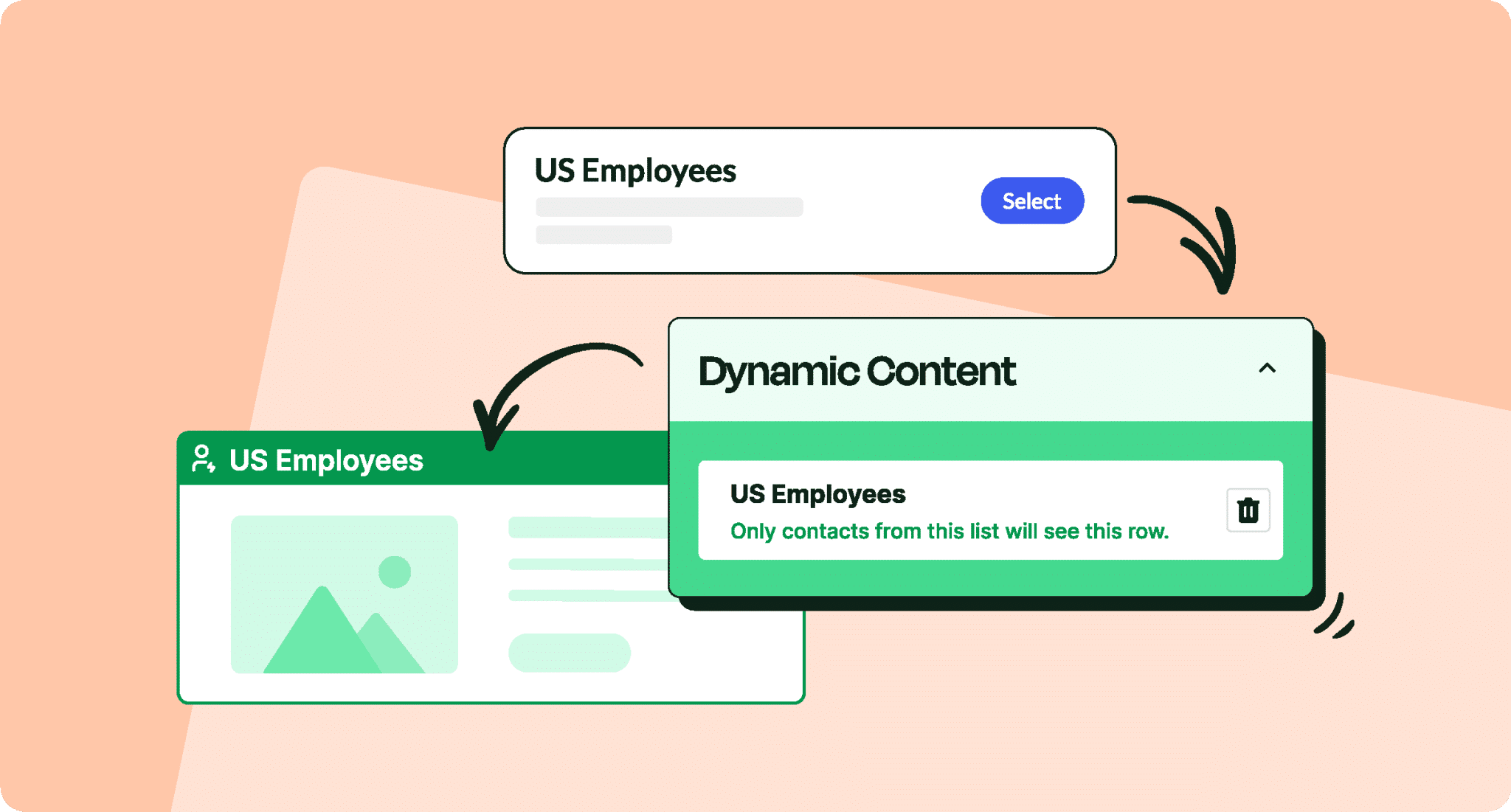
- Action: Conduct a full audit of all recurring internal sends, identifying overlapping content, redundant senders, and low-engagement emails that can be consolidated or cut; introduce a single weekly digest format with dynamic content blocks (tailored content sections for different audience segments) that replaces multiple standalone sends. Establish a centralized editorial calendar to prevent duplicate messaging across teams. Communicate the change to all employees, using their direct feedback to explain the rationale behind the update.
- Follow-up: In the following month’s communication pulse, measure whether consolidation has reduced perceived noise and improved relevance scores. Ask for open-ended feedback around how to improve the weekly digest to boost the channel’s credibility.
Type 5: Leadership pulse surveys for gauging credibility and visibility
A leadership pulse survey gives HR and internal communications teams a reliable, recurring read on how employees perceive senior leaders: Do they trust them? Do they view them as credible? Do they feel seen (or at least acknowledged) by senior leaders?
What this pulse survey is for: Measuring employee perceptions of leadership trust, transparency, decision-making credibility, and visibility, to identify whether gaps exist between how leaders believe they show up and how employees experience them.
When and how to run it: Quarterly as a standing leadership health check, and within one to two weeks following any significant leadership communication event, including a CEO transition. For organizations navigating a leadership transition or period of significant change, consider running a monthly CEO pulse survey to monitor trust levels in real time and course-correct communication strategies as needed.
Audience recommendations: Full organization, paying attention to gaps between tenured employees, as compounding experiences influence trust in leadership (or lack thereof) over time.
5+ pulse survey question examples:
- I trust that senior leaders make decisions in employees’ best interests. (1–5 scale)
- Senior leaders communicate openly, even when the news is difficult. (1–5 scale)
- When leadership makes a major decision, I understand the reasoning behind it. (1–5 scale)
- Senior leaders are visible and accessible. (1–5 scale)
- I feel confident in the direction senior leadership is taking the organization. (1–5 scale)
- How would you rate the overall quality of communication from senior leadership? (Star rating)
- What’s one thing senior leadership could do to build more trust with employees? (Open-ended)
Example results pattern (what you might learn): Scores on question four decline steadily over three consecutive quarterly pulses, dropping since the organization transitioned to a hybrid work model (unavailable to fully remote employees not near an office location). Open-ended responses reveal that fully remote employees feel significantly less connected to senior leaders than their in-office counterparts, describing leadership as “present for the people in the building and invisible to everyone else.”
Actionable next steps (owner + timeline): Using this information, internal comms can partner with the CEO and other C-Suite leaders to fill in communication gaps with remote employees:
- Owner: C-Suite, with support from the internal communications team
- Action: Within 30 days, the IC team introduces a monthly leadership communication touchpoint for remote employees, featuring a short, informal video message from the CEO addressing what’s on their mind, what decisions the C-Suite is making, and what they hear from remote employees. They also set up a monthly Q&A for remote employees. The IC team simultaneously audits all existing leadership visibility moments (town halls, walkthroughs, team visits) to assess whether remote employees have equitable access and adjusts formats accordingly.
- Follow-up: Next quarter’s leadership pulse segments visibility scores by remote and in-office groups to track whether the gap is closing and whether new leadership touchpoints are landing with remote workers.

Type 6: Change management pulse surveys for monitoring adoption, readiness, and behavioural adjustments
A change management pulse survey gives HR and internal communications teams a real-time read on how employees are understanding, accepting, and adapting to a specific organizational change, so interventions can be targeted and timely rather than reactive and too late. Conducting change management pulse surveys can be particularly beneficial for organizations that don’t have in-house change management expertise or access to external consultants to conduct change surveys for the organization.
What this pulse survey is for: Measuring employee readiness, adoption, and resistance throughout a change initiative, whether that’s a restructuring, a technology rollout, a policy shift, or a leadership transition. The results should directly inform targeted efforts, including the development of a manager toolkit (for cascading messages throughout the organization) and clarifying internal communications to address rumours.
When and how to run it: These surveys are most useful immediately after announcing a change, throughout the change process, and for sustained adoption long after the change. However, the value of change management pulse surveys lies in tailoring the questions to the different stages of the change process to achieve optimal results. Keep these surveys to 10 questions or fewer and conduct them for shorter periods (around a week) for real-time feedback.
Audience recommendations: The specific employee group(s) affected by the change, which could be your full organization or a smaller subset of employees. Segment survey results by department, role, and manager, to identify where to adjust and course-correct change efforts.
5+ pulse survey question examples:
- I understand why this change is happening
- I understand what this change means for my role. (1–5 scale)
- Leadership has been honest and transparent about this change. (1–5 scale)
- I have the information and tools I need to adapt to this change confidently. (1–5 scale)
- My manager has helped me understand how this change affects my day-to-day work. (1–5 scale)
- How would you rate the overall communication around this change so far? (Star rating)
- What’s one thing leadership could do right now to make this transition easier for you? (Open-ended)
Example results pattern (what you might learn): Two weeks into a major technology platform migration, question five scores vary significantly across teams. Some managers are actively supporting their teams through the transition, while others have communicated nothing beyond the initial announcement. The data reveals a communication gap between managers.
Actionable next steps (owner + timeline): Using this information, IC can partner with HR and any change management team members to improve manager communication:
- Owner: IC, HR business partners, and change leads
- Action: IC and HR launch a targeted manager toolkit for the lowest-scoring teams, including talking points, a simple FAQ, and a structured team-conversation guide that addresses the aspects of the change employees cited as most confusing. Additionally, IC sends an all-staff communication through multiple channels, directly addressing the most common misconceptions of the change surfaced in open-ended responses.
- Follow-up: Re-run the full change pulse, segmented by manager, to assess whether the targeted enablement has improved readiness and consistency scores across the affected departments.
Bonus mini-module: Post-acquisition pulse survey examples:
A post-acquisition pulse survey follows the same foundations as the change management pulse, but the stakes are higher, the emotional complexity is greater, and the questions need to reflect merger-and-acquisition anxieties: job security, cultural collision, and answering “Do I still have a place inside this new organization?” These tailored questions can help:
- I feel confident about my role and future following this acquisition. (1–5 scale)
- I feel respected and included as part of the combined organization. (1–5 scale)
- The values of the combined organization feel consistent with what I was told to expect. (1–5 scale)
- What’s your biggest unanswered question about the future of the organization? (Open-ended)
Type 7: Return-to-work pulse surveys for hybrid transitions
A return-to-work pulse survey gives organizations a direct, anonymous read on how employees are experiencing the transition: whether expectations are clear, the physical environment supports rather than hinders productivity, and managers consistently apply hybrid norms.
What this pulse survey is for: Measuring how employees are adapting to a return-to-office or hybrid work arrangements, focusing on clear expectations, proper workspace setups, and fair and consistent scheduling norms. An important thing to note about return-to-work pulse surveys is that they are only as effective as the questions you ask, meaning that asking questions about things you can adjust (e.g., rearranging desks for more privacy) is better than asking questions about things you cannot influence (e.g., an employee’s general lack of interest in returning to an in-office environment).
When and how to run it: Consider running these pulse surveys after announcing a return-to-work policy to gauge understanding and communication effectiveness. Then run a few consecutive surveys after the policy goes into effect, once employees have had enough time to adjust and can provide meaningful feedback. If you make changes based on employee feedback, run a follow-up pulse survey to assess whether the issues persist. Keep these pulse surveys to 6-8 questions and consider sending them via email so employees can complete them at a convenient time in their workday.
Audience recommendations: Full organization, segmented by work arrangement (remote, hybrid, and in-office), so results can be compared across groups.
5+ pulse survey question examples:
- I have a clear understanding of what’s expected of me regarding when and where I work. (1–5 scale)
- The office environment supports me in doing my best work when I’m on-site. (1–5 scale)
- I have the tools and technology I need to work effectively at home. (1–5 scale)
- My manager applies our hybrid work policy fairly and consistently. (1–5 scale)
- The commute and in-office requirements feel reasonable given the nature of my role. (1–5 scale)
Example results pattern (what you might learn): Survey results pinpoint scheduling differences across three teams. Focus groups following the pulse survey reveal that some managers are interpreting hybrid scheduling norms differently from others. Some offer full flexibility within the policy, others mandate specific days with no room for individual circumstances. Employees are frustrated by inconsistent policy enforcement.
Actionable next steps (owner + timeline): Using this information, HR can partner with people managers to implement more consistent practices, with the support of IC:
- Owner: HR business partners and people managers, light IC support
- Action: HR partners with IC to publish a plain-language hybrid work expectations guide clarifying what the policy requires, what flexibility exists within it, and how managers should make scheduling decisions. The internal comms team develops a running FAQ guide on hybrid work policy for managers and publishes updates bi-weekly. They send an internal managers-only email highlighting updates as they roll them out.
- Follow-up: Conduct the pulse survey again 4-6 weeks after implementing these changes to assess whether consistency improved, and flag any teams where scores remain significantly below the organization’s average for targeted HR business partner support.
Type 8: Employee well-being pulse surveys for burnout and energy management
In recent years, employee well-being has moved from a peripheral HR concern to a high business priority, backed by data suggesting that it must become a focus for senior leaders. According to Gallup’s 2024 State of the Global Workplace Report, one in five employees reported experiencing loneliness a lot the previous day, a figure with significant implications for mental health, productivity, and retention. A wellbeing pulse survey gives HR and internal communications teams an early, anonymous signal of how employees are really doing (when they feel they can respond honestly).
What this pulse survey is for: Monitoring employee energy levels, stress, workload sustainability, and sense of connection regularly. The survey aims to identify early warning signs of burnout, mental health strain, and loneliness before the organization as a whole begins to feel a significant impact. The results should directly inform workload interventions, Employee Assistance Program (EAP) promotion, structured manager check-in practices, and protected focus time policies that give employees time to complete their work.
When and how to run it: A monthly cadence usually works well for a wellbeing pulse survey; however, consider a higher frequency during particularly stressful periods or events that might lead to burnout, such as during the busiest workload season for your industry. Keep it to 6-8 questions, and use conversational language. Use an emoji reaction format for a low-friction way for employees to express how they’re feeling without having to translate nuanced emotional states into a numerical scale.
Audience recommendations: Full organization, with results segmented by department, level, and work arrangement. Manager-level segmentation is particularly valuable here, as team-level wellbeing variance often points directly to specific management practices or workload distribution issues that a manager can address quickly.
5+ pulse survey question examples:
- How are you feeling overall this week? (Emoji rating)
- I can manage my workload within working hours most of the time. (1–5 scale)
- I feel energized and able to bring my best to work most days. (1–5 scale)
- I feel comfortable talking to my manager if I’m struggling with my workload. (1–5 scale)
- I feel a genuine sense of connection with my colleagues. (1–5 scale)
- I am aware of the well-being resources and support available to me through this organization. (1–5 scale)
- Is there anything specific affecting your well-being right now that you’d like us to know about? (Open-ended)
Example results pattern (what you might learn): Emoji ratings and energy scores decline sharply near year-end across two consecutive monthly pulses, with the steepest drops concentrated in the customer-facing and operations departments. Open-ended responses reveal that employees don’t feel they have permission to protect personal time during peak periods, describing an unspoken expectation to be available outside working hours. Employees whose managers actively model boundary-setting score significantly higher on energy and sustainability than those whose managers are visibly working around the clock and implicitly expecting the same from their teams.
Actionable next steps (owner + timeline): Using this information, HR partners with people managers to implement more consistent work-life balance and boundary-demonstration practices:
- Owner: HR business partners, internal comms, and people managers
- Action: HR partners with internal comms to equip managers with specific language and guidance for normalizing boundaries with their teams. This includes modelling the behaviour themselves by visibly logging off on time, not sending non-urgent messages outside working hours, and proactively telling newer team members that sustainable work habits are an expectation. The internal comms team prepares speaking points that managers can reference in their meetings and communications. Additionally, IC works with senior leadership to address the always-available culture directly in the next all-hands, naming it honestly and setting a clear organizational expectation that recovery time is non-negotiable.
- Follow-up: After the all-hands and team clarifications, give managers time to lead by example. Run the same pulse survey questions to assess a shift in scores.

Type 9: Diversity, equity, and inclusion (DEI) pulse surveys for belonging and fairness
A DEI pulse survey measures gaps in how different employee groups experience fairness, belonging, and opportunity within the same organization. They examine whether DEI initiatives go beyond written policies and appear in real-life behaviours.
What this pulse survey is for: Measuring how employees across different demographic groups experience inclusion, psychological safety, fairness in decision-making, and access to opportunity, and identifying where gaps exist that require targeted action around inclusive leadership training, promotion transparency, employee resource group (ERG) support, and policy review.
When and how to run it: A biannual cadence works well, and a more frequent cadence can be helpful after implementing new or changed DEI initiatives. Clearly explain any demographic questions and the data, and be explicit about anonymity. Run the survey over a one or two-week period, depending on your organization’s structure.
Audience recommendations: Full organization. The value of this survey lies entirely in the segmentation.
5+ pulse survey question examples:
- I belong at this organization. (1–5 scale)
- People of all backgrounds have equal opportunity to succeed here. (1–5 scale)
- I feel comfortable bringing my whole self to work. (1–5 scale)
- Promotions and advancement decisions at this organization feel fair and transparent. (1–5 scale)
- My contributions are valued equally to those of my colleagues. (1–5 scale)
- I feel represented and supported by this organization’s leadership. (1–5 scale)
- What’s one thing this organization could do to feel more inclusive? (Open-ended)
Example results pattern (what you might learn): Scores on question four are consistently low across three departments, with open-ended responses revealing employees don’t feel they understand what advancement actually requires. Some describe watching colleagues get promoted without any visible explanation of why, leaving them uncertain about what criteria matter, who makes the decisions, and whether working hard and delivering results is actually enough.
Actionable next steps (owner + timeline): Using this information, HR business partners and department heads partner with IC on a promotion transparency communication campaign:
- Owner: HR business partners and department heads, with support from IC
- Action: HR works with department heads to develop a promotion criteria document for every level across the organization, outlining exactly what’s required, who’s involved in the decision, and the typical timeline. IC reviews documents to ensure each one is written in clear, plain language so employees know exactly what to expect. IC works with HR to prepare a manager guide so managers can have honest, specific career development conversations with their direct reports, so employees hear the criteria directly from their manager in the context of their own role. IC shares links to the promotion criteria across multiple channels, including the internal newsletter.
- Follow-up: During the next bi-annual pulse, assess whether promotion transparency communications have shifted fairness perceptions, and use open-ended responses to identify unaddressed concerns.
Type 10: New hire pulse surveys for feedback on the onboarding experience
The first 90 days of employment are the highest-stakes period in the entire employee lifecycle. New hire pulse surveys at 30, 60, and 90 days give HR and IC teams a precise, real-time read on where the onboarding experience is working and where it’s breaking down, allowing them to intervene before a new employee disengages or starts reconsidering their decision.
What this pulse survey is for: Measuring onboarding quality, role clarity, manager support, and cultural integration at three critical milestones in the new hire journey, and identifying specific gaps in training, connection, and expectation-setting that your organization can immediately address. Results should directly inform onboarding process improvements, buddy program effectiveness, manager check-in practices, and training gaps.
When and how to run it: Push three separate short pulses at days 30, 60, and 90, each tailored to the specific questions most relevant to that stage of the onboarding journey. Keep each pulse to 5-7 questions and consider adding them to pre-scheduled onboarding journey emails.
Audience recommendations: New employees only, within their first 90 days. Consider keeping this survey confidential rather than fully anonymous to allow for HR and manager intervention as needed.
5+ pulse survey question examples:
30 days:
- I understand what’s expected of me in my role. (1–5 scale)
- My first few weeks have matched what I was told to expect when I accepted this role. (1–5 scale)
- I feel welcomed and supported by my manager and team. (1–5 scale)
60 days:
- I have the training and resources I need to do my job confidently. (1–5 scale)
- I’m becoming part of the team and culture here. (1–5 scale)
- My buddy or onboarding contact has been genuinely helpful during my transition. (1–5 scale)
90 days:
- Overall, my onboarding experience prepared me to succeed in this role. (1–5 scale)
- I feel positive about my long-term future at this organization. (1–5 scale)
- What’s one thing that would have made your first 90 days better? (Open-ended)
Example results pattern (what you might learn): 30-day scores on role clarity and manager support are strong across the board, but 60-day scores on training adequacy drop significantly, with open-ended responses consistently citing a gap between the structured onboarding program, which ends at day 30, and the practical skills new employees need to perform independently from day 31 onward.
Actionable next steps (owner + timeline): Using this information, HR business partners can partner with Learning & Development (L&D) and people managers to improve the post-onboarding transition:
- Owner: HR business partners, L&D, and people managers
- Action: Teams work to extend the structured onboarding program to cover role-specific skills development through day 60 and to introduce a formal manager check-in at the 45-day mark, focused on identifying and addressing training gaps. Additionally, L&D reviews buddy program matching criteria to ensure new hires are paired with colleagues who have direct experience in a similar role and can provide practical, day-to-day guidance beyond cultural orientation.
- Follow-up: Track 90-day overall onboarding scores and intent-to-stay responses across three consecutive new-hire cohorts to assess whether extended onboarding and enhanced manager check-ins are improving both confidence and early retention signals.
Next Steps After Launching a Pulse Survey
Launching a pulse survey is the easy part. What happens in the days and weeks after it closes determines whether the program builds lasting employee trust. There’s no point in surveying employees if you plan to do nothing with the data, so don’t waste time if follow-up isn’t part of your game plan. This 3-step operating rhythm is customizable and easy-to-use, giving internal comms and HR teams a simple, repeatable framework for transforming survey data into action:
Step 1: Read, triage, and align in 72 hours or less
Within 48 to 72 hours of your survey closing, block time on your calendar if you didn’t do so during the initial planning to work through the following with relevant stakeholders (HR, internal comms, and other leaders):
- Check participation first. Did you hit your target response rate? If not, which teams or departments are underrepresented, and does that affect how confidently you can report on those groups?
- Pull your headline scores for the big picture. Can you easily access favorability scores for each question? What about sentiment analysis? Where might you use AI to analyze your data at the highest level and help you fill in the details? Note any significant changes in scores between the current and previous cycles for further investigation later.
- Triage open-ended responses. Use AI-assisted theme clustering to sort responses into three categories: things to celebrate, topics to investigate, and concerns that require immediate escalation and leadership attention. Anything that surfaces a safety, legal, or serious well-being concern should be escalated to the appropriate stakeholder within 24 hours, regardless of where you are in the broader results process.
- Align on your narrative before communicating anything. Develop your findings narrative (even a quick email summary will do), and brief senior leaders and all HR team members before presenting the key findings to the organization. When possible, giving people managers a heads-up is also ideal, so they don’t feel surprised by the results.
Step 2: Share a transparent results recap within 1-2 weeks
If you conduct your pulse surveys via email, it likely makes sense to follow up with a recap via email. Of course, choose the channels that work best for your organization to meet employees where they are. If you are preparing a written communication first (perhaps followed by a deeper recap during an all-hands meeting), try this format:
- Open with participation rates and gratitude. Share the initial participation rate goal, whether you met it, and what percentage of employees completed the pulse survey. Put the results into context by explaining whether that’s higher than, consistent with, or lower than the previous pulse survey(s).
- Share the good stuff (2-3 positives) first. Name three consistent positive themes or high rankings, and again, put them into context to signal consistency or improvement since the last survey. Add numbers and specifics where possible rather than saying things like, “We heard many of you feel supported by your managers.”
- Share 2-3 specific improvement areas. Employees already know what’s not working. Naming it honestly builds far more credibility than vague language that dances around issues. Be clear about the steps the organization is taking to build out action plans for these areas, even if that includes sharing the owner and stating you will provide additional follow-up after the owner has a chance to kick off the work.
- Close with specific dates. End every results recap with a committed next step and a real date. And then, stick to it.
Step 3: Move into action within one month
Within two to three weeks of the survey closing, communicate one or two specific, visible changes that are directly traceable to employee feedback. Use this checklist to make sure each action lands with credibility:
- Name the feedback that prompted the action. Don’t just announce changes and expect employees to view them as positive actions in response to their feedback. Tell them specifically which percentage of employees provided the feedback and how the change will address it.
- Make the action specific and time-bound. Vague commitments destroy trust. What are you going to do, specifically? When will you do it by? What happens if you don’t do it by the deadline?
- Name the owner publicly. Every action needs a named person accountable for delivering it, and that person’s name should appear in every communication regarding the associated plan going forward.
- Acknowledge what isn’t changing and why. If your organization isn’t acting on something employees shared immediately, say so directly and explain the reason. Sharing constraints is better than leaving employees to hope something might change when it never will.
- For longer action plans, share milestones rather than completion dates. Follow strong project management processes here and break your plans into achievable milestones. Update employees throughout the journey rather than sending a follow-up communication months later.
How to Conduct Surveys at Scale with Employee Pulse Survey Software
Running a pulse survey for a team of 50 is manageable with almost any tool, but running one for 500, 5,000, or 50,000 employees across multiple locations, languages, work arrangements, and time zones is a fundamentally different operational challenge. Here’s what to evaluate when choosing employee pulse survey software, and what separates the tools that grow with your organization from the ones that create more work than they save:
Segment your audience without compromising anonymity
When evaluating pulse survey tools, check that the platform automatically hides results for small groups, because manually tracking which segments are too small to report on is an easy thing to miss and a serious anonymity risk if you do. Ensure the tool applies those guardrails to every demographic cut, not just at the top level. Segmentation capabilities are also critical, enabling you to distribute targeted employee pulse surveys to employee groups based on department, location, role, tenure, and more. ContactMonkey’s audience segmentation features allow teams to target the right employees with the right survey at the right moment — and slice results by different dimensions to surface the gaps that organization-wide averages consistently obscure.
Send surveys through your existing integrations
A pulse survey platform that sits in isolation from your other HR and communications systems creates a data silo that slows analysis and limits the connections you can draw between survey results and broader people metrics. Make sure the pulse survey tool you choose integrates with your HRIS. ContactMonkey integrates with various HRIS platforms and integrates directly with Outlook and Gmail, so you can easily deliver your pulse surveys via internal email, eliminating the need for employees to access separate tools.
Send targeted survey reminders
Participation rates at scale depend heavily on well-timed, targeted reminders. Managing those manually across thousands of employees and multiple survey windows is neither practical nor effective. ContactMonkey’s real-time participation tracking gives communications teams visibility into response rates as they build during the survey window, enabling targeted follow-ups to specific teams or locations before the survey closes rather than blanket reminders to the entire organization.
Analyze results with a real-time analytics dashboard
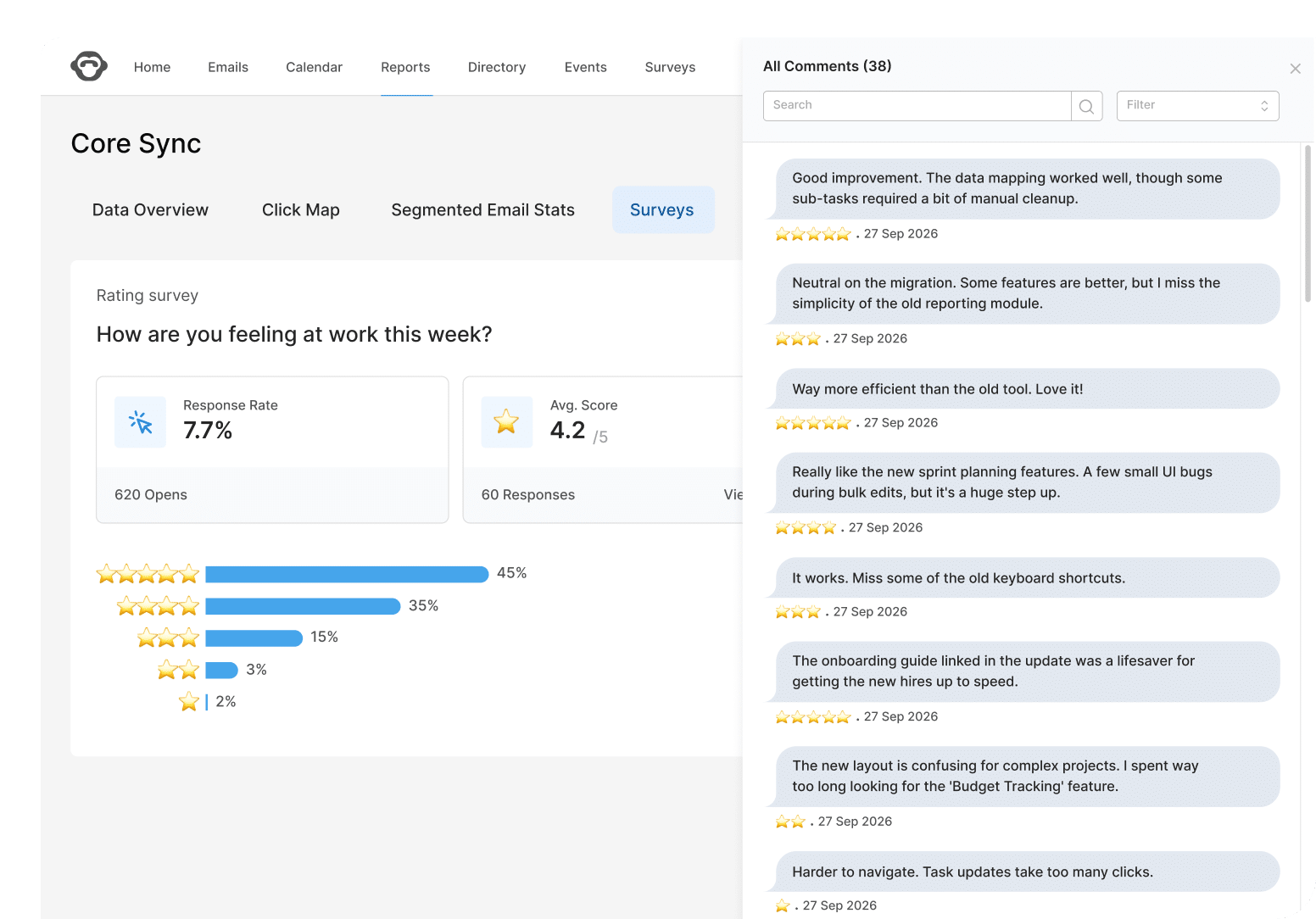
A strong pulse survey dashboard should display participation rates, favorability scores, score distribution, segment-level breakdowns, and trend lines across consecutive cycles in real time, without requiring manual data exports. ContactMonkey’s analytics dashboard surfaces employee sentiment trends over time, and benchmarks score shifts across cycles, giving HR and communications teams the evidence base to make confident, data-driven recommendations to leadership without hours of manual analysis.
Leverage AI in your internal comms workflow
AI is most useful in a pulse survey program, not as a replacement for human judgment, but as a way to reduce the manual work that slows teams down between feedback and action. For internal communicators specifically, that means using AI to draft follow-up communications faster, check whether a message is likely to land clearly before it goes out, and identify patterns across employee responses that would take hours to surface manually. The goal is to spend less time on execution and more time on the decisions that actually require your expertise.
If you want to read more about where AI is genuinely changing internal communications practice and where the limitations are still real: AI and the Future of Communication: What’s Actually Changing and What Isn’t.
Build and customize surveys faster with pre-built templates
Look for a pulse survey platform that offers pre-built, customizable survey templates covering the most common use cases, so you don’t have to create every survey from scratch. ContactMonkey’s pre-built survey templates give teams a ready-made starting point for common pulse survey use cases, which can be customized to reflect your organization’s voice, specific context, and pulse survey questions in minutes rather than hours.

From Feedback to Action: Build Your Pulse Survey Program with ContactMonkey
Building a pulse survey program that employees trust takes more than good questions. It takes a clear purpose for every survey you send, a realistic plan for what happens after it closes, and the discipline to communicate results even when the findings are uncomfortable. With 10 employee pulse survey types, questions to choose from as a starting point, and examples of how to take real action following feedback, you can start today. Pick the pulse type that matches what your organization needs to understand right now, anchor it to a single theme, and treat the follow-up as the actual deliverable.
Ready to run pulse surveys directly inside the tools your employees already use? Book a demo with ContactMonkey to see how it works in practice.