If you have ever sent an employee survey and watched the response rate slowly die, you already know the problem is rarely the questions. More often, it comes down to how surveys are delivered and experienced. Rather than being built with internal communicators in mind, most employee pulse survey tools were built for HR teams running annual engagement cycles, which means they are often too heavy, too slow, or too disconnected from the channels your employees actually use. According to ContactMonkey’s 2026 Global State of Internal Communications report, 73% of communicators spend one to six hours per week just designing, formatting, and sending internal emails. Adding a clunky survey tool to that workflow makes an already stretched job harder.
When the platform actually fits how your team works, you spend less time in the actual process and more time doing something with what you learn. That’s the difference between a pulse survey program that builds momentum and one that quietly gets deprioritized every quarter because nobody has the bandwidth to run it properly.
To help you get this right, this guide covers the best employee pulse survey tools and software available in 2026, what features actually matter when you are evaluating them, and how to match the right platform to your team’s size, structure, and goals.
What is an Employee Pulse Survey?
An employee pulse survey is a short, recurring survey sent to employees on a regular cadence, typically weekly, biweekly, or monthly, to measure how people are feeling about their work, their team, and the organization at a specific point in time. Most pulse surveys run between two and ten questions, take employees under five minutes to complete, and are designed to be repeated consistently so leaders can track how sentiment shifts over time rather than relying on a single annual data point that is already months old by the time anyone acts on it.
For internal communicators specifically, pulse surveys are one of the few tools that create a genuine two-way channel between leadership and employees. GSIC 2026 found that only 15% of organizations clearly communicate actions taken after collecting employee feedback. A well-run pulse program is how you close that loop visibly and consistently.
If you want a deeper look at how to build a pulse survey program from the ground up, read our complete guide: Employee Pulse Surveys: Complete Guide For 2026 Success. The guide covers:
- How to design pulse survey questions that get honest, useful responses
- How often to run pulse surveys and how to structure your cadence
- How to communicate results back to employees in a way that builds trust over time
- How to measure the success of your pulse survey program and prove its impact to leadership
How do pulse surveys differ from annual engagement surveys?
Annual engagement surveys are comprehensive by design. They cover a wide range of topics across the employee experience, run once a year, take fifteen to thirty minutes to complete, and are typically owned by HR. Pulse surveys are built for responsiveness rather than comprehensiveness: shorter, faster, and better suited to measuring the impact of a specific change, tracking sentiment during a period of uncertainty, or simply giving employees a regular touchpoint that signals their voice is part of how decisions get made. The most effective organizations use both, letting annual surveys set the strategic baseline while pulse surveys keep leadership connected to what employees are actually experiencing in between.
What to Look for in Employee Pulse Survey Software
The pulse survey platform you choose shapes everything downstream: how often your internal communications team can realistically run surveys, how much employees trust the process, and whether the data you collect actually reaches the people who need to act on it. Before committing to a tool, it is worth knowing which features to pressure-test and why they matter in practice.
If you are still working out what to actually ask in your surveys, read our Guide to Employee Pulse Survey Questions for Internal Communication Professionals.
Anonymity settings that employees actually trust
Anonymity is the feature most vendors lead with and the one most worth scrutinizing. The reality is that there is a meaningful difference between a platform that says responses are anonymous and one that is built so that even an admin cannot trace a response back to an individual. Employees who have been burned before, by a survey that felt anonymous but somehow led to a conversation with their manager, will not give honest answers the second time around regardless of what the platform claims.
When evaluating this feature, ask vendors directly how anonymity is enforced at the data level. Specifically, look for:
- A minimum response threshold before individual results are visible, typically five or more respondents, so that small teams cannot be reverse-engineered
- Clear disclosure to employees about what is and is not visible to managers versus HR versus leadership
- The ability to configure anonymity settings by survey type, since some pulse surveys, like post-town-hall reactions, may not require the same protections as a culture or wellbeing survey
- Audit controls that show who accessed what data and when
Ready-to-use pulse survey templates for every internal comms scenario
Look for platforms that include a drag-and-drop email builder with ready-to-use templates designed specifically for internal communications. The best tools let you build and send survey emails directly inside the platforms your team already works in, like Outlook, without switching between tools or asking IT for help.
The ability to embed employee surveys, reactions, or feedback prompts directly into a branded email is what makes a pulse program sustainable to run week after week. Adding a pulse survey to your regular employee newsletter is one of the most effective ways to collect feedback without asking employees to do anything extra, since the survey arrives in a communication they are already expecting and engaged with. When evaluating this feature, check whether:
- Templates are pre-built for common IC scenarios like town hall follow-ups, change management check-ins, and onboarding feedback
- The builder supports custom branding so every survey email looks consistent and credible across every send
- Surveys and feedback tools can be embedded directly into the email rather than linking out to a separate form employees have to navigate to
- The template can be reused and adjusted across survey cycles without rebuilding from scratch each time

Action planning features that turn survey results into next steps
This is where most pulse survey programs break down. Collecting responses is the easy part. The harder part is having a clear path from “here is what employees said” to “here is what we are doing about it,” and doing that consistently enough that employees start to believe the process is worth participating in.
The strongest platforms close that gap by connecting survey results directly to the follow-up communication workflow, so acting on feedback does not require jumping between four different tools. Specifically, look for:
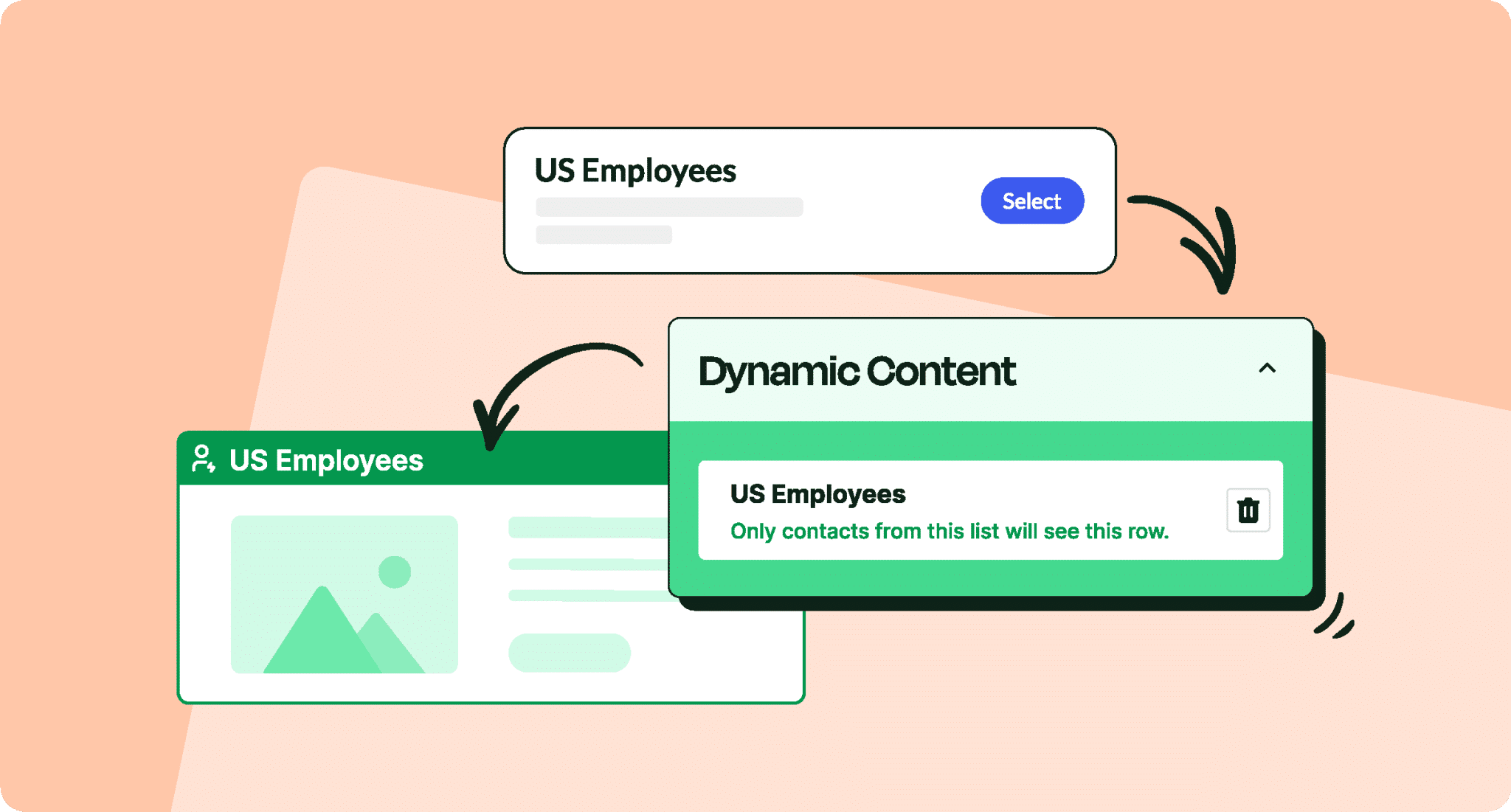
- Audience segmentation built into the survey workflow, so you can send targeted follow-up communications to the specific teams or departments whose feedback requires a response, rather than broadcasting a generic “thanks for your input” message to everyone
- AI-assisted content creation that helps you draft follow-up emails from survey results faster, particularly useful when you are managing multiple listening programs across a large or distributed organization and need to move quickly without sacrificing quality
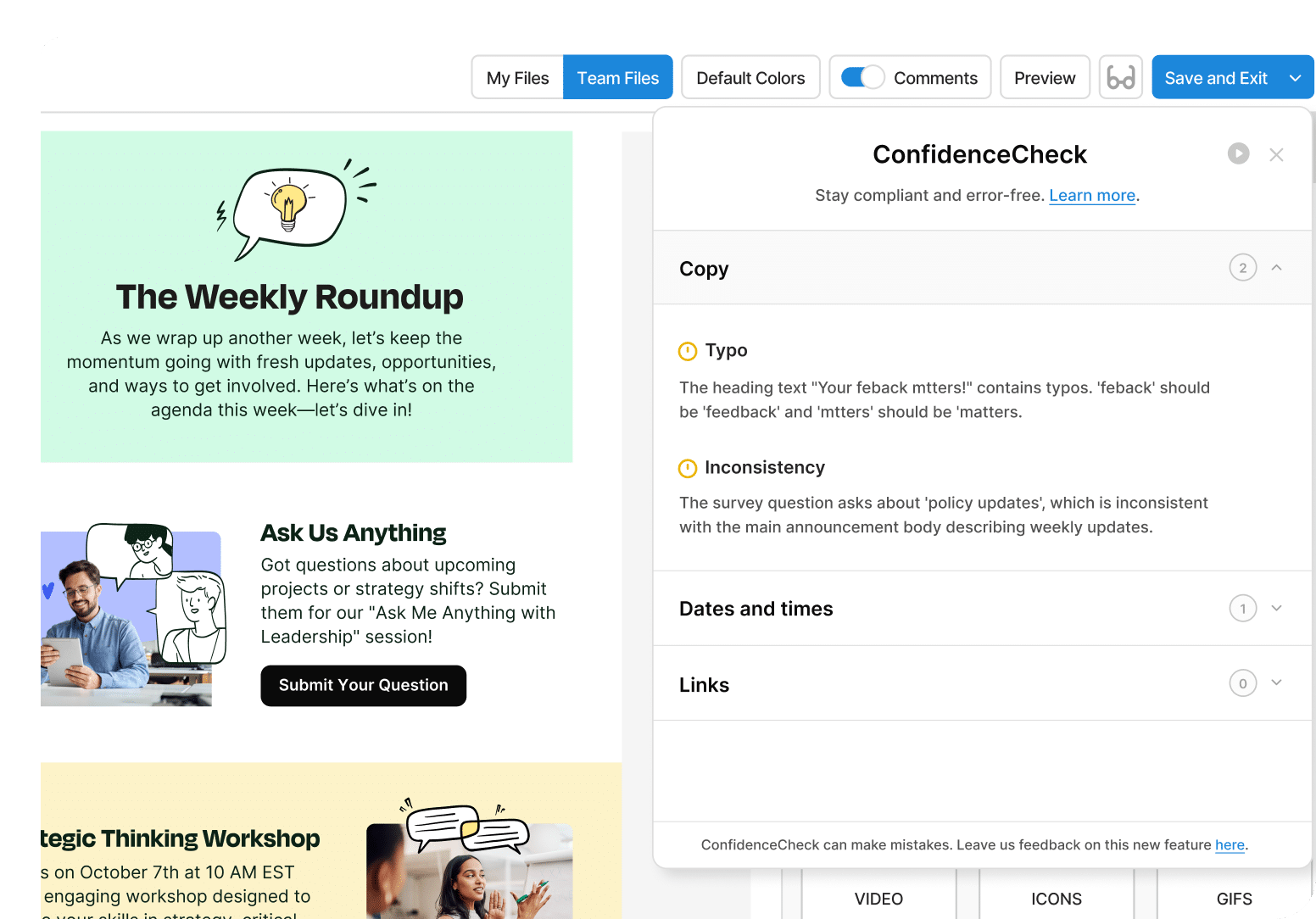
- Pre-send review tools that check your follow-up communications for clarity, accessibility, and consistency before they go out, because a confusing or error-filled response to employee feedback does more damage than saying nothing at all
- Embedded feedback tools in follow-up emails, such as pulse surveys, emoji reactions, or star ratings, that allow you to check whether the actions you took actually landed with employees, creating a genuine loop rather than a one-time transaction
Channel flexibility and integrations for desk-based, remote, and frontline teams
A pulse survey that only reaches employees sitting in front of a laptop is only capturing part of the picture, and often not the part where communication gaps are most acute. According to GSIC 2026, 70% of organizations have deskless or frontline employees, and 55% of those organizations support more than 100 frontline workers. If your survey tool cannot reach those employees in the channels they actually use, your response data has a structural blind spot built into it from the start.
Beyond channel reach, an equally important question is whether the platform keeps your audience lists accurate without manual work. If your employee data lives in an HRIS like Workday, ADP, or BambooHR, the best platforms sync directly with those systems so that your survey audiences update automatically as people join, leave, or change roles. When evaluating channel flexibility, check whether:
- Surveys can be delivered through email, Microsoft Teams, SharePoint, and SMS so employees receive them in whichever channel they are most likely to check during their workday
- The platform integrates directly with your HRIS to keep audience lists current without requiring someone to manually export and upload a new employee list every time there is a change
- Mobile-responsive design is a baseline, not an add-on, since most employees will open on a phone even if they work at a desk
- The survey experience is consistent across channels, meaning an employee gets the same straightforward experience whether they are responding in Teams or in their email inbox
Real-time analytics, dashboards, and benchmarking that put data in context
Raw response data is only useful if you know what to do with it, and knowing what to do with it requires both the right visibility and a clear path to getting results in front of the people who need to act on them. This is where a lot of platforms fall short: the data exists, but extracting it, segmenting it, and presenting it in a format that means something to a leadership team requires more manual work than an already stretched internal comms team can reasonably absorb on a regular cadence.
When evaluating employee engagement analytics and reporting capabilities, look for:
- Live dashboards that update as responses come in rather than requiring manual report generation, so you can spot trends while a survey is still in the field
- Trend lines across survey cycles that show how sentiment is shifting over time, not just how it looks in a single snapshot
- Export and download functionality that lets you move data into the formats your organization already uses for reporting, whether that is a CSV for further analysis or a clean summary your team can share with stakeholders
- An analytics API for teams that want to pull survey and engagement data into tools like Power BI or Tableau, where it can sit alongside other organizational data to build a fuller picture of engagement trends and demonstrate the ROI of your communications program to leadership
- Survey response data alongside email engagement metrics in the same dashboard, so you can see how a pulse survey performed relative to open rates, read time, and click data from the same send, rather than reconciling two separate reports
On the benchmarking point specifically, the most credible external benchmarks come from platforms analyzing actual campaign data at scale rather than self-reported responses. If you want a concrete reference point for what strong internal email performance looks like across industries and company sizes, the ContactMonkey Internal Email Benchmark Report 2026 is a good place to start.
2025 internal email benchmarks are in!
See where you stand. Download our report to measure your performance.
Get the guide

Built-in AI for drafting and reviewing pulse survey comms
Running a pulse survey program means writing more than just the survey itself. There is the email that delivers it, the follow-up that communicates what you heard, and often a series of manager-facing messages that translate results into next steps. For a lean IC team, that volume of communication adds up quickly, and it is where AI pulse survey tools can make a practical difference.
Look for platforms that use AI to help you move faster on the communications surrounding your survey program, whether that means generating a structured draft from a plain-language prompt so you are not starting from scratch every time, or automatically reviewing emails before they go out for broken links, readability issues, and accessibility gaps. The IC professionals who get the most out of these features are the ones who use them to protect time for the work that requires real organizational judgment, like how to communicate difficult results, which teams need a direct follow-up, and what leadership needs to hear.
If you want a broader look at how AI is changing the way internal communications teams work, read AI and the Future of Communication: What’s Actually Changing and What Isn’t.
10 Best Employee Pulse Survey Tools and Software Providers
With the criteria above in mind, here is how the leading employee pulse survey tools and software available in 2026 stack up.
1. ContactMonkey
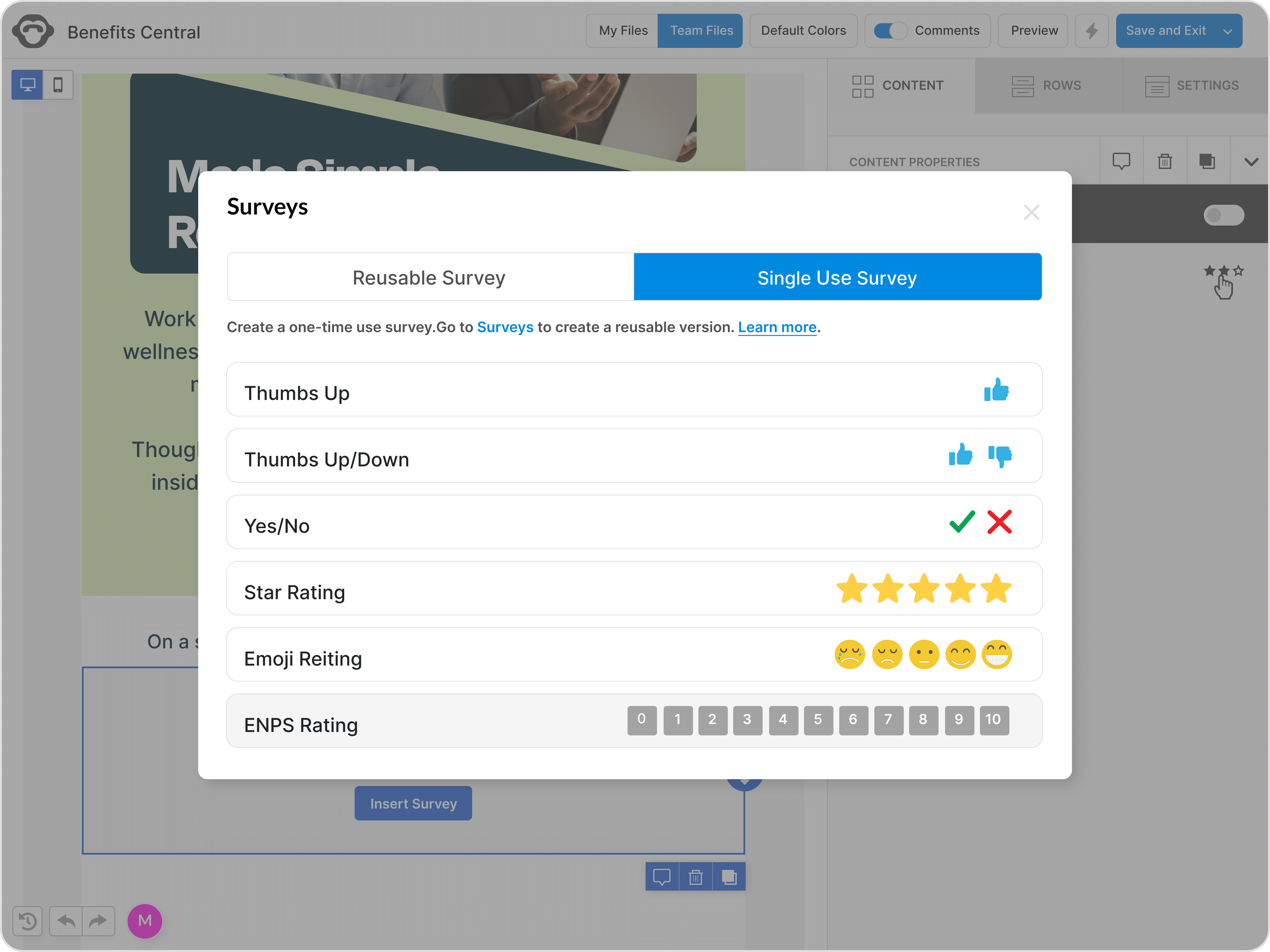
ContactMonkey is an internal communications platform built for teams that run their employee communications through Outlook or Gmail. Where most dedicated pulse survey tools sit outside the channels employees already use, ContactMonkey embeds surveys directly into internal emails, meaning employees can respond to a pulse check, eNPS survey, emoji reaction, or open-ended question without leaving their inbox or navigating to a separate platform.
The platform covers the full communications workflow: building and sending branded emails, collecting feedback, tracking employee engagement, and reporting results, all from a single tool. Pulse surveys are not a standalone module bolted onto an email platform. They are part of how the email itself is built, which means response data sits alongside open rates, click data, and read time in the same dashboard. For internal communicators who need to demonstrate the impact of their communications program to leadership, having all of that in one place is a meaningful advantage over managing multiple tools.
Best for: Mid-sized to enterprise organizations already running communications through Microsoft 365 or Gmail. Particularly well-suited for IC teams that want to consolidate their survey and email workflows into a single platform, organizations with hybrid or distributed workforces that need to reach employees across email, Teams, SharePoint, and SMS, and teams that need HRIS integration to keep audience lists accurate without manual maintenance.
Key features
- Pulse surveys, eNPS, emoji reactions, star ratings, and open-ended comments embedded directly into emails, so employees respond without leaving their inbox
- Drag-and-drop email builder with pre-built templates designed for internal comms use cases, built to work inside Outlook and Gmail without switching tools
- ConfidenceCheck, an AI editorial assistant that reviews emails before sending for broken links, accessibility issues, readability, and content consistency, and CoAuthor, an AI email builder that designs structured drafts from a single prompt directly inside the email editor
- Audience segmentation and HRIS integrations with Workday, ADP, BambooHR, SAP SuccessFactors, and others to keep sending lists accurate as your organization changes
- Analytics API for connecting engagement and survey data to Power BI or Tableau for deeper reporting and leadership-ready insights
- Multi-language email support with AI-assisted translation for global or multilingual workforces
Limitations: ContactMonkey is purpose-built for email-first internal communications and is not designed to replace a standalone engagement survey platform or performance management tool. Teams looking for a comprehensive annual engagement survey solution with extensive question libraries, manager-employee conversation tools, or goal-setting workflows will likely need a dedicated engagement platform alongside it.
Pricing: ContactMonkey offers three plans: Launch, Grow, and Enterprise. Pricing is custom based on your team’s size and needs. Request a custom quote here.

2. Culture Amp
Culture Amp is a widely used employee experience platform built around engagement surveys, pulse surveys, and people analytics. It was founded by organizational psychologists, which is reflected in the structure of its survey methodology and benchmarking capabilities. For HR and people teams that need to understand engagement at an organizational level and connect survey results to retention, DEI, and performance outcomes, Culture Amp covers a broad range of that territory in one platform.
Best for: Mid-sized to large enterprises, particularly HR and People teams that prioritize research-backed survey design, deep analytics, and industry benchmarking. Less suited to IC-led programs or teams looking for a lightweight, email-integrated listening tool.
Key features
- Engagement and pulse surveys with 40+ templates, eNPS, onboarding, and exit surveys
- AI-powered comment summaries and text analytics that surface themes across open-ended responses without manual analysis
- Industry benchmarking that lets organizations compare engagement scores against relevant peers
- Focus areas and action planning tools built into the results workflow
Limitations: Culture Amp is a comprehensive platform, which means it comes with a learning curve and an implementation investment that not every team is equipped for. Pricing is not published and scales with employee count, making it one of the more expensive options on this list, particularly for smaller organizations or teams that only need pulse survey functionality rather than the full engagement suite.
Pricing: Custom pricing based on employee count and modules selected. Pricing is available on request.
3. Workday Peakon Employee Voice
Workday Peakon Employee Voice is a continuous listening platform built for organizations that are already running their HR operations through Workday. Pulse surveys are delivered on a regular cadence, and the platform uses machine learning to identify engagement drivers, flag attrition risk, and surface manager-level recommendations automatically. For large enterprises where Workday is the system of record, Peakon is the most natural extension of that infrastructure into employee listening.
Best for: Large enterprises already invested in the Workday HCM ecosystem. Teams looking for a standalone pulse survey tool or organizations not using Workday will find the integration story less compelling and the implementation more complex than it needs to be.
Key features
- Continuous pulse surveys with anonymous response options and confidential two-way conversation threads between employees and managers
- Machine learning that automatically identifies engagement drivers and predicts attrition risk at team and organizational level
- Native integration with Workday HCM for unified employee data and reporting
- Manager-facing dashboards with prioritized action recommendations
Limitations: Peakon is purpose-built for Workday environments, which means organizations outside that ecosystem will not get the same integration value. The platform also has a steeper learning curve than lighter tools on this list, and some users report that the initial setup requires significant configuration time. Survey customization options are more limited than standalone engagement platforms.
Pricing: Custom pricing. Contact Workday directly for a quote tailored to your organization’s size and configuration.
4. Lattice
Lattice is a performance management platform that includes engagement surveys and pulse surveys as part of a broader suite covering goals, performance reviews, compensation, and career development. For HR teams that want engagement data to sit alongside performance and development workflows rather than in a separate tool, Lattice offers a cohesive experience. It is one of the more widely adopted platforms among mid-market companies building out their people management infrastructure.
Best for: Mid-sized organizations with 100 to 1,000 employees that want engagement and pulse surveys connected to performance management. Not the strongest choice if pulse surveys are the primary need, as the engagement module is an add-on rather than a core offering.
Key features
- Pulse surveys, eNPS, onboarding, and exit surveys with customizable templates
- AI-powered survey insights that identify engagement drivers and flag areas of concern
- Integration with major HRIS platforms and tools like Slack and Google Workspace
- Action planning and goal-tracking tools connected to survey results
Limitations: Pulse surveys and engagement tools are an add-on module priced separately from Lattice’s base plan, which means the total cost climbs quickly if you are combining multiple modules. The engagement survey functionality is less customizable and analytically deep than dedicated engagement platforms like Culture Amp or Qualtrics. Some users also report a steep learning curve for administrators configuring the platform for the first time.
Pricing: Base plans start at $11 per user per month. The Engagement add-on, which includes pulse surveys and eNPS, is priced at approximately $4 per user per month on top of the base plan. Annual contracts are standard. Pricing is available on request.
5. 15Five
15Five is an AI-powered performance and engagement platform that combines pulse surveys, weekly check-ins, performance reviews, and manager coaching tools in a single product. It sits at the more accessible end of the market compared to platforms like Culture Amp or Workday Peakon, and is particularly well regarded for its manager enablement features, including a Manager Effectiveness Indicator that scores leaders based on their team’s engagement, turnover, and feedback data.
Best for: Mid-market organizations with 50 to 500 employees that want to connect engagement data to manager performance and coaching. A fit for HR teams that want one platform covering both surveys and performance without the complexity or cost of an enterprise suite.
Key features
- Pulse surveys and eNPS with AI-driven insights that identify engagement drivers and prioritize recommended manager actions
- Weekly check-in tools that create a continuous feedback rhythm between employees and managers
- Manager Effectiveness Indicator that connects team engagement scores to individual manager performance data
- HRIS integrations with major platforms including BambooHR, Workday, and ADP
Limitations: 15Five is built around a performance management philosophy, which means some of its engagement features, particularly open-text analysis and advanced benchmarking, are less developed than standalone engagement platforms. It is also less suited to large enterprises with complex organizational structures or global compliance requirements.
Pricing: Plans start at $4 per user per month for the Engage module, $11 per user per month for Perform, and $16 per user per month for the Total Platform. All plans are billed annually.
6. Leapsome
Leapsome is a people enablement platform that treats pulse surveys as part of a connected HR system rather than a standalone feedback exercise. Survey results sit alongside performance reviews, goals, learning, and compensation data, which means follow-up actions can flow directly into the workflows where managers actually make decisions. It’s a good option for organizations that want engagement data to inform people strategy in a practical, operational way rather than just producing a sentiment report.
Best for: Mid-market to enterprise organizations with 50 to 2,000 employees, particularly those in Europe or with global workforces, that want to consolidate performance, engagement, and learning into a single platform. Less suited to teams looking for a lightweight pulse survey tool or organizations that do not need the broader HR functionality.
Key features
- Pulse and engagement surveys with customizable questions, science-backed templates, and heatmap analytics
- Sentiment analysis powered by natural language processing that surfaces themes from open-ended responses
- Survey results connected directly to goals, performance reviews, and development plans within the same platform
- HRIS integrations and multilingual support for global teams
Limitations: Leapsome’s breadth is also its main trade-off. Teams that only need pulse surveys will likely find themselves paying for capabilities they do not use. Pricing is custom and not published, which makes it harder to evaluate quickly during a buying process.
Pricing: Custom pricing based on modules and employee count. Available on request.
7. Microsoft Viva Glint
Microsoft Viva Glint is an employee engagement and pulse survey platform built into the Microsoft 365 ecosystem. In late 2025, Microsoft unified Viva Glint and Viva Pulse into a single product, meaning any Glint license now includes pulse survey capabilities as standard. For organizations already running on Microsoft 365 and Teams, Glint is the most frictionless way to run employee listening programs, since surveys, results, and manager actions all live within the tools employees and leaders already use every day.
Best for: Large enterprises with 1,000 or more employees that are already invested in Microsoft 365 and the broader Viva suite. Teams not operating within the Microsoft ecosystem will not get the same integration value and would be better served by a standalone platform.
Key features
- Engagement and pulse surveys with AI-powered Narrative Intelligence that automatically categorizes and summarizes open-ended responses
- Manager-facing dashboards with action recommendations built directly into Teams and the Viva suite
- Native integration with Microsoft 365, Viva Insights, and Teams for a unified employee experience
- People science-backed survey methodology with driver analysis and benchmarking
Limitations: Viva Glint is tightly coupled to the Microsoft ecosystem, which is both its strength and its constraint. Organizations outside that environment will find limited value in the integration story. Some long-time Glint users have also noted feature gaps following the Microsoft acquisition and subsequent platform consolidation. The confidentiality model, which is not full anonymity in every configuration, requires transparent communication to employees about how their responses are handled.
Pricing: Pricing starts at $2 per user per month as a standalone product and is also available bundled within the Microsoft Viva Suite at $12 per user per month. Contact Microsoft for enterprise-specific pricing.
8. Qualtrics EmployeeXM
Qualtrics EmployeeXM is built for large enterprises that need research-grade survey design, advanced text analytics, and the ability to measure employee experience across the full employee lifecycle from onboarding through to exit. Where other platforms make pulse surveys easy to run, Qualtrics makes it possible to understand them in exceptional depth, connecting feedback data to operational metrics and business outcomes in ways that require dedicated people analytics capability to fully leverage.
Best for: Large enterprises with 1,000 or more employees that have dedicated HR analytics or people operations teams. Organizations that need advanced customization, complex survey logic, or the ability to integrate employee feedback into a broader experience management program. Not suited to teams looking for a simple, fast-to-deploy pulse survey solution.
Key features
- Advanced survey design with branching logic, skip patterns, and research-grade methodology
- AI-powered text analytics and sentiment analysis across large volumes of open-ended responses
- Full employee lifecycle listening from candidate experience through to exit surveys
- Native integrations with major HRIS platforms and a broad API for connecting to existing analytics infrastructure
Limitations: Qualtrics is one of the most powerful platforms available and also one of the most complex. It requires meaningful implementation effort and ongoing administration, and the depth of the platform can feel excessive for organizations that primarily need a straightforward pulse survey program. Pricing reflects the enterprise positioning and is among the higher end of this list.
Pricing: Custom enterprise pricing. Industry sources estimate costs in the range of $20 to $30 per user per year for the EmployeeXM suite, typically bundled with other Qualtrics products. Contact Qualtrics for a tailored quote.
9. Workleap Officevibe
Workleap, formerly known as Officevibe, is one of the most straightforward employee pulse survey tools available. It runs automated weekly or biweekly pulse surveys in the background with minimal setup, surfaces results in a clean manager-facing dashboard, and includes an anonymous feedback channel that lets employees flag issues between survey cycles. For organizations that want a continuous listening program without the complexity or cost of an enterprise platform, Workleap is a practical and accessible starting point.
Best for: Small to mid-sized organizations with 50 to 500 employees that want a lightweight, always-on pulse survey program with minimal administrative overhead. A good fit for teams new to structured employee listening that do not yet need the depth of platforms like Culture Amp or Qualtrics.
Key features
- Automated weekly or biweekly pulse surveys with pre-built, research-backed question sets that rotate over time
- Anonymous feedback channel that allows employees to submit comments between survey cycles
- Manager-facing dashboards with coaching tips and suggested actions tied to survey results
- eNPS tracking and team-level reporting with simple segmentation
Limitations: Workleap is designed for simplicity, which means it trades depth for ease of use. Open-text analysis is basic compared to enterprise platforms, and the reporting capabilities may not satisfy HR leaders who need to segment results across complex organizational structures or present detailed analytics to senior leadership. It is not built for large enterprises with sophisticated people analytics requirements.
Pricing: Workleap Officevibe is available as a standalone tool starting at $5 per user per month. Bundled pricing with other Workleap products is available at $22 per user per month.
10. SurveySparrow
SurveySparrow takes a different approach to pulse surveys than most platforms on this list. Its conversational survey format presents questions one at a time in a chat-like interface rather than as a traditional form, which the platform reports produces higher completion rates and a less fatiguing experience for employees. It supports recurring pulse surveys, 360-degree feedback, and NPS, and works across web, mobile, and email, making it a flexible option for teams with diverse employee populations.
Best for: Organizations looking for a higher-engagement survey experience, particularly those with younger or mobile-first workforces where traditional survey formats see low completion rates. Also a reasonable option for teams that need both employee and customer feedback programs on a single platform.
Key features
- Conversational survey format that presents questions one at a time to reduce survey fatigue and improve completion rates
- Recurring pulse survey scheduling with automated delivery across email, web, and mobile
- 360-degree feedback surveys alongside standard pulse and engagement surveys
- Real-time reporting dashboard with response tracking and basic sentiment analysis
Limitations: SurveySparrow is a flexible general-purpose survey platform rather than a purpose-built employee engagement tool. It lacks the people analytics depth, benchmarking capabilities, and action planning features that dedicated platforms like Culture Amp or Leapsome offer. Organizations that need to connect survey results to performance management, HR workflows, or detailed engagement analytics will likely find it insufficient as a standalone solution.
Pricing: Plans start at $19 per month for basic survey functionality. Employee experience and 360-degree feedback plans are available at higher tiers. Pricing scales with the number of users and features required. Enterprise pricing is available on request.
Start Running Employee Pulse Surveys That Get Results With ContactMonkey
The tools on this list serve genuinely different needs, and the right choice depends on where your organization is today: how your team is structured, which platforms you already rely on, and whether you need a comprehensive HR platform or something that fits inside the communications workflow you already have.
For internal communicators and HR leaders who need to run employee pulse surveys regularly, reach employees across a hybrid or distributed workforce, and close the feedback loop without adding more tools to an already crowded stack, the decision comes down to fit. You need something that works inside the workflow you already have, produces data you can act on quickly, and does not require a full implementation project every time you want to check in with your people.
ContactMonkey is the only employee pulse survey software on this list that works directly inside Outlook and Gmail, embeds surveys into the emails you are already sending, and connects employee feedback data to email engagement metrics in a single dashboard. Here is what that looks like in practice:
- Email-native survey delivery and embedded feedback formats: Build and send pulse surveys directly from Outlook or Gmail, with surveys, eNPS, emoji reactions, star ratings, and open-ended comments embedded directly in the email so employees respond without leaving their inbox
- AI-assisted drafting and pre-send quality checks: Use CoAuthor to generate a structured survey email or follow-up communication from a plain-language prompt, and ConfidenceCheck to automatically review every send for broken links, accessibility issues, and content inconsistencies before they go out
- Real-time analytics and reporting: Track survey participation, sentiment trends, and email engagement metrics in one dashboard, and connect data to Power BI or Tableau via the Analytics API for leadership-ready reporting
- Multi-channel delivery and HRIS integration: Reach desk-based, remote, and frontline employees across email, Microsoft Teams, SharePoint, and SMS, with audience lists that sync automatically from your HRIS so they stay accurate as your organization changes
- Dynamic content: Personalize survey emails for different employee groups within a single send, showing relevant content to specific departments, locations, or roles without duplicating or manually rebuilding the email each time
For internal communications teams that are already stretched thin, adding a pulse survey program should not mean adding a separate platform, a separate login, and a separate report to pull every time leadership asks how employees are feeling.
If you are ready to see how ContactMonkey works in practice, book a demo to see the full employee survey and communications workflow for yourself.
FAQs
1. What is the difference between a pulse survey and an engagement survey?
A pulse survey is a short, recurring survey sent on a weekly, biweekly, or monthly cadence to track employee sentiment in real time. An annual engagement survey is longer, more comprehensive, and run once or twice a year to capture a broad view of the employee experience. Pulse surveys are built for responsiveness and are better suited to measuring the impact of a specific change or tracking sentiment during a period of uncertainty. Most organizations benefit from using both, with annual surveys setting the strategic baseline and pulse surveys filling the gaps between those cycles.
2. How often should you run a pulse survey?
Most organizations run pulse surveys on a biweekly or monthly cadence, which balances regular insight with avoiding survey fatigue. Weekly surveys can work for smaller teams or specific listening programs, but tend to see declining response rates over time if employees feel the frequency is excessive. The right cadence depends on what you are trying to measure and how quickly you can realistically act on and communicate results back to employees. Running surveys more frequently than you can follow up on is one of the most common reasons pulse programs lose participation over time.
3. What is a good employee pulse survey response rate?
A response rate of 70% or above is generally considered strong for an employee pulse survey. Rates below 50% are worth investigating, as they often signal either survey fatigue, low trust in the anonymity of the process, or a history of feedback not visibly leading to action. Response rates tend to be higher when surveys are short, delivered in the channels employees already use, and consistently followed by visible communication about what was heard and what will happen next.
4. What features should I look for in employee pulse survey software?
The most important features to evaluate in employee pulse survey software are anonymity controls that employees genuinely trust, delivery across the channels your workforce actually uses, action planning tools that connect results to follow-up communications, real-time analytics and benchmarking, and AI tools that help your team draft and review survey communications faster. For internal communication teams specifically, the ability to embed surveys directly into internal emails without requiring employees to navigate to a separate platform is one of the most impactful features for driving consistent response rates.