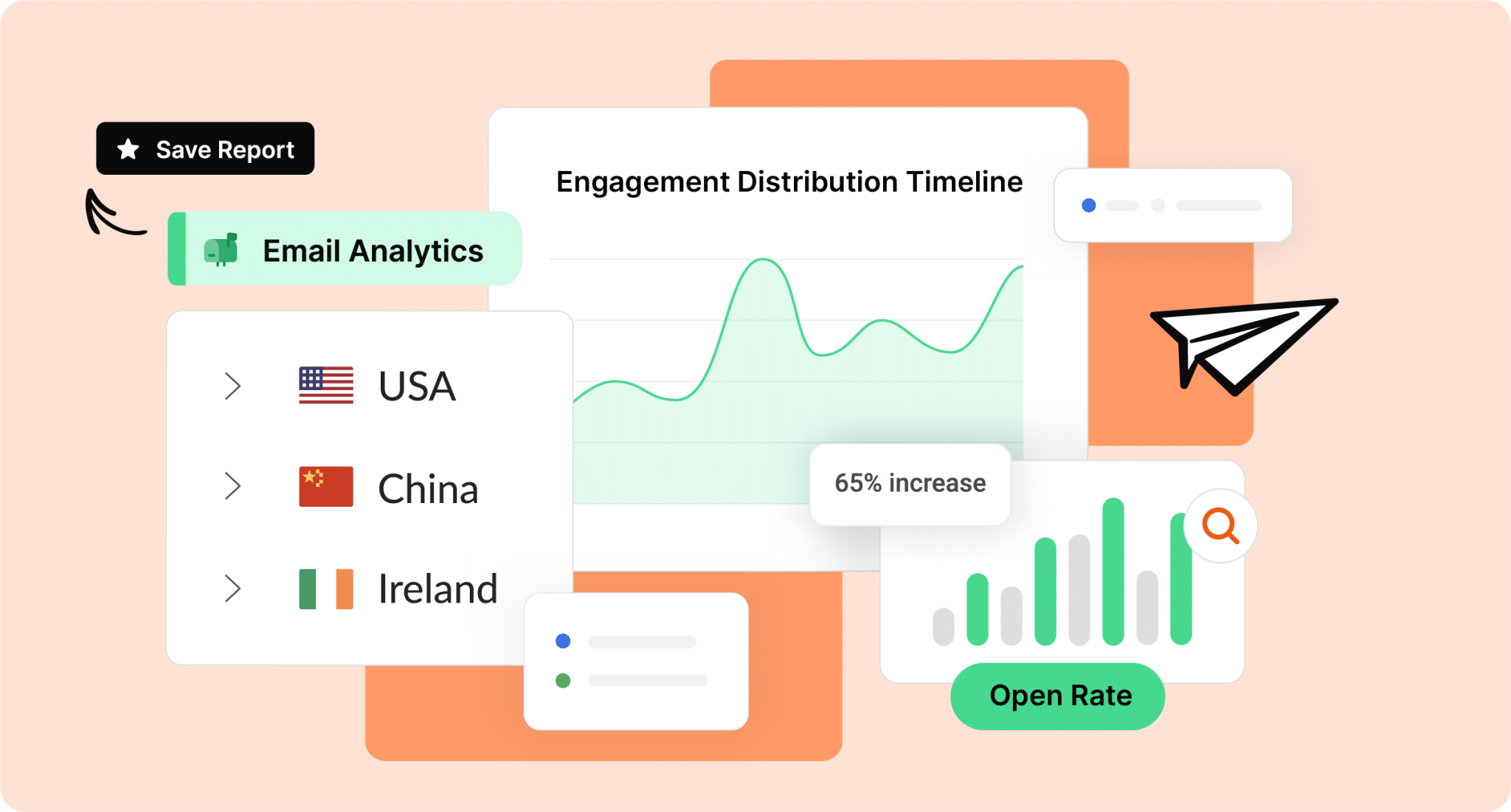
Most internal communications teams are making decisions about email with incomplete information. They know how many messages they sent and what their open rate was, but rarely how that performance compares to organizations like theirs. ContactMonkey’s 2026 Internal Email Benchmark Report was built to answer that question. Drawing on performance data from more than 255,000 anonymized internal email campaigns sent through the ContactMonkey platform across 20+ industries, the report gives internal communications teams a concrete, data-backed picture of what strong email performance looks like and where the most common opportunities for improvement tend to lie.
The headline finding is one that still surprises many communicators: internal email achieves an average open rate of 76% across all industries analyzed. At a time when many organizations are questioning whether email remains a relevant channel, the data offers a clear verdict. Email reaches employees in a way few other channels can match, and it does so consistently across sectors, company sizes, and regions.
What makes the 2026 report particularly valuable is that it goes beyond the standard employee engagement metrics. The findings reveal something that most IC teams have not formally considered, which is that the best time to send an internal email depends heavily on where your employees are and how their industry structures the workday.
This article pulls out the key findings internal communicators need to know from the 2026 benchmark report and translates them into practical direction for the year ahead.
2025 internal email benchmarks are in!
See where you stand. Download our report to measure your performance.
Get the guide

Key Findings from the 2026 Internal Email Benchmark Report
The 2026 report draws on performance data from more than 255,000 internal email campaigns sent through ContactMonkey across 20+ industries, spanning organizations of all sizes and every major sector from banking and healthcare to retail and pharmaceuticals. Most IC teams are making decisions about email without a clear sense of how their peers are performing. These benchmarks are different because they come directly from real campaign performance, which makes them a far more reliable foundation for setting realistic targets and figuring out where to focus. The findings below represent the most important takeaways from the report and what they mean for internal communications best practices in 2026.
1. Most organizations are underestimating how well their internal emails perform
Across more than 255,000 internal email campaigns analyzed in the 2026 report, the average internal email open rate sits at 76%. That number tends to surprise people, and it should. External marketing emails average somewhere between 20% and 40%, depending on the industry, which means internal email is outperforming commercial email by a significant margin. This happens not because employees are more enthusiastic about their inboxes, but because workplace communications carry a different kind of weight. Company announcements, leadership updates, and operational information that directly affect someone’s day-to-day work get opened.
The range across industries is worth paying attention to because your benchmark should reflect your sector rather than the overall average. Industries with the highest open rates are usually the ones where employees need to take action on the message. For example:
- Legal and Real Estate lead with average open rates of 86%, where communications routinely require employees to acknowledge, respond, or act on time-sensitive information
- Insurance follows at 84%, driven by compliance-heavy communications that employees know carry consequences if missed
- Electrical/Electronic Manufacturing and Utilities both sit at 82%, reflecting workforces where operational updates are closely tied to day-to-day work
Some industries sit at the lower end of the range, and the reason is simpler than most teams assume. For example:
- Transportation and Trucking sits at 63%, reflecting drivers and field operators who are rarely at a desk when communications arrive
- Airlines/Aviation follows at 65%, with a workforce split across gates, cockpits, and terminals
- Logistics and Supply Chain lands at 67%, where shift-based and mobile workers check email less consistently than office-based employees
If your organization is still debating whether internal email is worth the investment, a 76% average open rate across 255,000 campaigns tends to settle that conversation. That said, open rate is a measure of reach, not impact. The more important question the 2026 data pushes internal communications teams to ask is whether the emails employees are opening are actually earning the attention they receive once they are inside. A high open rate tells you your subject line worked and your sender’s credibility is intact. It does not tell you whether your message was understood, acted on, or even fully read. That is where read time data, click rates, and employee feedback become the more meaningful indicators of whether your internal email strategy is actually working.
If you want to understand what inefficient, untargeted sending is actually costing your organization, the ContactMonkey ROI Calculator shows you exactly how much time and money your team could save by communicating more deliberately.
How much is low employee engagement costing you?
Tally it up with ContactMonkey’s ROI calculator.
Calculate now

2. Click rates tell you more about your communications than open rates do
A 76% average open rate is an encouraging headline, but it is an incomplete one. The 2026 benchmark data shows that click rates vary far more dramatically across industries than open rates do, and understanding why is where most IC teams find the most useful direction for improving their email strategy.
The overall average click rate across 255,000 campaigns is 9%. But the range across industries tells a more specific story:
- Not-for-Profit and Insurance lead all industries with average click rates of 13%, driven by communications that consistently ask employees to complete a specific action, whether that is a survey, a policy acknowledgment, or a deadline-driven request
- Agriculture follows at 11%, with Construction, Legal, Leisure Travel and Tourism, and Logistics and Supply Chain all landing at 10%
- Airlines/Aviation, Transportation and Trucking, and Media and Entertainment sit at the lower end at 7%, reflecting high-reach informational sends to audiences that engage passively
Most IC teams see a low click rate and assume something is wrong with their content. The 2026 data suggests a more useful starting point: ask whether the email was asking employees to do anything in the first place. An organization-wide leadership update with a 7% click rate and a benefits enrollment reminder with a 7% click rate are two completely different situations, and the response to each should be completely different.
Where click rate becomes genuinely useful is when you compare it against your own industry benchmark rather than the overall average. A 9% click rate in an insurance organization, where compliance communications routinely require employee action, means something very different than a 9% click rate in a media company where most internal emails are informational. Benchmarking against the wrong number leads IC teams to fix things that are working and overlook things that are not.
To benchmark your own click rates, explore ContactMonkey’s internal email analytics.
3. Reaching a large audience and engaging them are two different problems
The 2026 data makes a clear case for segmentation. Across 255,000 internal email campaigns, open rates decline steadily as audience size grows, from 89% at organizations with fewer than 50 employees down to 73% at organizations with more than 10,000 employees. Here is how that breaks down across organization sizes in the dataset:
- 1 to 50 employees: 89% average open rate
- 51 to 200 employees: 82% average open rate
- 201 to 500 employees: 80% average open rate
- 501 to 1,000 employees: 82% average open rate
- 1,001 to 5,000 employees: 78% average open rate
- 5,001 to 10,000 employees: 75% average open rate
- 10,000 or more employees: 73% average open rate
This does not mean large organizations cannot achieve strong engagement. It means the approach has to change. Sending the same message to 8,000 employees and expecting it to land the same way it would for a team of 50 is where most enterprise IC teams lose ground. The answer is not to send less. It is to segment more deliberately so that every employee receives a version of the message that connects directly to their role, location, or function.
In ContactMonkey’s top employee engagement trends for 2026, internal communications leader Alyssa Towns makes the point directly. Employees today are absorbing more information than ever before, both inside and outside of work, and that volume has made them far more selective about what they give their attention to. According to GSIC 2026, more than half of internal communicators say employees sometimes miss key updates, and 30% say this happens often or very often. Half of respondents estimate employees lose one to three hours per week to poor or unclear communication. For large organizations, that cost compounds quickly across a distributed workforce.
The most effective enterprise IC teams are the ones treating segmentation as a core part of how they plan communications, not an optional refinement. An organization-wide email sent to 8,000 people will almost always underperform compared to the same core message broken into audience-specific versions sent to the departments, locations, or roles it actually applies to. The core message stays the same. What changes are the examples, the calls to action, and the framing that make the communication feel like it was written for the person reading it.
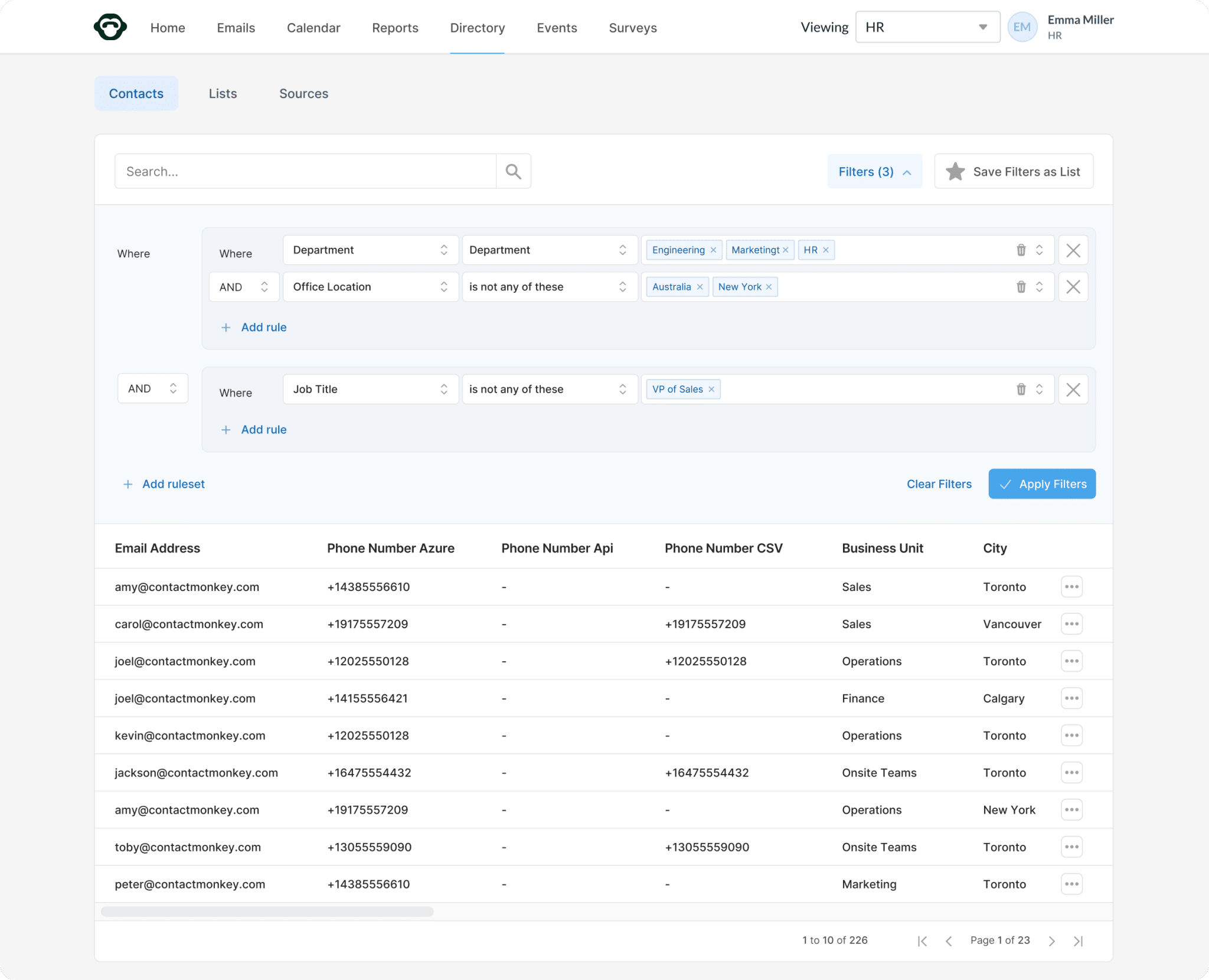
ContactMonkey’s audience segmentation feature allows internal communications teams to build and automate targeted distribution lists directly within Outlook. Combined with HRIS integrations that sync employee data in real time, IC teams can personalize communications at scale without the manual list management that typically makes segmentation feel like more work than it is worth.
4. Most orgs are sending internal emails at the wrong time – when you send matters as much as what you send
Getting the timing right is one of the easiest ways to improve engagement, and the 2026 benchmark report makes that clearer than ever. This year, the report introduces a new layer of analysis, converting all send timestamps from EST to each recipient company’s local timezone. The patterns that show up tend to challenge a lot of the assumptions internal communicators bring over from general email marketing.
The first thing the data settles is the Wednesday myth. Wednesday is the day most frequently cited in general email marketing guidance as the optimal send day, yet it does not rank as the best send day for a single industry in the dataset. Friday dominates across the largest group of industries, while Tuesday leads for knowledge-worker sectors, including Education, Insurance, Legal, and Technology. Monday clusters operational industries like Retail, Transportation and Trucking, and Utilities.
Peak send times are shaped almost entirely by the nature of work in each sector:
- Field-based and operational workforces tend to be most reachable in the afternoon once site or route activity winds down, rather than first thing in the morning
- Desk-based and knowledge-worker industries skew toward early morning, before meetings take over the day
- European organizations peak in the early afternoon, consistent with workplace cultures where mornings tend to be protected for focused work
- North American organizations concentrate in mid-morning, with Tuesday at 10:00 AM as the peak across the region
Timing is not a scheduling detail. For organizations with global or distributed workforces, getting it right is one of the most straightforward improvements available and one that costs nothing to act on. If your send times are still based on when it is convenient for the sender rather than when your employees are actually at their desks, the data suggests you are consistently missing a portion of your audience at the moment they are most likely to engage. Understanding the best timeto send internal emails for your specific industry and region is one of the simplest places to start.
5. Adding interactivity to internal emails drives measurably stronger engagement than regular sends
While most IC teams treat interactive email features as nice-to-haves, the 2026 data tells a different story. Emails that include embedded surveys or emoji reactions consistently outperform standard sends across every engagement metric in the dataset:
- Emoji reactions produce an average click rate of 8% and a click-to-open rate of 10%, both above the overall benchmark
- eNPS surveys embedded directly in emails push that further, with an average click rate of 11% and a click-to-open rate of 11%, outperforming the overall benchmark on both measures
The reason these features perform well is straightforward. Think about the last employee newsletter you received that had a simple feedback question built right into the bottom, something like “what did you think of this week’s issue?” with three emoji options to choose from. If you read the whole thing, you probably clicked one without even thinking about it. When employees can respond directly within the email without navigating away or opening a separate tool, they do. Even something as simple as clicking out to another survey tool is enough to lose a chunk of employees who would have responded. When the interaction lives right inside the email, it removes that extra step and makes it feel more like a two-way conversation.
Beyond engagement, interactive features give internal communications teams something more valuable than a metric. An eNPS survey embedded in a company update generates direct, in-the-moment feedback from employees on the content and initiatives that matter most. That feedback closes the loop that the GSIC 2026 Report identifies as one of the most persistent gaps in internal communications today, where 47% of organizations say actions taken on employee feedback are only sometimes communicated back to employees.
Interactive email features are one of the most direct ways to solve that problem, and ContactMonkey’s embedded surveys and emoji reactions are built directly into the email sending workflow. A benefits enrollment reminder with an embedded emoji reaction asking employees how clear the process feels, or a leadership update with a pulse survey asking whether employees have what they need to act on the news, generates feedback in the same moment employees are reading the communication.

What This Means for Your 2026 Internal Communications Strategy
Internal communications teams are under more pressure than ever to demonstrate impact, and the expectations are not getting any easier to meet. The good news is that the metrics most teams are already tracking are the right ones. The 2026 benchmark data gives those metrics the context they have been missing.
Open rates and click rates are useful, but benchmarks are what make them actionable
The 2026 benchmark report makes one thing clear, and it’s that a number without context isn’t just a measurement but rather a data point. A 75% open rate looks strong until you realize your industry average is 86%. A 9% click rate looks average until you realize your communications are informational, and a 7% benchmark is what your peers are achieving. The benchmark data is what turns those numbers into something you can actually act on. According to GSIC 2026, 65% of internal communications teams already cite open and click-through rates as their primary success metrics, yet nearly 50% agree that demonstrating the impact of internal communications remains one of their biggest challenges. Those two findings sitting side by side tell a story worth paying attention to. Teams are tracking the right things, but without industry-specific benchmarks to interpret what those numbers mean, the data stops short of actually being useful.
Start by asking better questions about the data you are already collecting
The internal communications teams making the most progress in 2026 are not necessarily the ones with the biggest budgets or the largest teams. They are the ones who use these benchmarks to ask better questions about the data they already have access to. Before your next send, it is worth sitting with a few of these:
- What percentage of employees who opened my last email actually read it for more than nine seconds?
- Is my open rate strong relative to my industry benchmark, or am I measuring myself against an average that does not reflect my context?
- Are my click rates low because my content is underperforming, or because my communications are informational and do not require employees to act?
- Are my send times based on when my employees are actually at their desks, or on when it is convenient for me to send?
- When did I last segment my audience deliberately, and what did that do to my engagement numbers?
These are not complicated questions, but most internal communications teams don’t have the data to answer them with confidence. That is what the 2026 benchmark report is designed to help address. Having an internal communications platform that tracks open rates, read time, click rates, and audience engagement in one place is what makes these questions answerable on a regular basis, not just when someone asks you to pull a report. That is the difference between a team that is always catching up to what happened and one that is consistently making smarter decisions about what to send next. With ContactMonkey, internal communications teams get the full picture in one platform, the data to prove value to leadership, and the insights needed to drive real action, rather than spending time stitching together numbers from multiple tools that were never built to work together.
The difference between reaching employees and engaging them is where the benchmark data becomes useful
The 2026 report makes something visible that most IC teams already sense but struggle to put data behind. Reaching employees and engaging them are two different things. A 76% open rate tells you employees are opening your emails. Read time data tells you whether they are actually reading them. Segmentation data tells you whether the message felt relevant enough to act on. Timing data tells you whether it arrived at a moment when employees were in a position to engage with it. GSIC 2026 identified the culture gap as the defining challenge for internal communications teams in 2026, the growing disconnect between the communication structures organizations put in place and how employees actually experience work. The Benchmark Report reinforces exactly where that disconnect shows up in practice, in read times, click rates, and employee engagement scores fall short because the fundamentals of timing, relevance, and audience were not given enough attention before the send. Timing data shows that even a well-crafted message can fail simply because it arrived at the wrong moment in someone’s workday. The organizations closing the culture gap are the ones who understand that volume alone doesn’t move employees, but knowing your audience does.
How ContactMonkey Helps Internal Communications Teams Put These Benchmarks to Work
The 2026 benchmark data consistently points in one direction. The internal communications teams making the most progress are not necessarily the ones sending the most emails. They are the ones who understand how their performance compares to peers in their industry, who know whether their employees are genuinely reading or just opening, and who use that knowledge to make smarter decisions about timing, audience, and content.
The good news is that most of the improvements in the 2026 data points are simpler than you might expect. Segmenting your audience more deliberately, adjusting send times to reflect your employees’ workday, and embedding a survey or emoji reaction to generate real-time feedback are changes that compound over time and show up directly in your engagement numbers.
What makes them achievable is having the right platform in place. ContactMonkey gives internal communicators the analytics, segmentation, and feedback tools to act on exactly what this report surfaces, built directly into Outlook. Whether your priority is improving read time, closing the feedback loop, or finally having benchmark data that reflects your industry, ContactMonkey is built for the work internal communications teams are actually doing.
If you want to see how your internal email performance compares against the 2026 benchmarks, book a demo with ContactMonkey today.