What you’ll find inside: Most internal comms advice tells you what to do. These five case studies show you how real teams actually did it, from the challenges they faced, the strategies they built, the results they measured, and the actions you can take from each one.
There is no shortage of internal communication advice, and most of it points in the same direction. Send more frequently, segment your audiences, and measure what lands. The challenge is that knowing what to do and seeing how real teams actually did it are two different things.
That gap is expensive. According to ContactMonkey’s Global State of Internal Communication (GSIC) Report 2026, 46% of internal communicators cited low employee responsiveness as a significant challenge, while 40% struggle to track and measure communications. The teams that consistently get internal communication in 2026 right tend to share one thing in common: they have a clear picture of what works, and they build deliberately from it.
The following five internal communication case studies come from ContactMonkey customers across different industries and starting points, and each one is documented because the problems they faced are ones most internal comms teams will recognize. For each of the case study examples, we cover the core challenge the team faced, the strategy behind their solution, the results they measured, and the specific actions you can take from each one.
What Makes an Internal Communication Case Study Actually Useful?
Most internal communications teams learn more from a single well-documented example than from a year of general advice. The problem is that most internal communication case study examples stop at the result without explaining the conditions that produced it. A useful one gives you enough context to understand the situation, enough detail to evaluate the approach, and enough specificity in the results to know whether the strategy actually moved anything. The examples in this post are each broken down into four questions that internal communicators should be asking before deploying any new strategy.
Tie the case study to a real business problem, not just a metric
Open rates and click rates matter, but they are internal communication metrics that show engagement, not impact. The real objective usually ties to something the broader organization already cares about, like training completion, policy compliance, or program adoption. When the objective is clearly defined at that level, every downstream decision, from messaging to channel selection to measurement, becomes easier to justify and easier to track.
Common business problems that internal communication software is directly equipped to solve include:
- Low participation in employee recognition, referral, or benefits programs despite repeated announcements
- High turnover in specific teams or locations where employees feel uninformed or disconnected from leadership
- Frontline or deskless workers who are functionally unreachable through existing communication channels
- Change initiatives that stall because employees do not receive consistent, timely updates from a trusted source
- New hire onboarding that relies on ad hoc emails and produces inconsistent employee experiences across departments
Show a clear understanding of what’s blocking employee engagement
Knowing your audience in internal comms means more than knowing your headcount. It means understanding which channels employees trust, what they are already tuning out, what is competing for their attention from managers and leadership, and what actually matters to them in their day-to-day work. Several of the organizations in this post had significant portions of their workforce that were not reliably reached by their communication plan.
Choose communication channels based on where employees actually are
Internal communication channels are not interchangeable, and defaulting to the same channel for every message because it is familiar is one of the most common reasons otherwise solid strategies underperform. According to ContactMonkey’s GSIC 2026 report, 67% of communicators identify email newsletters as one of the most valuable channels, and that holds up across the case studies in this post. But email alone does not reach everyone. The same report also shows that 55% of organizations report having 100 or more frontline employees, and 72% rate frontline engagement as important or very important, yet most communication systems are still built around employees who sit at a desk and check their inbox regularly. The teams in this post that saw the sharpest improvements were generally the ones that made a deliberate decision to go where their audience actually was, even when that meant adding a channel or retiring one they had relied on for years.
Connect internal comms efforts to measurable organizational outcomes
This is the question that determines whether internal comms gets treated as a strategic function or an administrative one. Most internal communications professionals know their work matters. The harder part is proving it to the people who control the budget. According to a 2025 global study from Workvivo, which surveyed more than 5,200 internal communications professionals, 92% of them admit they struggle to prove the ROI of internal comms. For most teams, this comes down to a measurement problem rather than a skills or credibility one, and it is far more common than most people in the profession want to admit.
The case studies in this post are useful precisely because they go beyond open rates. Outcomes like referral hire increases, award nomination surges, and leadership trust shifts are what make a business case for internal communications software, headcount, and strategy investment. When you can show that a newsletter drove 10 additional hires in a month, the conversation with leadership changes entirely.

5 Internal Communication Case Studies and Examples Worth Following
1. Mustang Cat Internal Communication Case Study: Building an Internal Communications Program From Scratch
Mustang Cat had no internal communications foundation when it started working with ContactMonkey. There were no engagement metrics, no consistent sending process, and 40 to 50% of the workforce had never been reliably reached by company communications. What followed was a ground-up build of an internal communications program that established sender credibility, introduced audience segmentation, and created trackable feedback loops for the first time.
- Industry: Construction and infrastructure
- Company size: 1,000 to 9,999 employees
- Key focus: Building foundations, establishing sender credibility, using AI and analytics to run a lean team
The Goal and Audience
When Jerilyn Hall joined Mustang Cat as Employee Communications Manager, she was not walking into a program that needed refinement. She was starting from zero. Company-wide messages were being distributed through image rotators with no way to track whether anyone had seen them. There was no consistent sender identity, no recognizable email format, and no feedback loop of any kind.
The visibility problem was especially acute for deskless employees, a group representing 40-50% of the total workforce, who had no reliable communication pipeline at all. For a company where trust and transparency are foundational to culture, the absence of a structured internal communications strategy wasn’t just an operational gap. As Jerilyn put it, “Before ContactMonkey, we had nothing. We had no benchmark. We had no idea what messaging was getting to our employees, how they were best receiving it. We had very limited two-way feedback loops.”
The Approach
Jerilyn’s first priority was establishing the basics that most communicators take for granted: a consistent sender identity, a recognizable email format, and a reliable sending cadence. Before any creative or strategic work could happen, employees needed to know where communications were coming from and what to expect from them.
From there, she used ContactMonkey’s email analytics dashboard and heat map to understand how employees were actually engaging with content. Email analytics in this context means tracking who opened a message, how far down employees scrolled, which links they clicked, how long they spent reading, and where attention dropped off entirely. That kind of granular data is what makes it possible to improve content over time based on actual behavior rather than assumptions.
She also used audience segmentation to make sure messages reached the right employee groups. Segmentation means dividing your employee list into distinct groups based on criteria like department, location, role, or manager level, and then tailoring the content or send list for each group. In Mustang Cat’s case, this was particularly important for reaching deskless workers who had previously fallen outside the communication pipeline entirely.
Two-way feedback loops were introduced so employees had a way to respond and contribute rather than just receive. “People want structure,” Jerilyn noted. “They want something they can rely on. They want consistent communication, and that’s what builds trust.”
AI as a Practical Tool for Lean IC Teams
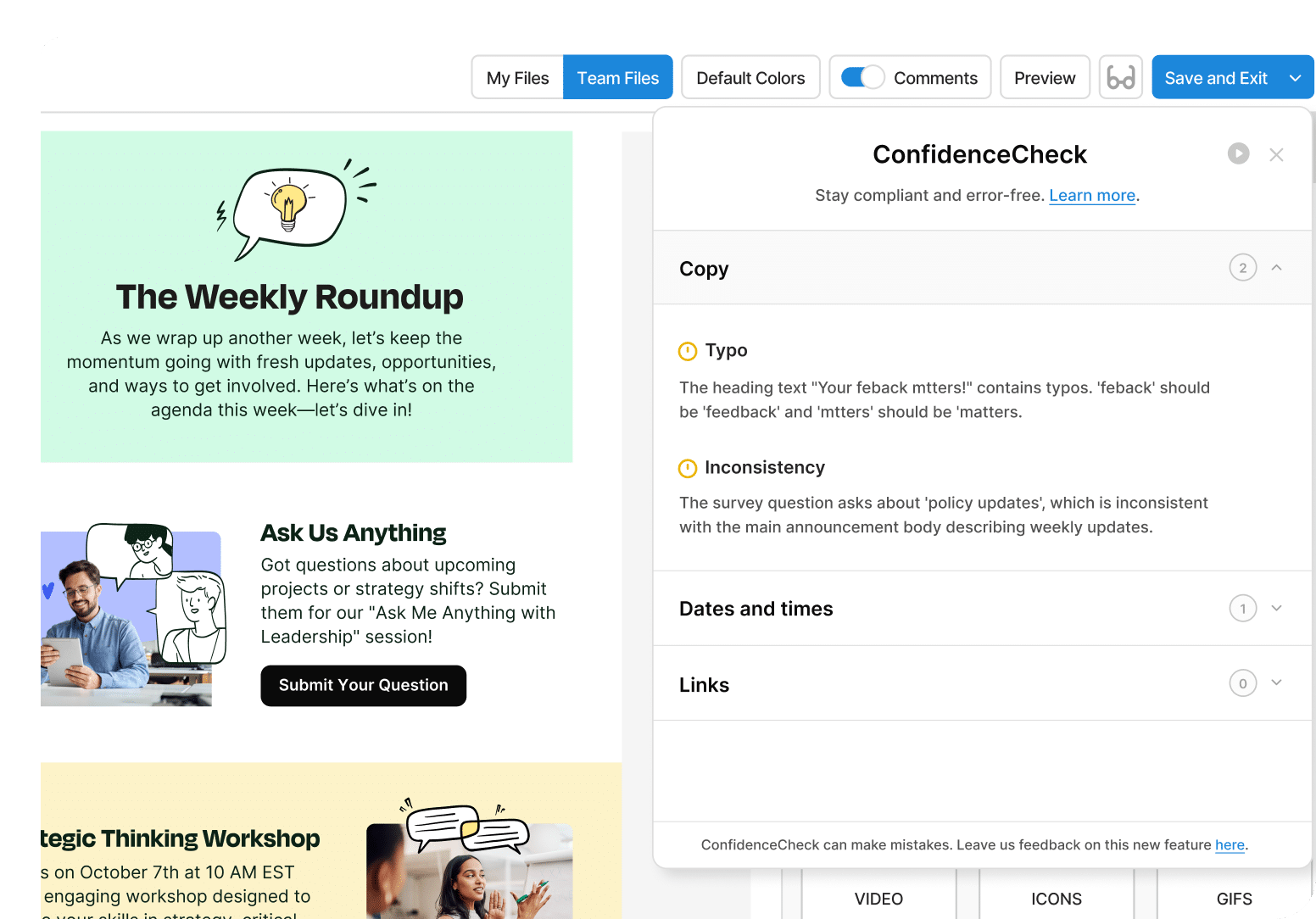
One of the more instructive elements of Mustang Cat’s story is how Jerilyn approached the reality of running a one-person communications function. When ContactMonkey introduced ConfidenceCheck, an AI agent that reviews emails for errors, tone, and quality before sending, her reaction was immediate. “I often do it by myself. To know that ContactMonkey was looking for ways to have my back, I was just stunned.”

This is worth paying attention to because it reflects a broader shift in how AI in internal communications is actually being used on the ground. The most practical applications are about reducing the risk of errors, improving consistency, and freeing up time that lean teams can redirect toward strategy. If you want to go deeper on this, ContactMonkey’s guide on AI and the future of internal communications covers what is genuinely changing and what is not.
The Results
- Deskless employees representing 40 to 50% of the workforce received reliable and trackable communications for the first time
- Servant Leader of the Year award nominations increased exponentially after targeted campaigns were introduced
- Employee trust in communications improved measurably, with clearer pipelines reducing ambiguity between work groups
- Leadership attributed the structured communication program as a contributing factor to reduced employee turnover
How to Replicate This in Your Organization
1. Run a communications audit before adding anything new. Document what employees currently receive, who it comes from, how often it goes out, and whether anyone is tracking whether it lands. If you cannot answer those questions with confidence, that audit is your entire starting point. Everything else follows from knowing your baseline.
2. Segment your audience before you optimize your content. Start by identifying your two or three most distinct employee groups and build separate sends or dynamic content blocks for each. For organizations with significant deskless or frontline populations, this step is not optional. Sending the same message to every employee regardless of role or location is one of the most reliable ways to train people to ignore your communications over time.
3. Use AI in internal communications where it genuinely improves consistency. AI-assisted features are most valuable when they reduce the kind of errors and inconsistencies that erode sender credibility over time, things like tone mismatches, formatting issues, or factual mistakes in a company-wide send. Before reaching for AI to generate content faster, identify the sspecific points in your workflow where quality tends to slip and start there.
2. First Onsite Internal Communication Case Study: Crisis Communications and Frontline Reach
With 80% of its workforce deployed to active disaster sites across North America, First Onsite needed an internal communications strategy that could reach deskless employees reliably, including during live emergency response. Email alone was not enough. What followed was a channel strategy built around employee SMS, geographic segmentation, and mobile-first email design that took newsletter open rates from 55% to 100%.
- Industry: Construction and infrastructure
- Company size: 10,000+ employees
- Key focus: Crisis communications planning, channel strategy for deskless and frontline workers
The Goal and Audience
First Onsite is a restoration and property reconstruction company that deploys skilled tradespeople to active disaster sites across the United States and Canada. Around 80% of its workforce are frontline employees, the boots-on-the-ground responders who mobilize when hurricanes, floods, and environmental emergencies strike.
When Toni Daylor stepped into the Director of Global Internal Communications role, she inherited a communication setup that relied almost entirely on email to reach a workforce that was rarely sitting at a desk. For time-sensitive crisis mobilizations, that gap was serious. A missed notification or a message buried in an inbox could mean delayed response times and real consequences for people affected by disasters.
The Approach
Toni recognized immediately that email alone could not carry the full weight of First Onsite’s communication needs, particularly for urgent mobilizations where every minute mattered. She added ContactMonkey’s employee SMS to the mix, giving her a channel that frontline workers would see and act on quickly, regardless of whether they were near a computer. SMS functions as a direct push channel: messages land on employees’ personal devices, are treated with more urgency than email, and are far easier to read and act on in the field.
Toni used distribution lists to segment her sending by geographic region, so mobilization messages only reached employees operating in the area of a given emergency. This kept communications targeted and prevented the notification fatigue that sets in when employees repeatedly receive messages irrelevant to their location or role.
Internal email remained a core part of the strategy for non-urgent communications. Toni sent a monthly organization-wide newsletter, a bimonthly HR newsletter to leaders, and regular updates covering organizational changes, training, and policy information. All emails were built using ContactMonkey’s email template builder to ensure mobile responsiveness, an important detail for a workforce that reads most communications on a phone.
“Our most important use of SMS is our crisis communication,” Toni explained. “We had the hurricanes just a couple of weeks ago, and I had to send out messages to mobilize people to get to where they needed to be.”
Analytics played a consistent role in refining the strategy over time. When First Onsite began tracking engagement through ContactMonkey, the monthly newsletter had open rates of 55% and read rates of 40%. After using analytics to identify what content was resonating and adjusting accordingly, open rates reached 100%, and the proportion of employees spending more than a minute reading the newsletter climbed to 55%.
The Results
- Open rates on the monthly newsletter improved from 55% to 100% after analytics-informed content adjustments
- Read rates improved from 40% to 55%, with more employees spending meaningful time with content
- Frontline employees across the US and Canada became reliably reachable during live crisis events through geographically segmented SMS
- SMS link tracking and email click maps gave Toni ongoing visibility into what was driving engagement and where to adjust
How to Replicate This in Your Organization
Crisis communications is one of the areas where most internal communications plans have the largest gap between intent and execution. But the channel and segmentation lessons from First Onsite apply well beyond emergency response.
1. Map every employee group to the channel they will actually act on. For every major employee group in your organization, identify which channel they are most likely to see and act on within the first 30 minutes of receiving a message. For desk-based employees, that is usually email. For frontline or deskless workers, it is almost always SMS or mobile push. If your internal communications plan routes everything through a single channel regardless of audience, it has a gap that will show up at the worst possible moment.
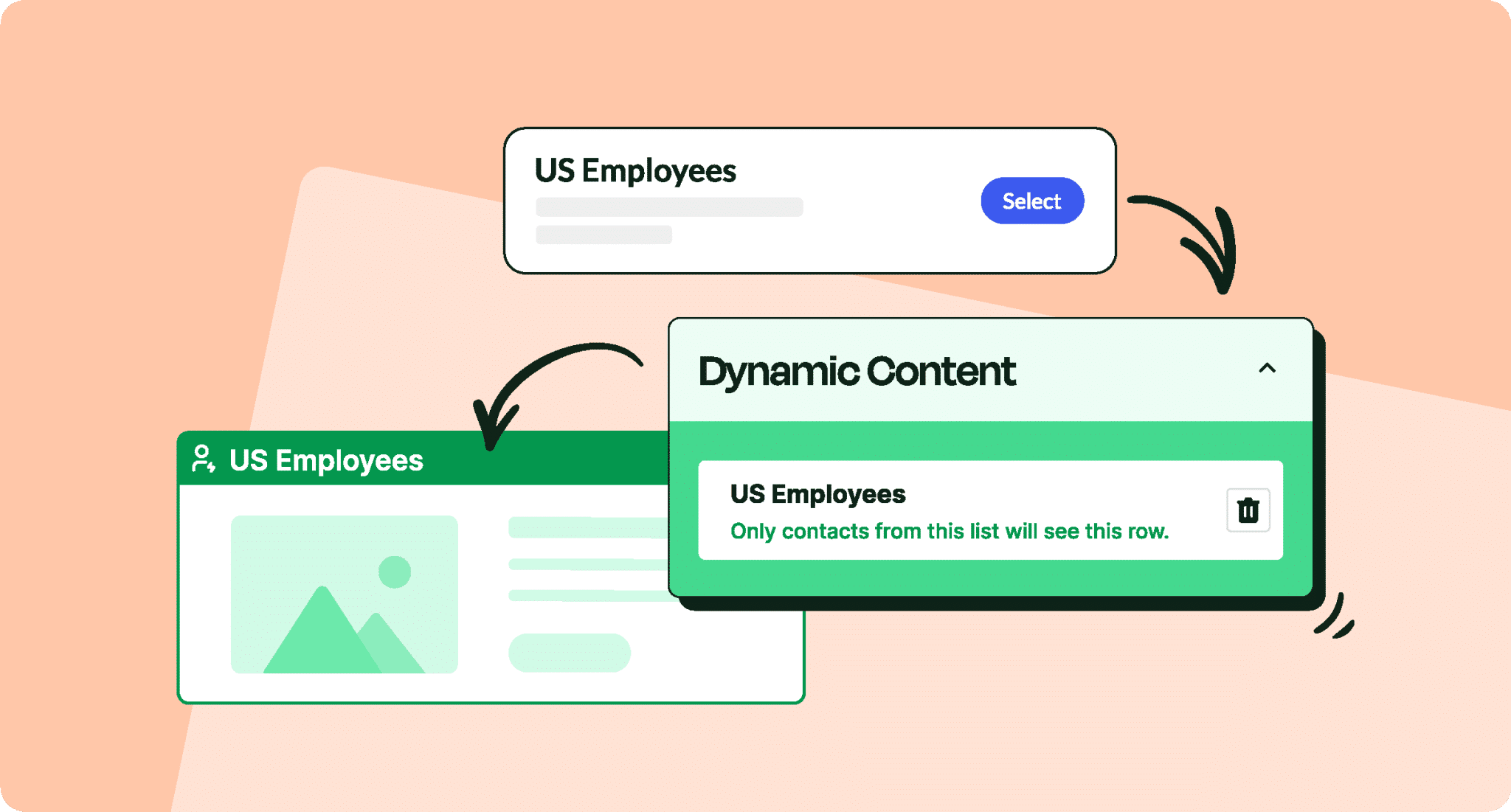
2. Use dynamic content to make one send do the work of several. Dynamic content allows you to build a single email or newsletter that displays different content blocks to different employee groups based on criteria like department, location, role, or manager level. A hospital using dynamic content might send one weekly newsletter that shows clinical staff their compliance updates and shift reminders, while people managers in the same send see leadership briefings and team engagement prompts. For organizations with both hybrid and frontline populations, this is one of the highest-leverage changes you can make to an existing internal communications strategy without overhauling your entire setup.

3. Design every communication to be read on a phone first. For organizations with significant frontline populations, designing communications for desktop first and mobile second is the wrong order of operations. Email templates should be tested on mobile before they go out, links should be easy to tap, and any critical information should appear high enough in the message that employees do not need to scroll to find it.
3. Healthcare Internal Communication Case Study: Turning an Employee Newsletter Into a Recruitment Engine
A behavioral health organization supporting more than 5,000 employees needed its internal communications program to do more than inform. It needed to drive measurable participation in employee referral campaigns and strengthen culture across a distributed workforce. What followed was a newsletter and campaign strategy that pushed referral contest email open rates above 90% and increased monthly employee referral hires from 20 to 30.
- Industry: Healthcare and life sciences
- Company size: 1,000 to 9,999 employees
- Key focus: Running an internal communication campaign, using internal communications to drive a specific business outcome
The Goal and Audience
Ashley Castillo is a Recruitment Marketing Specialist at an organization providing autism therapy and behavioral health services across the United States, supported by more than 5,000 professionals. Her challenge is one that many internal communicators in healthcare will recognize. She needed internal communications to do more than inform. She needed them to inspire participation, strengthen culture, and produce outcomes the broader organization could measure, specifically around employee referrals and retention. Before ContactMonkey, employee newsletters and culture updates were functional but flat. Engagement felt low, visibility into results was limited, and referral campaigns relied on internal email without any way to know whether those emails were actually driving participation.
The Approach
Ashley’s approach combined creative content and performance data, two things that tend to be treated separately in most organizations. She used ContactMonkey’s email template builder to design employee newsletters that felt genuinely human, incorporating team photos, employee shout-outs, and recurring culture features that gave employees a reason to look forward to each send rather than scan and delete it.
At the same time, she tracked employee engagement metrics on every send, using open rates, read rates, and click data to test what was resonating and refine her approach over time. She optimized send times based on when employees were most likely to engage, adjusted layout based on where attention dropped off, and used that data to build a case internally for the value of what she was doing.
The referral campaign component is where the results became genuinely instructive for other internal communications teams. Rather than treating employee referrals as an HR initiative that occasionally needed a promotional internal email, Ashley ran targeted referral contests with dedicated sends designed to generate excitement and urgency. Those emails were tracked and optimized the same way her employee newsletters were, which meant she could see in real time whether the campaign was building momentum or needed adjustment.
“Employees actually look forward to our communications now,” Ashley said. “They tell me the newsletters feel more human, relevant, and enjoyable, and the data backs that up.”
The Results
- Monthly employee referral hires increased from 20 to 30, a direct result of stronger campaign visibility and employee excitement around referral contests
- Referral contest emails consistently achieved open rates above 90%
- Company-wide employee newsletter satisfaction reached a rating of 4.41 out of 5 from employees
- Fully read rates climbed from 31.3% to 37.3%, peaking at 41.7% in the first quarter
- Employees began proactively sending in team photos to be featured in the newsletter, a sign that internal communications had become part of the company identity rather than a broadcast employees tolerated
How to Replicate This in Your Organization
This case study is most directly applicable to internal communications teams in healthcare, professional services, or any people-heavy industry where employee referrals, retention, and culture are genuine business priorities. The steps below show how to run an internal communication campaign that produces outcomes leadership cares about.
1. Design your employee newsletter to be something employees genuinely want to read. This means treating your employee audience the way a good editorial team treats its readers. Include content that has genuine value beyond company updates, recurring features that create familiarity and anticipation, and visual design that reflects the culture you are trying to build. Team photos, peer recognition, and employee spotlights consistently outperform policy updates and leadership announcements on engagement metrics, and they cost very little to produce. For a practical starting point, this list of 20 internal company newsletter ideas with examples covers a wide range of formats and approaches worth considering.
Create employee newsletters that drive clicks and conversations
Easy drag-and-drop content blocks. Add videos, photos, or custom polls. Customize content blocks to specific internal audiences.
Explore newsletter features

2. Give campaign messages their own dedicated internal email send. When a campaign message competes with six other items in a newsletter, it rarely gets the attention it needs. Dedicated sends with a single clear call to action, a specific deadline, and a subject line written to generate curiosity consistently outperform newsletter inclusions for campaign-type content. Use your regular employee newsletter to build culture and maintain trust, and use targeted internal emails to drive specific actions.
3. Build a feedback loop that doubles as a content pipeline. Asking employees to submit team photos, share wins, or nominate peers for recognition does two things simultaneously. It gives employees a reason to engage with communications as participants rather than passive recipients, and it generates a steady stream of authentic content that makes your employee newsletter feel more like a community touchpoint. For more ideas on driving genuine employee participation, this list of 30 fun and creative employee engagement ideas and activities is a useful starting point.
4. SEEK Internal Communication Case Study: Dynamic Content, Segmentation, and Newsletter Strategy
SEEK’s internal communications team was running a weekly employee newsletter on a rigid, costly platform that made it difficult to serve different regional audiences or match the visual quality of its external brand. What followed was a move to ContactMonkey that introduced dynamic content targeting for people managers, improved email design across all regions, and shifted employee channel preferences away from Slack toward internal email, with ANZ open rates reaching 55 to 60%.
- Industry: Technology
- Company size: 1,000 to 9,999 employees
- Key focus: Employee newsletter strategy, dynamic content, multi-audience segmentation across regions
The Goal and Audience
SEEK is a leading global employment marketplace headquartered in Australia, connecting millions of job seekers with opportunities across Australia, New Zealand, and Asia. Its internal communications team, led by Internal Communications Specialist Emily-Rose Carr, runs a weekly employee newsletter that serves as one of the most visible touchpoints for employees across multiple countries and time zones.
The challenge was that the tool SEEK was using to reach them had become a constraint. Templates were rigid and difficult to adjust, creativity was limited, and the cost of the platform relative to what it delivered had become hard to justify. Meanwhile, employees across different regions had different communication needs, and the existing setup offered very little flexibility to serve them differently within the same send.
“We wanted something more nimble that would let us change things quickly, test new ideas easily, and make our comms look as polished internally as our external brand,” Emily-Rose explained.
The Approach
When SEEK evaluated alternatives to their existing platform, their criteria were straightforward: every must-have feature needed to be present, including dynamic content, flexible template customization, and security integration; as many nice-to-have features as possible without additional cost; and total cost equal to or less than what they were already paying. ContactMonkey met all three, and the impact on SEEK’s employee newsletter strategy was immediate.
Dynamic content became the centerpiece of SEEK’s approach to serving a multi-audience workforce within a single send. People managers across Australia, New Zealand, and Asia received role-specific content tailored to their needs inside the same weekly newsletter that every other employee received. Rather than managing separate sends for different groups, the communications team maintained one campaign while delivering a more relevant experience to each segment. Internal emails were also redesigned to match SEEK’s external brand standards, which had a measurable effect on how employees perceived and engaged with them. Employees notice when internal communications feel like an afterthought compared to external-facing content, and that perception affects engagement.
The channel shift that followed was one of the more unexpected results. Historically, SEEK employees preferred Slack for company updates. After the redesign and introduction of more targeted content through ContactMonkey, employee feedback showed a clear move toward preferring internal email for important updates, driven by quality and relevance rather than mandate. SEEK also began using ContactMonkey’s translation feature to better serve employees in Indonesia and Thailand in their native languages, with the expectation that this would close the engagement gap between ANZ and Asian markets.
The Results
- Average click rates reached approximately 19%, well above internal communications industry benchmarks
- ANZ audiences achieved open rates of 55% to 60%, while Asian markets reached 35% to 40%, with plans to close the gap through native language translation
- Employee channel preference shifted away from Slack toward internal email for important updates, driven by improved design and content relevance
- People managers began receiving role-specific content inside the main weekly newsletter through dynamic content targeting
- Internal emails reached a level of visual polish consistent with SEEK’s external brand standards
How to Replicate This in Your Organization
This case study is most relevant to internal communications teams managing a distributed or multi-region workforce, or anyone whose current internal communications platform has become a constraint. The steps below focus on the newsletter strategy, dynamic content, and segmentation lessons that are most transferable.
1. Identify which employee groups are receiving content that was not written for them. Before introducing dynamic content, map out your primary audience segments and the content that is most relevant to each one. People managers need different information from individual contributors. Employees in one region may need updates that are irrelevant to another. Once you have that map, you have the foundation for an internal email personalization strategy.
2. Treat your internal email channel with the same strategic discipline as your external marketing channels. This means investing in template design, writing subject lines with the same care you would for an external campaign, and testing send times based on when employees are most likely to engage rather than when it is most convenient to send. The SEEK example shows that when an internal email is treated as a genuine communication channel, employees respond to it differently.
3. Address language and accessibility barriers before drawing conclusions about low engagement. Before attributing underperformance to content or strategy, check whether the communications a particular employee group receives are genuinely accessible to them. ContactMonkey’s multi-language email feature allows teams to deliver the same internal email in multiple languages without managing separate sends, and ConfidenceCheck now includes built-in accessibility checks to catch issues before they reach employees.
5. Freedom Mobile Internal Communication Case Study: Using Email Analytics to Drive Leadership Alignment
SEEK’s internal communications team was running a weekly employee newsletter on a rigid, costly platform that made it difficult to serve different regional audiences or match the visual quality of its external brand. What followed was a move to ContactMonkey that introduced dynamic content targeting for people managers, improved email design across all regions, and shifted employee channel preferences away from Slack toward internal email, with ANZ open rates reaching 55 to 60%.
- Industry: Technology and telecommunications
- Company size: 1,000 to 9,999 employees
- Key focus: Using internal communications analytics to inform strategy, drive leadership alignment, and navigate organizational change
The Goal and Audience
Freedom Mobile is a Canadian wireless telecommunications provider serving millions of customers across the country. When the business was acquired by a new parent company, Jeremy Roberts, Senior Manager of Communications, Go-To-Market and Incentives, faced a situation most internal communications professionals will recognize in some form. A change in organizational structure created pressure to consolidate tools, and ContactMonkey was on the list of platforms under review.
Jeremy made the case to keep it. Not because it was familiar, but because of what it allowed his team to do on a daily basis. “We were recently acquired by a new company, and I was very passionate that the contract had to go from the old company to the new company because of what ContactMonkey allows us to do.” That decision, and the reasoning behind it, is what makes Freedom Mobile’s story useful for internal communications teams trying to demonstrate the strategic value of their function during periods of organizational change.
The Approach
Freedom Mobile’s communications team used ContactMonkey’s analytics not just to report on performance but to make active decisions about strategy. Open time distribution data informed when emails were deployed, so sends went out when employees were most likely to engage. Click maps and read time data identified which content was genuinely resonating and which sections employees were skipping, allowing the team to refine their approach, send by send.
The more distinctive element of Freedom Mobile’s approach was how they used analytics beyond the communications team itself. Rather than keeping performance data internal, Jeremy shared engagement reports directly with people managers across the organization, showing them which content their teams were engaging with. Those managers then used that data in direct conversations with their teams, creating a feedback loop that connected internal email performance to team-level behavior change.
This is a meaningful shift in how internal communications analytics tend to be used. In most organizations, engagement data stays within the communications function and is used primarily to justify the team’s existence or tweak subject lines. Freedom Mobile used it as a leadership tool, which changed both the impact of the data and the perceived value of the communications function that produced it.
The Results
- Open rates improved by an average of 15% across internal audiences through data-informed send time optimization
- Read rates grew from 32% to 40%, reflecting deeper content engagement across the organization
- People managers used team-level engagement data to drive direct improvements in how their teams interacted with communications
- ContactMonkey survived an acquisition review and was retained as a strategic platform under the new parent company, a direct result of the team’s ability to demonstrate its value
How to Replicate This in Your Organization
1. Establish your baseline metrics before making any strategic claims. Pull the open rates, read rates, and click rates from your last ten sends and calculate your averages. That baseline is what makes every subsequent improvement legible to leadership, and it is what separates a team that says communications are getting better from one that can show it.
2. Share engagement data with people managers as a regular practice. Build a simple monthly report that shows each people manager how their team is engaging with internal communications, which sends they opened, which links they clicked, and where employee engagement is lower than the organizational average. Frame it as a tool for managers rather than a performance review, and the data will start driving team-level behavior change rather than just justifying the communications function.
3. Connect your analytics story to a business outcome that leadership already tracks. The more persuasive version of engagement data connects communication performance to something leadership already measures, whether that is change adoption speed, retention in a specific team, or participation in a key program. Identify one connection between your internal communication metrics and a business outcome, document it consistently over two or three quarters, and use it as the foundation of your business case.

The 2026 Internal Communication Trends That Show Up Across Every Case Study
Reading five internal communication case studies back-to-back makes certain patterns hard to ignore. The organizations that saw the strongest results were the ones that had gotten deliberate about a small number of things that the broader industry is only now catching up to.
Internal email remains the most effective channel, but the bar has risen
Every organization in this post used internal email as a primary channel, and every one of them saw meaningful improvements when they treated it with the same strategic care that marketing teams apply to external campaigns. Subject lines, send timing, mobile optimization, and visual design all moved the needle in ways that adding a new channel would not have. The channel itself was rarely the problem. How it was being used was almost always.
Reaching frontline and deskless workers has become a strategic priority
The Mustang Cat and First Onsite case studies both center on a workforce where 40 to 80% of employees have no reliable desk-based communication pipeline. This is not a niche problem. GSIC 2026 data shows that 55% of organizations report having 100 or more frontline employees, and 72% rate frontline engagement as important or very important. The gap between that stated priority and the communication systems most organizations have built to serve it remains one of the most significant structural challenges in internal communications today.
Measurement has moved from a reporting function to a strategic one
Freedom Mobile and the healthcare organization in this post both used engagement data in ways that went beyond tracking opens and clicks. They used it to influence leadership behavior, drive team-level improvements, and connect internal communication activity to outcomes the broader business cared about. According to Ragan Communications’ 2026 internal communications trends survey, leading IC teams are now expected to tie communication metrics to organizational goals and outcomes such as reduced errors, improved compliance, and higher completion rates. The teams that do this shift from being seen as a support function to being seen as a strategic partner.
AI is changing what internal comms teams can accomplish
Mustang Cat’s experience with ContactMonkey’s ConfidenceCheck feature reflects where AI in internal communications is delivering the most immediate value today. But the opportunity extends well beyond quality control. According to GSIC 2026, AI is the number one topic of interest among internal communicators, with teams exploring applications across content creation, sentiment analysis, translation, accessibility, and engagement analytics. The practical applications are already making a measurable difference, and the strategic ones are developing quickly.
Relevance has replaced volume as the primary driver of employee engagement
SEEK’s use of dynamic content to serve different employee groups within a single send reflects a shift that is showing up consistently across internal communication case studies. The organizations seeing the strongest engagement results are not the ones sending the most communications. They are the ones sending communications that feel worth reading because they are tailored to the person receiving them. Segmentation, dynamic content, and audience-specific sends are the mechanics behind that relevance, and they are increasingly accessible to teams without large budgets or technical resources.
Ready to See What Your Internal Communications Can Do With ContactMonkey?
The five case studies in this post share a common thread. Whether the starting point was zero infrastructure, a disconnected frontline workforce, a flat employee newsletter, or an acquisition that put every tool under review, a more deliberate internal communications strategy produced outcomes that went beyond engagement metrics and into territory leadership actually cares about. More hires, higher trust, better retention, and a communications function that could demonstrate its own value.
The tactics vary by organization and context, but the underlying pattern is consistent. Teams that defined a clear objective, matched their channel to their audience, measured what mattered, and connected their results to a business outcome are the ones that saw the biggest improvements and built the most durable programs.
If you want to see how ContactMonkey can help you get there, book a demo to see what a stronger internal communications strategy looks like for your organization.
FAQs
1. What is an internal communication case study?
An internal communication case study documents how a specific organization identified a communication challenge, implemented a strategy to address it, and measured the outcome. The most useful examples include enough context about the audience, channels, and constraints involved that another team can evaluate whether the approach applies to their own situation.
2. What makes an internal communication strategy effective?
The most effective internal communication strategies share four characteristics. They are built around a specific business objective rather than a general goal like “improving engagement.” They match the channel to the audience rather than defaulting to whatever is most familiar. They use data to refine the approach over time. And they connect communication activity to outcomes that the broader organization measures independently of the communications function.
3. How do you measure the effectiveness of internal communications?
Effective measurement starts with baseline metrics, including open rates, read rates, and click rates, tracked consistently across sends. The next layer connects those metrics to business outcomes such as employee referral rates, training completion, change adoption speed, or retention in specific teams. Organizations that share engagement data with people managers, as Freedom Mobile did in this post, often see the greatest improvements because measurement becomes a tool for organizational alignment rather than internal reporting.
4. How can internal communications drive employee engagement?
Internal communications drives employee engagement when it moves beyond broadcasting updates and starts delivering content that feels relevant, human, and worth reading. The healthcare organization in this post increased employee referral hires by 50% by designing newsletters around culture and recognition rather than announcements, and by running targeted campaigns with a single clear call to action. Consistency, relevance, and a two-way feedback loop are the three factors that show up most consistently across high-engagement internal communications programs.
5. What internal communication channels work best for reaching frontline employees?
Email remains the most effective channel for desk-based employees, but frontline and deskless workers require a different approach. SMS is the most reliable channel for urgent or time-sensitive communications because messages land directly on personal devices and are treated with more urgency than email. For organizations with both desk-based and frontline populations, dynamic content within a single email send allows teams to deliver relevant content to each group without managing multiple separate campaigns.