Years ago, I worked for an organization navigating significant change. Following a CEO transition, our new CEO restructured our team and sought support with the announcement, with little time to prepare. The leaders I worked closely with on all staff announcements jumped right into creating a slide deck for our all-hands meeting, complete with detailed org charts and team hierarchies, but lacking the broader narrative around the restructure.
We rolled out the restructuring at one of our usual all-hands meetings. Employees had several questions that leaders couldn’t answer because we hadn’t taken the time to align on the messaging and narrative. To add, we had no way of knowing whether our communication about the restructure was “successful,” since we didn’t define what success looked like upfront.
An internal communications brief, or IC Impact Brief, prevents experiences like these. In this article, we’ll cover what an IC Impact Brief is, why it belongs at the start of every internal communications effort, what to include in yours, and importantly, what it can’t fix.
The Real Cost of Working Without an Internal Communications Brief
Fielding ad hoc requests without a formal internal comms request process isn’t uncommon, especially in smaller organizations without operational internal communications structures. Feeling under-resourced and over-requested (and, even, overwhelmed) is an experience many internal communicators share. And recent research supports the fact that IC teams are small, demands are high, and strapped teams simply can’t do it all.
ContactMonkey’s Global State of Internal Communications (GSIC) 2026 Report revealed that nearly half of internal communications teams have 2-5 members, and 19% are a team of one. Internal communicators field ad hoc requests left and right, without enough resources or the tools to manage them effectively.
Aside from the obvious workflow disruptions, the cost of working by responding to requests is high. Reactive request culture is a structural problem that shows up in how internal communicators spend their time. According to GSIC 2026, internal communicators spend 78% of their time on content creation and templates, compared to 36% on strategy development, underscoring capacity constraints.That imbalance is partly structural: reactive request culture, without a planning document to anchor it, keeps teams in execution mode by default
That means many internal communicators spend most of their time tactically executing, in part because an ad hoc internal comms request process facilitates this kind of work. Without the right structures in place, such as an IC Impact Brief, solo internal communicators and small teams unintentionally lock themselves into a heavily leaning tactical ratio.
Another challenge with last-minute requests that most internal communicators know all too well is the errors that urgency facilitates. Pulling together messaging with muddied objectives and unclear narratives under pressure often causes more harm than good. 44% of teams had to resend or correct an internal email 1-2 times in the past year; 27% did so 3-5 times, GSIC 2026 revealed. An IC Impact Brief helps address common causes of unwanted errors: unclear objectives and last-minute timelines.
Unlock Internal Comms Superpowers
Discover why 10,000+ rely on us. See the internal email and employee newsletter platform in action.
Book demo

What Is an Internal Communications Impact Brief (And What Does It Include)?
An IC Impact Brief is a strategic planning document designed to capture the intent behind an internal communications effort or campaign before any work begins. The IC Impact Brief anchors every internal communication to measurable outcomes so your messages don’t just reach people, they drive them to take action, learn new information, or change their behaviors or workflows. It answers the foundational questions teams overlook when they rush to publish last-minute, including:
- Why are we communicating this message?
- Who needs to hear this information, and why does it matter to them?
- What do we want people to think, feel, or do differently as a result of this information?
Think about it this way: An IC Impact Brief captures the “why,” establishes goalposts to work toward, and provides a shared understanding of how your team will measure success. Your IC Impact Brief should serve as a single source of truth that aligns all communicators, stakeholders, and leaders around the purpose, audience, and outcomes of an internal communication before ever writing a single word of copy. In practice, learning how to brief internal communications means answering the strategic questions that shape every message.
An IC Impact Brief is not the same as an email chain with multiple stakeholders offering input or guidance on an internal communication. In fact, sometimes, email chains like these create more confusion, particularly in environments where it’s unclear who’s driving the communication forward and has final approving authority. IC Impact Briefs provide far more clarity than an email chain can.
IC Impact Brief vs. Project Plan vs. Content Calendar
An IC Impact Brief is one of many tools internal communicators should use as part of their foundations, but it’s important to understand that it’s not the same as, or a replacement for, thorough project plans or internal communications content calendars. All three of these tools serve different purposes and are most useful at different points in the internal communications lifecycle.
Let’s take a closer look at each of these three tools, what they do best, and where they don’t shine as bright:
| IC Impact Brief | Project Plan | Content Calendar | |
| Definition of the tool | A strategic document that captures the intent, audience, and desired outcomes of an internal communications effort, before the work begins | A task-by-task breakdown of who does what and by when | A schedule of what content gets published, on which channels, and when |
| Primary purpose | Define the “why,” set success criteria, and set impact goals before writing any copy | Manage the execution of the work and create shared accountability | Organize and sequence content delivery across various internal communications channels |
| When to use this tool | At the very start (the first step), before any writing, planning, or scheduling happens | Once intent is aligned and work is ready to be assigned and tracked | Once you outline the internal communications strategy, and you’re ready to plan content sequencing |
| What this tool does well | Creates strategic messaging clarity and stakeholder alignment | Keeps teams on track, surfaces dependencies, and ensures accountability | Provides visibility into the full internal communications landscape and prevents gaps or overlaps |
| What this tool doesn’t do well | Track tasks or schedule content | Define the broader internal communications strategy (a project is one piece of a broader strategy) | Explain why content exists or what it should achieve |
Depending on the internal communication itself, timeline, and your workflows, you might not need (or have time for) a full project plan, especially if you are working on lower-stakes messaging rather than multi-month campaigns. In these instances, I always recommend including task breakdowns and clear roles and responsibilities in the IC Impact Brief to prevent any confusion.
What Belongs in an Internal Communications Brief Template?
Here are the non-negotiables to include in your communications brief template, in the recommended order of inclusion:
- Communication objective: A clear, specific statement outlining what you want this communication to accomplish and why it matters to the organization right now (tie why it matters to a business objective for maximum impact).
- Target audience (role, location, language needs): A precise definition of who this communication is for, including any nuances in role, geography, or language that will shape how you deliver the message.
- Core message (3-5 key points, maximum): The essential ideas your audience needs to walk away with, distilled to only what is necessary and nothing more.
- Desired employee outcomes: A description of what you want employees to think, feel, or do differently as a direct result of receiving this internal communication.
- Channel(s) and format(s): The specific channels (e.g., internal email, newsletter, team meetings, town hall, etc.) and content formats (e.g., written copy, videos, digital signage, etc.) you’ll use to reach your audience where they are, in the way they’re most likely to engage.
- Schedule and key milestones: The timeline that anchors the internal communication effort, including critical dates, dependencies, and any events or deadlines the messaging must align with. (Be thorough here if you won’t be creating a full project plan for the effort.)
- Defined roles and responsibilities: A clear record of who owns what (e.g., drafting, reviewing, approving, sending) so nothing falls through the cracks.
- Success metrics and measurement: The specific indicators you’ll use to evaluate whether the internal communication achieved its intended impact, defined before the work begins.
- Related internal communications and messages: A note on any other messages, campaigns, or announcements that intersect with this effort, so the broader narrative stays consistent and coordinated.
In addition to the sections above, there are a few high-value additions worth considering, depending on the nature of your work, including:
- Sensitivity or confidentiality level: A flag for how sensitive the information is and any constraints on who you can and cannot loop in, how early, or what you can and cannot share in draft form. This is critical for change announcements, layoffs, restructuring, and other people-impact messages.
- Change impact summary: A note on how this internal communication connects to a broader organizational change, if relevant.
- Manager resource development: A clear list of what people managers need to support the internal communication, which could include talking points, a pre-briefing meeting, supporting FAQs, and other templated materials to help their teams receive and process the message.
- Two-way feedback commitment: If you are collecting employee feedback, use this section to commit to a follow-up timeline and plan to ensure this information doesn’t sit untouched (and break employee trust).
Use these sections as you see fit to supplement the non-negotiables above.
Note: If your team uses AI tools to generate first drafts, the brief is what prevents that output from being generic. AI can move quickly, but it can only write to the direction it is given. A brief with a defined audience, tone, and desired outcome is what turns an AI-generated draft into something worth sending. According to ContactMonkey’s 2026 Global State of Internal Communications report, AI in the workplace is the top topic of interest for internal communicators this year, cited by 57% of respondents. IC teams are already using AI, and the brief is what keeps that usage grounded in organizational context and measurable intent. To go deeper on how IC teams are putting AI to work, ContactMonkey’s guide toAI for internal communications is a good place to start.
Why the IC Impact Brief is Also a Measurement Tool
According to GSIC 2026, 67% of IC professionals agree it is difficult to demonstrate the impact of their work inside their organization. The IC Impact Brief is where that changes. Not only does an IC Impact Brief provide the foundation for effective internal communication, but it also serves as a measurement tool that organizations lack when operating in a reactive request mode.
An IC Impact Brief functions as a measurement tool because it requires teams to define success before sending, which gives every analytics data point a benchmark to be evaluated against. When you define success metrics in your IC Impact Brief, you outline the before-state that adds context to your internal communications or employee engagement analytics. In other words, when you specify what you want to achieve, the analytics you gather help you assess whether you achieved your goal (rather than serving as empty numbers).
Here’s why an IC Impact Brief is also one of your best measurement tools:
Metrics without context are just numbers
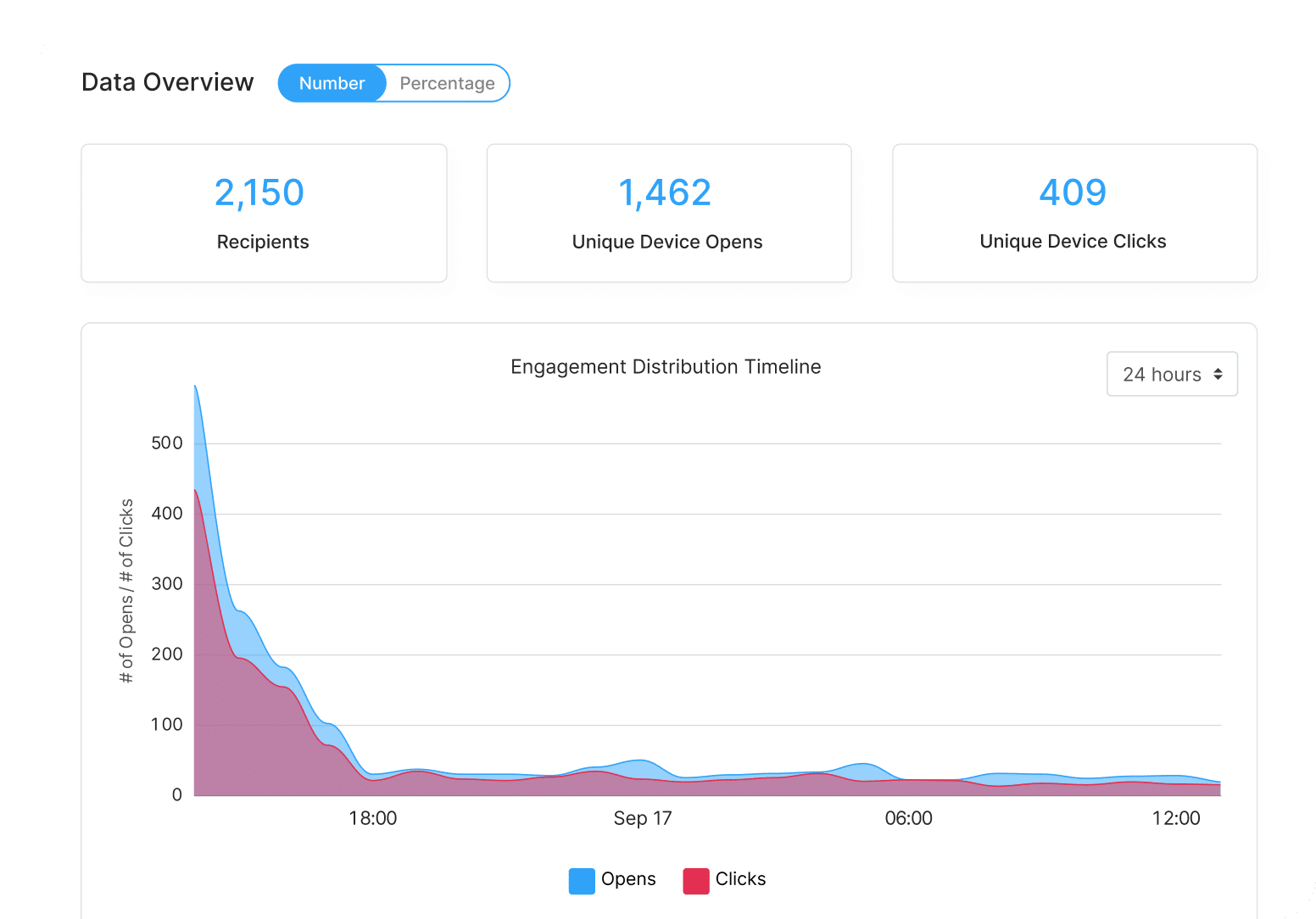
Internal communications platforms like ContactMonkey provide advanced internal email analytics that help organizations and internal communicators analyze and improve their work, but you have to add context to use the data effectively. Open rates, click-through rates, engagement metrics, survey responses, and other measures add the most value when you compare them against your expectations. You can’t deem a 42% open rate “good” or “bad” without a contextual understanding of the goal (or the organization’s internal benchmarks, which an internal communications platform like ContactMonkey also provides).
Effective comms briefs connect outputs to outcomes
Most IC measurement looks at generic outputs: How many people opened this message? How many people clicked on the link in this internal email? An IC Impact Brief pushes teams to define outcomes beyond quantitative measures, encouraging them to ask questions like: What should change as a result of this internal communication? What will employees do differently? What action(s) do we want employees to take? This is the difference between measuring reach alone and measuring reach and impact. A combination of both is what transforms IC into a strategic function rather than a reactive production service.
It creates a system for communication improvement
When you document intent, channels, audience, and success metrics in your IC Impact Brief and then measure against them, you build an institutional record over time. With this information, you can better understand and monitor patterns, including channel performance, audience engagement, and action rates across your organization’s segments.
Post-communication analysis is faster and more honest
Without an IC Impact Brief, post-mortems (if they even occur) rely on memory and subjective assessments. With an IC Impact Brief, any form of reflection or retrospective has a clear reference point. You can measure your qualitative and quantitative outcomes against what you set out to achieve and have a more honest, evidence-based conversation about what to do differently next time.
It encourages choosing the right metrics upfront
One underrated benefit of an IC Impact Brief is that defining success metrics before jumping into the work encourages teams to choose metrics that actually align with the goal, not just the ones that are easiest to pull. An internal email about a benefits enrollment deadline shouldn’t be measured solely by open rate; enrollment completion is the signal that demonstrates whether the internal communication drove action. (And, for bonus points, you could measure how quickly enrollment completion occurs and how many questions employees ask about enrollment to gauge the clarity of your comms). An IC Impact Brief helps teams tune in to what actually matters rather than push information for its own sake.
ContactMonkey’s analytics give that defined success metric somewhere to land, tracking open rates, read time, click behavior, and department-level engagement against the outcomes the brief established before the send.

How Can You Get Stakeholders to Actually Use an IC Impact Brief?
Okay, so an IC Impact Brief sounds nice in theory, but facilitating adoption of a comms brief is an entirely different story, right? Anyone who has ever tried to implement a new process, no matter how helpful, knows this is always easier said than done. Fortunately, though, it’s not impossible, and I learned some valuable lessons to share from introducing briefs to senior leaders in previous roles.
Here are my tried and true tips for encouraging stakeholders to adopt your new IC Impact Brief process:
Address any time objections upfront (and flip them)
When stakeholders say, “We don’t have time for this,” they’re often objecting because they don’t yet see the value in the new process. And it might take some data and showcasing how valuable the IC Impact Brief is before they are ready and willing to hop on board.
When pitching your IC Impact Brief process for the first time, consider two elements for success: (1) Clearly convey how you will insert it into current processes, and (2) If you can’t obtain buy-in for long-term use right away, pivot to ask for support in piloting the IC Impact Brief to prove it works.
It’s important to explain how you will integrate your IC Impact Brief into existing processes to prevent overwhelm. Grounding the document in your current workflows makes it a tool within an already familiar process. Don’t be afraid to arm yourself with data, either. Introduce where the IC Impact Brief fits into current workflows, and how it will save hours of revision cycles, stakeholder misalignment, and approvals, with examples of where these issues are creating current bottlenecks.
Additionally, if stakeholders and leaders resist or express skepticism, ease their concerns by asking if they can comfortably commit to using the IC Impact Brief in a pilot exercise (for 3-4 upcoming internal communications). This provides you with the opportunity to put the process into practice, gather data to support its value, and celebrate smaller successes along the way.
Ask stakeholders to contribute to the IC Impact Brief template (within reason)
One of the first pieces of advice you often hear when implementing a change is to ask for input from the people you are asking to make a change. That’s because asking for input and feedback fosters buy-in and ownership.
I once worked with a highly collaborative CEO who offered insightful perspectives on our communications. Upon creating our internal brief, I met with the CEO to introduce and review the template in detail before using it for the first time. During our meeting, I asked questions like:
- As you look at this brief, what stands out as most important to you?
- Is there anything I’m missing that you would find beneficial to add to this specific section?
- Is there anything you want employees to know that might not be obvious from the core message that would help them understand the “why” behind our communications? Do we have space in the brief to capture that information effectively?
- Where do you anticipate we will run into challenges as we complete this brief for upcoming internal communications? What should I be aware of?
We had a productive and intentional conversation about the template, and the CEO even offered a content-framing addition I hadn’t considered that helped us navigate significant organizational changes: What might a “skeptic” say about this message, and how can we proactively address their concern/reaction? Are there any unintended consequences of this message?
This step can add significant value by building buy-in and support, but you have to guide the process to gather helpful feedback. It’s important to be clear about what you want feedback on and which parts of the IC Impact Brief you feel are non-negotiable to prevent unwanted revisions.
Make it as easy as possible to say yes
Friction is the enemy of adoption, especially when a new process creates another to-do list item for someone else. Part of learning how to brief internal communications well is making the process simple enough that stakeholders will actually use it. In some organizations, it might be helpful to encourage stakeholders to complete an IC intake form and fill out the brief before handing it over for your review and discussion. I have always found that it’s easier to get stakeholders on board by introducing the IC Impact Brief and asking them to attend a quick (15-20 minute) conversation to complete the document as a team. When introducing a comms brief, I made it clear that I’d own completing the document, so long as all necessary stakeholders were available to discuss its contents on a call.
A bonus of doing it this way is that when you bring your stakeholders into a room to fill out a comms brief, you might surface misalignment among your organization’s leading voices. That’s the point. One of the most valuable things the IC Impact Brief does is expose disagreement early, before it’s too late to resolve. Naming this openly and encouraging leaders to hash out misunderstandings can make the new process feel slightly more frictionless.
Sell yourself as a strategic partner, not a gatekeeper
How you frame the IC Impact Brief matters enormously. If it feels like a compliance requirement or a process bottleneck that slows work down drastically, stakeholders are more likely to resist it. If you frame it as a tool that helps internal communications land with impact, it becomes a value-add. The language you use when introducing the IC Impact Brief sets the tone for everything that follows. Avoid framing it as a gatekeeping mechanism for preserving your sanity, and help your stakeholders understand what’s in it for them.
Sample messages for implementing an IC Impact Brief
If you’re ready to implement your own IC Impact Brief and want help communicating the new process with your stakeholders, borrow and customize one of the same messages below:
Sample Message 1: Use with a skeptical or time-constrained stakeholder
Hi [Name],
I know your plate is full, so I’ll keep this brief (no pun intended).
As we plan [internal communication initiative], I’d like to try something I’ve found saves significant time and improves results: a short planning conversation using the IC Impact Brief. The IC Impact Brief helps us align on intent, audience, and outcomes before the work begins, which means fewer revision cycles, errors, and last-minute messages that don’t land with the impact we intend.
I’d like to pilot the IC Impact for [2-3 upcoming internal communications] and share what we learn. I’ll own the completion of the document and keep each planning conversation to 15-20 minutes.
Would you be willing to give this a try?
[Your name]
Sample Message 2: Use with an internal stakeholder you are working with on an internal communication for the first time
Hi [Name],
As we start planning this [internal communication], I want to ensure we build a campaign that supports [business objective].
To do that, I’d love to introduce a planning document I use called the IC Impact Brief. It’s a short template that helps us align on the essentials before any writing begins: who we’re communicating to, what we want employees to think, feel, or do differently, and how we’ll know whether our communication is successful.
I’d like to schedule a 15-20 minute call to walk through it together. I’ll complete the document; I just need you and [any other key stakeholders] in the room to discuss the core messaging and our approach.
Does [date/time] work for a quick call?
[Your name]
What an IC Impact Brief Cannot Fix
The IC Impact Brief is a planning and alignment tool, not an organizational fix. While it provides a stronger foundation to work from, it can’t compensate for the structural, cultural, or relational conditions that determine whether the internal communications function has what it needs to succeed in the first place.
An IC Impact Brief (no matter how well done) cannot fix:
A culture where IC lacks authority to push back (and ask tough questions)
The brief provides IC with a basis for having hard conversations, but it can’t create the organizational conditions that support them. If leaders view internal communication as a production function rather than a strategic one, stakeholders may not welcome the surfacing of misalignment challenges that a brief can reveal. When an internal communication objective is vague, a timeline is unrealistic, or a core message is likely to land poorly, an IC Impact Brief surfaces those problems. But acting on them requires a level of credibility and authority that has to be earned and protected over time. The brief is a tool; the influence to use it effectively is something IC has to build separately.
Unrealistic and impossible internal communications timelines
An IC Impact Brief can document an unrealistic timeline, but it can’t manufacture the time needed to do the work well. When senior leaders hand an internal communicator a message with a two-day turnaround that realistically requires two weeks, the IC Impact Brief becomes a record of what leaders asked and what was possible, not a solution to the gap between them. An IC Impact Brief can make the constraint visible and create a paper trail that supports an honest conversation about what’s achievable. Over time, that documentation can help you make the case for being brought in earlier in the planning process, but only if those conversations are actually happening.
The absence of a clear organizational narrative
If your organization doesn’t have a coherent story about where it’s headed and why, no IC Impact Brief will compensate for that gap. Internal communicators can craft clear, well-targeted messages, but if leadership hasn’t aligned on the bigger narrative, those messages will eventually contradict each other (and employees almost always notice).
A message that was never going to land positively
If the news you are sharing is genuinely difficult, the decision is unpopular, or the organizational context is low-trust, a well-structured IC Impact Brief won’t change how employees receive the communication. The IC Impact Brief can ensure the message is as clear and thoughtfully delivered as possible, but it can’t create credibility or make up for goodwill that doesn’t exist.
Leaders and stakeholders who bypass processes
Even the most well-designed IC Impact Brief process breaks down when senior leaders go around it. This is one of the most common experiences in internal communications, and it’s a symptom of how leaders value IC, not a problem the brief can solve on its own. What the brief can do, over time, is build a track record of better outcomes that makes the case for bringing IC in earlier. But that’s a long game, and it requires executive sponsorship to stick and build traction.
The Secret to Better Internal Comms is an IC Impact Brief
The strongest internal communications don’t begin with urgency, a draft, or an ad hoc email request; they begin with clarity. An IC Impact Brief gives internal communicators and stakeholders a shared starting point to align on purpose, audience, outcomes, and measurement before the work begins. While it can’t solve every structural challenge IC teams face, it can create better conversations, stronger communications, and intentional outcomes that are actually measurable.
That last part is where ContactMonkey comes in. Once you have defined what success looks like in your IC Impact Brief, ContactMonkey gives you the analytics to know whether you achieved it, from open and read rates to department-level engagement and click behavior across every send. The brief sets the question. ContactMonkey answers it.
If you are ready to make your internal communications strategy more intentional and measurable, book a demo today to see how ContactMonkey can help.
FAQ
What is an internal communications brief?
An internal communications brief, or IC Impact Brief, is a planning document that outlines the purpose, audience, key messages, desired outcomes, and success measures for an internal communication before creating any content or copy. It helps teams align early, making internal communications more strategic, consistent, and impactful.
What should be included in an internal comms brief?
At a minimum, an internal comms brief should include the communication objective, target audience, core message, desired employee outcomes, channels and formats, timeline, roles and responsibilities, and success metrics. Depending on the internal communications campaign, it can also be helpful to include change impact, confidentiality level, manager resources, and two-way feedback follow-up plans.
How do I convince stakeholders to submit a comms brief?
Position your IC Impact Brief as a tool that saves time and improves outcomes, not a burdensome process. Make adoption easier by offering to complete the brief together in a short 15 to 20 minute planning conversation rather than asking stakeholders to fill it out independently. Connect it to workflows they already use, and if you cannot get full buy-in immediately, ask stakeholders to commit to using it for two or three upcoming communications first. That limited trial gives you the opportunity to demonstrate its value with real examples before asking for broader adoption.
What is the difference between an internal comms brief and a project plan?
An internal comms brief defines the strategic foundation of the communication: why it matters, who it is for, and what success looks like. A project plan follows the brief and focuses on execution, outlining tasks, owners, deadlines, and dependencies needed to deliver the work. If your organization does not run formal project plans, include tasks, owners, and dependencies in the brief itself.
How does a communications brief improve internal communications ROI?
A communications brief improves internal communications ROI by requiring teams to define success before the work begins. That upfront clarity transforms open rates and click data from isolated numbers into evidence of whether a communication achieved its intended outcome. For example, an internal email about a benefits enrollment deadline should not be measured by open rate alone. The signal that actually matters is whether employees completed enrollment. Defining that outcome in the brief before sending is what makes the data meaningful after. When IC teams can connect a specific message to a specific behavior change or business result, demonstrating the value of internal communications to leadership becomes significantly more straightforward. ContactMonkey also offers a free internal communications ROI calculator for IC teams looking to put a number to that impact.
How does ContactMonkey support an IC Impact Brief?
ContactMonkey is an internal communications platform built to give IC teams the data their briefs require. Once you define success metrics in your IC Impact Brief, ContactMonkey’s analytics features track open rates, read time, click behavior, and department-level engagement across every send, so you can evaluate whether the communication achieved its intended impact. ContactMonkey features including AI-assisted drafting, audience segmentation, and send optimization also help teams execute against the strategic intent the brief establishes, closing the gap between planning and proof.