Almost every organization collects employee feedback today. ContactMonkey’s 2026 Global State of Internal Communications (GSIC) Report found that 95% of organizations actively collect it in some form. The harder problem is what happens after. The same report found that only 15% of organizations say the actions taken on employee feedback are clearly communicated and visible to employees, while 47% say actions are only sometimes shared, and 31% describe follow-up as inconsistent or delayed.
That gap, not a shortage of survey tools, is the actual problem this category needs to solve. This guide covers the 15 types of employee feedback tools worth knowing in 2026, what each one is actually good for, and how to evaluate feedback software built to close the loop.
Why Does Employee Feedback Matter for Internal Communicators?
Employee feedback is the cheapest research an organization has access to, and most still get less out of it than a single honest exit interview. It is your only direct line to whether a message actually landed, whether a policy change made sense to the people living under it, and whether leadership’s read on morale matches reality.
A feedback program that is actually working does a few specific things.
- It builds trust, because asking for input and visibly acting on it tells employees leadership takes their perspective seriously, not just their attendance
- It surfaces problems while they are still small, before a quiet frustration turns into a bigger issue
- It gives you, the internal communicator, evidence for your own calls, so a shift in messaging strategy is backed by what employees said
- It closes the gap between how a message was intended and how it actually landed, which are two different things far more often than leadership assumes
Almost every organization already does the first half of this. But what separates the programs that matter from the ones employees have quietly stopped trusting is what happens after collection, and that is where most of this guide is aimed.
What Are Employee Feedback Tools?
Employee feedback tools are software built to collect, organize, and act on input from employees, ranging from a single emoji reaction to a full annual engagement survey.
For definitions of related terms like eNPS or pulse survey, if you’re new to internal comms, ContactMonkey’s internal communications glossary is the right resource for you.
How is a feedback tool different from a survey tool?
A survey tool is usually one format within the broader feedback category, a structured set of questions sent on a schedule. Feedback tools as a category also include lighter, always-on formats like emoji reactions, comment boxes, and one-question pulse checks that do not require a full survey structure to collect something useful.
What Types of Employee Feedback Tools Are Available in 2026?
These formats fall into three groups worth thinking about separately when you build a program. Structured formats run on a schedule and give you comparable data over time. Always-on formats collect input continuously without waiting for a campaign. Lifecycle formats trigger automatically around a specific employee moment, like a resignation or a promotion. A mature feedback program uses all three, not just the one that is easiest to set up.
| Type | Group | Best used for | Typical cadence |
| Comprehensive engagement surveys | Structured | A strategic baseline across the whole employee experience | Annual or semi-annual |
| Pulse surveys | Structured | Tracking sentiment shifts between larger campaigns | Weekly to monthly |
| Face to face feedback | Structured | Nuanced or sensitive topics that need dialogue, not a rating | As needed |
| Anonymous comment tools | Always-on | Honest input on topics employees will not attach their name to | Continuous |
| Embedded eNPS surveys | Structured | A quick, repeatable read on overall workplace sentiment | Quarterly |
| Emoji reaction tools | Always-on | Low-effort sentiment on one specific message or update | Per send |
| Exit interview and offboarding tools | Lifecycle | Candid input at the point employees have the least to lose | Triggered by departure |
| Onboarding feedback tools | Lifecycle | Catching process gaps while a new hire’s impression is still forming | First 30 to 90 days |
| Manager one-on-one templates | Structured | Recurring feedback that lives outside a formal survey cycle | Weekly or biweekly |
| Recognition and peer feedback tools | Always-on | Surfacing day-to-day wins a formal survey would never catch | Continuous |
| Town hall and live Q&A tools | Structured | Real-time questions during company-wide meetings | Per event |
| Suggestion box tools | Always-on | Open-ended ideas with no campaign attached | Continuous |
| Lifecycle survey tools | Lifecycle | Feedback tied to a specific moment, like a reorg or a new manager | Triggered by event |
| 360-degree feedback tools | Structured | Input from peers, managers, and direct reports together | Semi-annual |
| Embedded email feedback | Always-on | Placing any format above directly inside an email, not a separate link | Per send |
Where does ContactMonkey fit among these types?
Right in the always-on and lifecycle columns, without asking the employee to leave their inbox. ContactMonkey embeds eNPS, pulse questions, emoji reactions, and comment boxes directly inside the internal email itself. For the structured, recurring formats, like a full engagement survey, ContactMonkey’s employee survey software runs the same embedded approach at a larger scale, with segmentation and internal-specific reporting built in.
So your question might be: can I get feedback via internal emails? Yes. Every format in this guide, from a full survey to a single emoji reaction, can run as an embedded email feedback tool, meaning it lives inside the email itself rather than sending employees to a separate link.
What Are the Best Employee Feedback Tools and Software in 2026?
Now that you know the types, you’re probably asking: what are the leading platforms for employee feedback surveys? Here is how six worth knowing compare, including where ContactMonkey fits. This list covers the broader feedback category, including recognition, anonymity, and comprehensive engagement:
If pulse surveys specifically are your main need, ContactMonkey’s dedicated comparison of the best employee pulse survey tools goes deeper on that category.
1. ContactMonkey
ContactMonkey is an internal communications platform, not a standalone survey tool bolted onto email. Every format on this list, eNPS, pulse questions, emoji reactions, comment boxes, even a full engagement survey, embeds directly inside Outlook or Gmail, so response data sits in the same dashboard as your open rates and click data instead of a second, disconnected report. Best for internal communications teams that want feedback collection, reporting, and follow-up in the same platform they already send from.

2. TINYpulse
A standalone platform built specifically around anonymous, continuous feedback and recognition, rather than annual engagement cycles. TINYpulse is a reasonable fit for smaller organizations that want a dedicated always-on channel and do not need it tied to email or newsletter delivery. It requires a separate login from whatever your team already uses to communicate, which is the tradeoff for going with a purpose-built standalone tool.
3. Culture Amp
Built by organizational psychologists and structured around research-grade survey methodology, benchmarking, and 360-degree feedback. Culture Amp is a strong fit for HR and People teams that need to connect engagement data to retention and performance outcomes at scale. It comes with a real implementation lift and pricing that scales with headcount, which makes it a heavier commitment than most IC-led programs need.
4. Bonusly
A peer recognition platform where feedback shows up as public or private shoutouts tied to company values, rather than survey responses. It is a useful complement to a formal feedback program, surfacing the kind of day-to-day positive signal a quarterly survey never catches, but it is not built to collect structured, actionable input on a specific policy or leadership question.
5. Qualtrics EmployeeXM
The most research-heavy option on this list, with branching survey logic, lifecycle listening from candidate through exit, and deep text analytics. It is built for large enterprises with a dedicated people analytics function that can actually use that depth. Smaller teams tend to find it more platform than they need.
6. SurveyMonkey
A flexible, general-purpose survey builder that was never built specifically for internal communications or employee listening. It works fine for a one-off feedback push but lacks the internal-specific analytics, segmentation, and embedded delivery that a dedicated internal comms platform provides out of the box.
The pattern across this list is consistent. Standalone tools go deep on one piece of the feedback category, anonymity, recognition, or research rigor, and leave the reporting-back step as a separate manual task. ContactMonkey is the only option here that keeps collection and follow-up communication inside the same channel employees already check.
| Employee Feedback Tool | Pros | Cons |
| ContactMonkey | Native Outlook and Gmail integration; feedback and email analytics in one dashboard; anonymous surveys; audience segmentation and personalization | Built for internal email and SMS specifically, not a fit for teams that want a standalone HR survey suite |
| TINYpulse | Strong anonymous feedback; real-time engagement tracking; mobile-friendly; built-in one-on-one tools | Standalone platform with its own login; analytics shallower than the larger suites; pricier for smaller teams |
| Culture Amp | 360-degree and pulse surveys in one platform; strong benchmarking; dedicated DEI reporting | Real implementation lift; learning curve for admins; pricing scales quickly with headcount |
| Bonusly | Lightweight peer recognition; easy adoption; surfaces day-to-day sentiment a survey misses | Not built for structured, actionable feedback on a specific policy or leadership question |
| Qualtrics EmployeeXM | Advanced analytics and branching survey logic; strong third-party integrations; full lifecycle listening | Steep learning curve; more platform than most IC teams need; slower to set up for simple use cases |
| SurveyMonkey | Flexible and familiar; multiple distribution channels; solid security and compliance | Basic reporting on lower tiers; not built for internal-specific segmentation or embedded delivery |
What Types of Employee Feedback Should You Collect?
Rotating through a few deliberate categories tells you more than repeating the same general engagement survey every quarter. Each of these has a specific blind spot worth watching for.
7 ways to get honest feedback from employee surveys
Check our our library of helpful sample emails and internal comms templates today.
Download tips

Feedback on leadership
This is the category where employees and leadership tend to see things most differently. Employees often rate their direct manager fine but rate “leadership” as a whole much lower, since anything vague about the company gets pinned on that group by default. A useful question here asks about a specific recent decision or announcement, not a general “how is leadership doing” prompt that tends to get a one-word answer.
Feedback on performance
Collected from the employee’s own perspective, not just the manager’s, this category tends to surface unclear expectations before they show up as a performance issue on paper. It works better as a running input alongside regular one-on-ones than as a once-a-year review question, since an employee’s read on their own role can shift within a single quarter.
Feedback on onboarding
A new hire has the sharpest, most honest read on your onboarding process that they will ever have, and it fades fast. Ask in the first two weeks, not the first ninety days, and ask about something concrete, like whether they knew who to go to with a question in week one, rather than a general satisfaction score.
Feedback on goals and alignment
This measures whether your messaging around company goals actually worked, which is a separate question from whether the goals themselves are good. If employees cannot restate the top priority for the quarter in their own words, that is a communications gap, not a strategy gap, and it is one only feedback will surface.
Feedback on HR and support functions
Employees interact with benefits, HR processes, and internal support systems constantly, and that experience is invisible to leadership unless someone asks directly. This category frequently surfaces friction that has nothing to do with your messaging strategy but shapes how supported people feel day to day, which makes it easy to overlook and worth collecting anyway.
How Do You Collect Employee Feedback?
Most organizations rely on a mix of these methods rather than one.
- Email surveys and templates, embedded directly in the channel employees already check
- Pulse surveys, short and frequent enough to track sentiment between larger campaigns
- 360-degree feedback, gathering input from peers, managers, and direct reports together
- eNPS surveys, a quick repeatable measure of overall workplace sentiment
- One-on-one conversations, best for nuanced or sensitive topics that need dialogue, not a rating
- Anonymous submissions, for feedback employees would not put their name on
The method matters less than consistency. ContactMonkey’s guide to the best ways to collect employee feedback goes deeper into when to use each one and how to build a cadence around them.
How Do You Evaluate Employee Feedback Tools?
When you’re finally at the stage of evaluating employee feedback tools, here is what to actually look for:
Embedded delivery inside the email itself
ContactMonkey’s 2026 Internal Email Benchmark Report found that eNPS surveys embedded directly inside internal emails achieve an average click rate of 11%, above the report’s overall 9% benchmark. A feedback question employees can answer without leaving the email they are already reading consistently beats one that sends them somewhere else first.
2025 internal email benchmarks are in!
See where you stand. Download our report to measure your performance.
Get the guide

A tested anonymity threshold
GSIC 2026 found that only 39% of employees feel comfortable sharing honest feedback with leadership, another 39% feel only somewhat comfortable, and 17% feel uncomfortable to some degree. A tool that lets you toggle “anonymous” on is not the same as one that has actually tested how many respondents it takes before an individual becomes identifiable. So it’s important to ask the vendor directly how that threshold works.
Low friction on the employee’s side
A drag-and-drop email template builder on the admin side is table stakes at this point. What actually determines participation is what the employee has to do, meaning a one-click or one-tap response, no login, and no second app. Every extra step between the question and the answer costs you respondents.
Integration with the systems you already run on
A feedback tool that lives inside Outlook or Gmail, or connects to Slack or Teams, removes the extra login that quietly kills participation. It also matters for audience segmentation, since a tool that can pull department or location data from your existing systems saves you from hand-building and maintaining a separate audience list.
Automated reminders that support participation
Reminders that nudge non-respondents or prompt a manager to review results keep a cadence running without extra manual work. What they cannot do is report back to employees on what changed, which still takes someone actually writing and sending that update.
A visible way to report back to employees
This is the step that determines whether your next survey gets a real response rate. GSIC 2026 found that only 15% of organizations clearly communicate the actions taken on employee feedback, while 47% say it happens only sometimes and 31% describe it as inconsistent or delayed.
Look for a tool that makes it easy to report back inside the same channel employees used to respond, rather than treating that follow-up as a separate task that quietly gets deprioritized. ContactMonkey’s guide to building effective employee feedback loops covers what that follow-up actually looks like in practice.
Jerilyn Hall, Employee Communications Manager at Mustang Cat, described the starting point a lot of organizations recognize.
“Before ContactMonkey, we had nothing. We had no benchmark. We had no idea what messaging was getting to our employees, how they were best receiving it. We had very limited two-way feedback loops.”
Dave, at Travel Counsellors, described how embedded formats changed day-to-day monitoring.
“We look at engagement in terms of the pulse surveys we’re embedding. Checking in with franchisees using the emoji reactions has been a big help and we’re looking at our open rates as a whole to make sure we’re sending the right messages out.”
If you are weighing a new feedback tool against the cost of staying with a manual or fragmented process, ContactMonkey’s Build Your Business Case calculator can help quantify the time and engagement gains for leadership.
Why ContactMonkey Is the Right Employee Feedback Software For Your Team
The tools compared above each go deep on one slice of this category. ContactMonkey is built to run the whole loop, collection through follow-up, inside the inbox your team already sends from.
Every feedback format lives inside the email itself
eNPS, pulse surveys, emoji reactions, comment boxes, and other employee feedback features embed directly inside an internal email or newsletter. Employees respond without a second login or a separate tab, which is the reason embedded feedback consistently outperforms a link out.

Segmentation that points at the actual problem
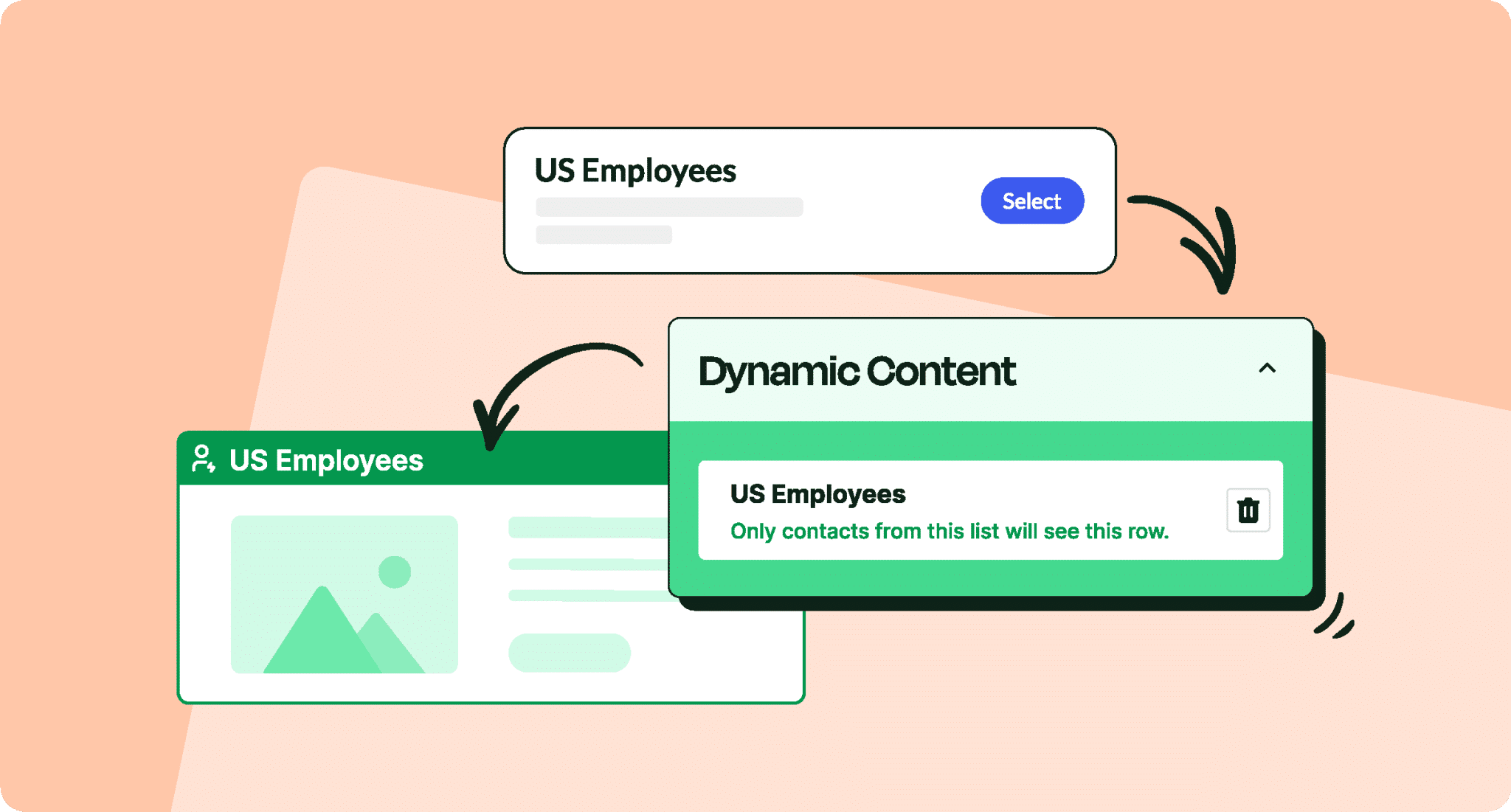
Feedback results only tell you something once you know which team, location, or role they came from. ContactMonkey’s audience segmentation breaks responses down that way by default, so a real problem in one department does not get averaged out by a fine-looking company-wide number.

Insights Assistant reads the trend so you do not have to
Once responses come in, the Insights Assistant lets you ask questions about your feedback data directly, like which location’s sentiment is declining or which department is driving a low score, and get a straight answer instead of digging through a dashboard yourself. That is the difference between a report you have to interpret and one you can just ask.

Reporting back happens in the same place employees answered
Because ContactMonkey is built for sending, not only collecting, you can report back on what changed in the exact same email channel employees used to respond. That single habit is what most feedback programs quietly skip, and it is the biggest single lever for whether participation holds up over time.
Book a demo to see ContactMonkey’s employee feedback tools in action.
FAQ
What is the difference between an employee feedback tool and an employee survey tool?
An employee survey tool typically refers to structured, scheduled surveys like annual engagement surveys or pulse checks. Employee feedback tools are a broader category that also includes always-on formats like emoji reactions, anonymous comment boxes, and recognition tools that do not follow a survey structure.
What is an eNPS survey?
An eNPS, or employee Net Promoter Score, survey asks employees how likely they are to recommend their workplace to others, typically on a numeric scale, and is used as a quick, repeatable measure of overall sentiment.
Can employee feedback tools be anonymous?
Yes. Most modern employee feedback tools, including pulse surveys, eNPS tools, and comment boxes, offer anonymous or aggregated response options specifically to protect individual employees from being identified by their answers.